

Aliya Islam ( Military Hospital Rawalpindi. )
Ayesha Hanif ( Military Hospital Rawalpindi. )
Ambreen Ehsan ( Military Hospital Rawalpindi. )
Saadia Arif ( Military Hospital Rawalpindi. )
Shaharyar Khan Niazi ( Islamic International Medical and Dental College, Islamabad. )
Asfandyar Khan Niazi ( Shifa College of Medicine, Islamabad. )
June 2013, Volume 63, Issue 6
Original Article

Abstract
Objective: To assess the morbidity from episiotomy.
Methods: The prospective randomised control study was conducted at the Military Hospital Rawalpindi\\\'s Gynaecology & Obstetrics Department from January 2006 to April 2008. It comprised 100 patients who were given a mediolateral episiotomy at the crowning of the foetal head (group 1). Another group of 100 patients were delivered without an episiotomy (group 2). Postpartum morbidity was compared in the two groups. Morbidity included perineal damage by tears, subjective assessment of pain at perineum, dyspareunia after puerperium, feeling of pressure puerperium, incontinence and objective assessment of prolapse after puerperium.
Results: Morbidity including perineal damage by tears, pain at perineum and dyspareunia, was much more in group I as compared to the group II. There was no significant difference in feeling of pressure perineum, subjective feeling of urinary and flatus incontinence or objective assessment of prolapse of vagina and uterus.
Conclusion: There are no significant advantages of episiotomy. In fact, it leads to morbidity which is otherwise avoidable in deliveries that are episiotomy-free.
Keywords: Episiotomy, Morbidity. (JPMA 63: 696; 2013).
Introduction
Episiotomy as the most frequently performed surgical procedure is becoming a technique of the past.1 Although episiotomy was thought to be an integral part of labour management for most of the 20th century, it has been proven to have many risks, without the benefits that were originally associated with it.2 The use of episiotomy should be restricted to situations when expedited delivery is necessary, such as with a non-reassuring foetal heart rate tracing, a prolonged second stage of labour, or when sometimes operative vaginal delivery is required.1,3 When an episiotomy is cut or a spontaneous laceration occurs, recognition of any defect and proper stitching, if required, is done. The use of routine or elective episiotomies is clearly not in the best interest of patients.1-3
Previously it was believed that episiotomy shortens the pushing phase and, thus, reduces the chance that the baby will suffer from oxygen deprivation, that it protects the foetal skull and brain from damage as it is "thrust against" the pelvic floor and prevents ragged perineal tears and "permanent relaxation of the pelvic floor with its possible sequelae of cystocoele, rectocele, and uterine prolapse".2-5 Another reason given by many doctors in support of episiotomy is to maintain vaginal tightness for the enhanced pleasure of a sexual partner. So many obstetrical residents are not trained to deliver babies without performing one.
Decades of clinical research has discovered that episiotomy had few documented benefits. One study6 has suggested an optimal episiotomy rate for vaginal deliveries of less than 5% and an operative vaginal delivery rate of less than 6%.6 The 2006 American Congress of Obstetricians and Gynaecologists (ACOG) Practice Bulletin recommends that obstetricians should restrict their use of episiotomy.7 The largest two randomized controlled trials (RCTs) of episiotomy suggest that women who undergo episiotomy are at increased risk for third- and fourth-degree tears.8
Subjects and Methods
The study was conducted at the Department of Gynaecology and Obstetrics of the Military Hospital, Rawalpindi, from January 2006 to April 2008. It comprised 100 patients who were given a mediolateral episiotomy (group I) and an equal number (group II) who were delivered without an episiotomy. The sample size was adopted calculated on the basis of previous literature.9 All patients were primiparas carrying full-term singleton pregnancies with normal vertex presentation. Only patients in spontaneous labour were included in the study. Patients with malpresentations, multi-foetal pregnancies, grossly malformed foetus and preterm labour were excluded from the study. All cases of foetal distress, occipito-posterior positions in labour, labours requiring forcep application and neonatal birth weights of more than 4.5kgs were also excluded from the study. Likewise, patients with established or gestational diabetes were also excluded. In group II patients, 62 (62%) were delivered without any perineal tears and sustained only minor or no vaginal mucosa lacerations. Besides, 23 (23%) patients in group II had 2nd degree vaginal tears which were stitched; 6 (6%) patients received minor periurethral tears which were also stitched; 9 (9%) patients had first degree vaginal tears which were left as such. In group I, 37 (37%) patients had extensions of episiotomy. None of the patients in any group had 3rd or 4th degree perineal tear. Both groups were taught Kegel exercises10 on postnatal day and discharged from the hospital. All patients were called during the first post-natal week. The episiotomy site was examined for the health of the stitches. All the patients were inquired about the subjective assessment of pain at perineum after delivery according to the Visual Analogue Scale (VAS).
A 10cm line labelled at \\\'0\\\' with \\\'no pain\\\' and \\\'10\\\' with \\\'worst pain\\\'. The line was marked by patients at a point corresponding to their assessment of pain. The distance of the mark from zero was then measured (Figure).
Patients were then called again just after puerperium and questioned regarding dyspareunia after delivery, feeling of pressure perineum and subjective assessment of urinary, faecal and flatus incontinence. Patients were examined to have an objective assessment of cystocoele, rectocoele and uterocervical descent.
Results
Basic medical characteristics of the entire study population was noted down (Table-1).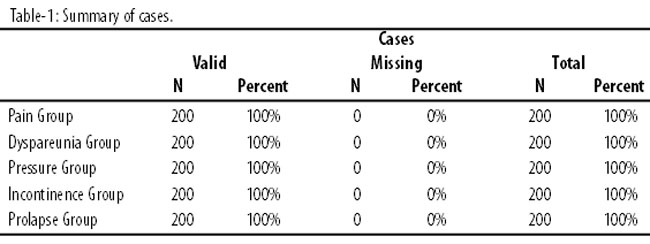
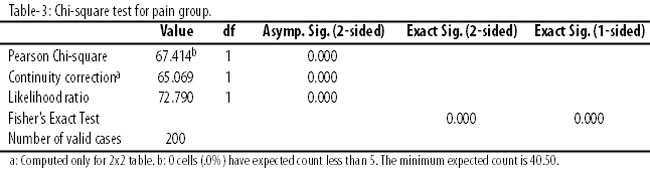
Besides, 69 (69%) patients in group I reported pain postnatal compared to 12 (12%) patients in group II (Table-2, 3).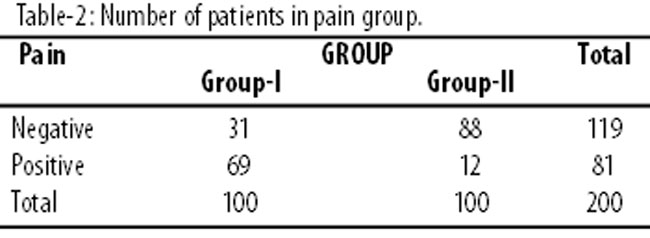
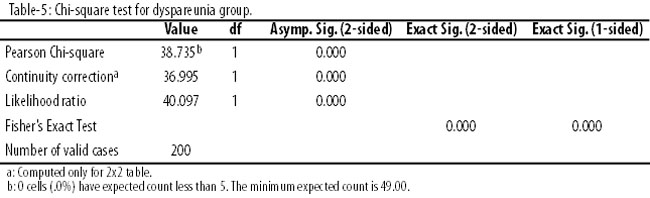
The same trend was seen in the patients reporting dyspareunia (Table-4,5).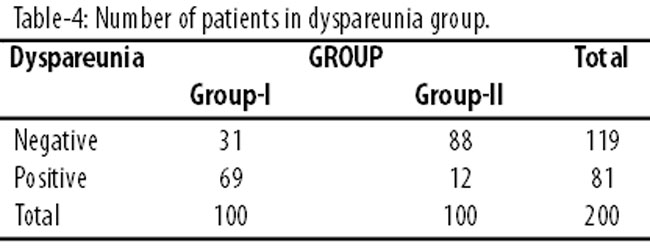
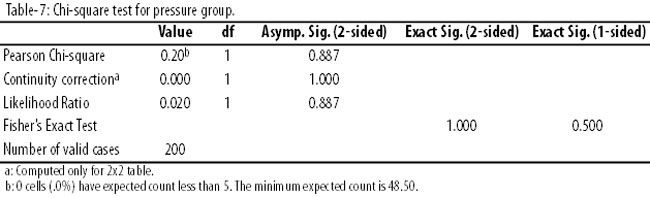
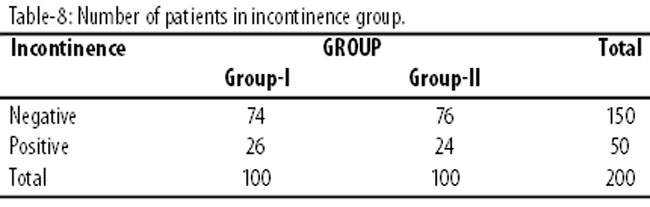
With respect to feeling pressure, 48 (48%) in group I reported the feeling against 49 (49%) in group II. Likewise, incontinence was reported by 26 (26%) in group I against 24 (24%) in group II (Tables-6-9).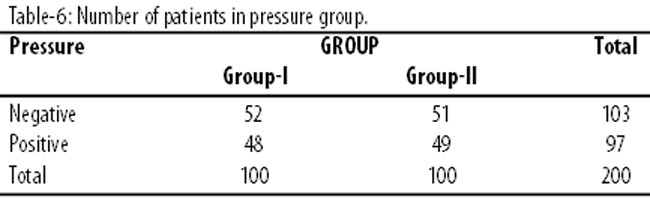
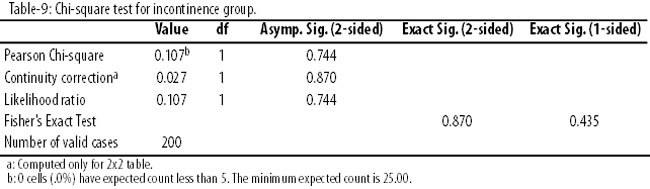
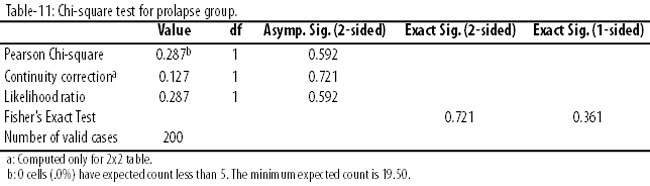
Uterine prolapse was seen in higher numbers in group II, but it was statistically insignificant (18% in group I vs. 21% in group II) (Table-10,11).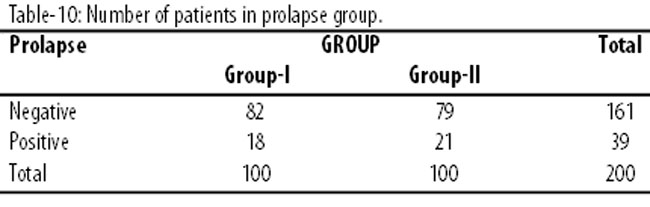
Discussion
The study was designed to compare the morbidity in patients with episiotomy with patients without episiotomy. Morbidity is an incidence of ill health. Morbidity was assessed on the basis of extension of episiotomy into the perianal region or the vaginal wall.
It is almost universally accepted that rupture of the anal sphincter (3rd degree tear), especially with concomitant disruption of the rectal mucosa (4th degree tear), is the common complication of highest morbidity from either a spontaneous laceration or from extension of an episiotomy. A study11 cited 7 papers published between 1919 and 1981. Another research studied a random sample of delivery records of 400 women from two hospitals.12 Comparing women either with or without an episiotomy, the rates of anal sphincter damage were not significantly different between the hospitals. A study13 reviewed all births from 1976 to 1987 at the Aarhus University Hospital, Denmark. Mediolateral episiotomy remained the third most powerful predictor of anal sphincter damage, after shoulder dystocia and forceps delivery.
In a university hospital near Stockholm in 1984,12 patients receiving an episiotomy had a 4.2% chance of a third-degree laceration, compared to 1.7% with no episiotomy. Another study14 reported that among the spontaneous deliveries, third-degree tears were suffered by 6% without episiotomy, 11% with mediolateral episiotomy, and 20% with midline episiotomy. The first randomized controlled trial published was from Dublin.15 "None of the patients delivering without having had an episiotomy during either the study or the preceding six months sustained a third-degree tear." The use of midline episiotomy has consistently been found to be the strongest risk factor for a subsequent severe tear, even after controlling for confounding variables. The situation is less suspicious for mediolateral episiotomy: only two studies of reliable design13,16 reported an increased risk of deep laceration with mediolateral episiotomy, while most studies, including four RCTs, have uncovered no positive or negative effect.
One study17 reported a 15% incidence of pain during episiotomy (mostly mediolateral), versus none for a spontaneous tear, either second- or third-degree. According to another study,18 10 per cent of patients with episiotomies were still experiencing pain six weeks after delivery, with none of those with second-degree tears. Others19 claimed that they could detect no difference in pain between women with episiotomy and those with second-degree lacerations.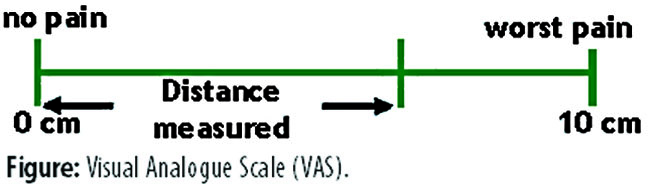
Other studies concluded that 38% more women reported residual perineal pain in the liberal episiotomy group than in the restrictive group.1,15 The only RCT to use a previously standardised and validated pain scale detected no overall difference between the two trial arms in perineal pain.16
A study20 surveyed women for dyspareunia, and reported that pain at first postpartum intercourse was less among those with spontaneous tears than among those with episiotomies, while fractions having resumed sexual relations at six weeks and level of sexual satisfaction were similar.
The second major advantage claimed for episiotomy is that it prevents relaxation and its sequelae, such as urinary incontinence, cystocoeles, and rectocoeles. Research on this question has used two main outcome variables: subjective reports of urinary incontinence and objective measures of pelvic floor muscle strength. In literature, studies have compared postpartum symptoms after episiotomy and spontaneous tears.16,21 They were very similar in percentages reporting development of urinary incontinence. Others15,16 discovered no difference between the groups of episiotomy versus no episiotomy.
One of them16 found that liberal or restrictive use of episiotomy had no effect on pelvic floor functioning at three months postpartum.10 The only one of these studies to focus specifically on the urinary sphincter mechanism followed 43 nulliparous Dutch women through pregnancy and the puerperium to observe changes in the urethral pressure profile as assessed by a transducer catheter.22 The magnitude of the changes were unaffected by the use or non-use of mediolateral episiotomy. One well-designed study found a marked impairment in pelvic floor muscle strength at eight weeks postpartum in patients with mediolateral episiotomy when compared to those with spontaneous or no laceration.23
The last main category of claimed benefit for episiotomy is prevention of foetal injury, specifically intracranial haemorrhage and intrapartum asphyxia. A study found that the presence or absence of episiotomy did not change the incidence of intraventricular haemorrhage (IVH) in breech, forceps, or spontaneous vertex deliveries.24
Two studies of premature babies found that episiotomy did not affect the incidence of brain haemorrhage or low Apgar scores.25 If episiotomy has no value even for these fragile babies, it isn\\\'t likely to benefit a healthy, full-term infant. No difference in length of second stage with or without episiotomy has been reported.13,17,21
It is frequently asserted that an episiotomy is easier to repair than a spontaneous laceration. There is still no objective confirmation of this claim. Even if it is true, the ease of repair for the accoucheur could be entertained as a reason to perform an episiotomy only if it were definitively shown not to harm the patient in the process. "All of the lacerations that occurred in the absence of episiotomy were easy to repair," noted researchers. The best evidence on this matter is provided by an RCT which found more suture material used in the liberal episiotomy group than in the restrictive group. The former also required more suturing time.
An episiotomy will reduce the risk of anterior tears, but it does so at the expense of the much greater morbidity of posterior perineal injury. In Cambridge, a study claimed that the use of any of several intrapartum interventions, including episiotomy, was negatively correlated with the patient\\\'s overall satisfaction with the birth experience.21
Several risks of episiotomy include foetal risks, maternal risk and risk to birth attendant. Episiotomy at first vaginal delivery increases the risk of spontaneous obstetric laceration in the subsequent delivery. This finding should encourage obstetric providers to further restrict the use of episiotomy. Episiotomy may affect women\\\'s sex life during the second year post partum with more frequent pain and vaginal dryness at intercourse.
Conclusion
The presented study concluded that no advantages were observed in women receiving an episiotomy compared to the women who delivered without an episiotomy. In fact morbidity in the former group in the form of pain and dyspareunia was significantly higher.
References
1. Klein MC, Gauthier RJ, Robbins JM, Kaczorowski J, Jorgensen SH, Franco ED, et al. Relationship of episiotomy to perineal trauma and morbidity, sexual dysfunction, and pelvic floor relaxation. Am J Obs Gyne 1994; 171:591-598.
2. Hartmann K, Viswanathan M, Palmieri R, Gartlehner G, Thorp J Jr, Lohr KN. Outcomes of routine episiotomy: a systematic review. JAMA 2005; 293:2141-2148.
3. Carroli C, Belizan J. Episiotomy for vaginal birth. Cochrane Library. 2008; DOI: 10.1002/14651858.CD000081. Published Online First: 8 October 2008.
4. Kainen BRV. Development of a measure of perineal integrity: a report submitted in partial fulfillment for the degree of Master of Science, Parent-Child Nursing. Michigan: University of Michigan; 1997.
5. Thorp JM Jr, Bowes WA. Episiotomy: can its routine use be defended? Am J Obstet Gynceol 1989; 160:1027-1030.
6. Barbieri RL. It\\\'s time to restrict the use of episiotomy. The Journal of Family Practice 2006; 18.
7. American College of Obstetricians and Gynecologists. ACOG Practice Bulletin. Episiotomy. Clinical Management Guidelines for Obstetrician-Gynecologists. Number 71. Obstet Gynecol 2006; 107:957-962.
8. Helewa ME. Episiotomy and severe perineal trauma: of science and fiction. CMAJ 1997; 156:811-3.
9. Ali SS, Malik M, Iqbal J, Faruqi NJ. Routine episiotomy versus selective episiotomy in primigravidae. Ann King Edward Med Uni 2004; 10:482-4.
10. Harvey MA. Pelvic floor exercises during and after pregnancy: a systematic review of their role in preventing pelvic floor dysfunction. J Obstet Gynecol Can 2003; 25:487-498.
11. Thacker SB, Banta HD. Benefits and risks of episiotomy: an interpretive review of the English language literature, 1860-1980. Obstet Gynecol Surv 1983; 38:322-338.
12. Röckner G, Wahlberg V, Ölund A. Episiotomy and perineal trauma during childbirth. J Adv Nurs 1989; 14:264-268.
13. Møller Bek K, Laurberg S. Intervention during labor: risk factors associated with complete tear of the anal sphincter. Acta Obstet Gynecol Scand 1992; 71:520-524.
14. Pearl ML, Roberts JM, Laros RK, Hurd WW. Vaginal delivery from the persistent occiput posterior position. Influence on maternal and neonatal morbidity. J Reprod Med 1993; 38:955-961.
15. Harrison RF, Brennan M, North PM, Reed JV, Wickham EA. Is routine episiotomy necessary? BMJ 1984; 288:1971-1975.
16. Klein MC, Gauthier RJ, Jorgensen SH, Robbins JM, Kaczorowski J, Johnson B, et al. Does episiotomy prevent perineal trauma and pelvic floor relaxation? Online J Curr Clin Trials 1992; Doc No 10. [Published erratum: Klein MC. Does episiotomy prevent perineal trauma and pelvic floor relaxation? Online J Curr Clin Trials 1992; Doc No 20.]
17. Röckner G, Henningsson A, Wahlberg V, Ölund A. Evaluation of episiotomy and spontaneous tears of perineum during childbirth. Scand J Caring Sci 1988; 2:19-24.
18. Lee B. Episiotomy. BMJ 1982; 284:595.1.
19. Woinarski JE, Wright J. Episiotomy. BMJ. 1982; 284:595.2.
20. Larsson PG, Platz-Christensen JJ, Bergman B, Wallstersson G. Advantage or disadvantage of episiotomy compared with spontaneous perineal laceration. Gynecol Obstet Invest 1991; 31:213-216.
21. Thranov I, Kringelbach AM, Melchior E, Olsen O, Damsgaard MT. Postpartum symptoms. Episiotomy or tear at vaginal delivery. Acta Obstet Gynecol Scand 1990; 69:11-15.
22. van Geelen JM, Lemmens WA, Eskes TK, Martin CB Jr. The urethral pressure profile in pregnancy and after delivery in healthy nulliparous women. Am J Obstet Gynecol 1982; 144:636-649.
23. Röckner G, Jonasson A, Ölund A. The effect of mediolateral episiotomy at delivery on pelvic floor muscle strength evaluated with vaginal cones. Acta Obstet Gynecol Scand 1991; 70:51-54.
24. de Crespigny LC, Robinson HP. Can obstetricians prevent neonatal intraventricular haemorrhage? Aust NZ J Obstet Gynaecol 1983; 23:146-149.
25. Thorp JM, Bowes WA Jr, Brame RG, Cefalo R. Selected use of midline episiotomy: effect on perineal trauma. Obstet Gynecol 1987; 70:260-262.
Related Articles
Journal of the Pakistan Medical Association has agreed to receive and publish manuscripts in accordance with the principles of the following committees:


