

Mazhar Mahmood ( National Institute of Cardiovascular Diseases, Karachi. )
Abdul Samad Achakzai ( National Institute of Cardiovascular Diseases, Karachi. )
Parveen Akhtar ( National Institute of Cardiovascular Diseases, Karachi. )
Khan Shah Zaman ( National Institute of Cardiovascular Diseases, Karachi. )
June 2013, Volume 63, Issue 6
Original Article

Abstract
Objective: To compare the accuracy of the Global Registry of Acute Coronary Events risk score and the Thrombolysis In Myocardial Infarction risk score in predicting the extent of coronary artery disease in patients with non-ST segment elevation acute coronary syndrome.
Methods: The cross-sectional study comprising 406 consecutive patients was conducted at the National Institute of Cardiovascular Diseases, Karachi, from August 2010 to March 2011. For all patients, the GRACE and TIMI RS\\\'s relevant scores on the two indices were calculated on admission using specified variables. The patients underwent coronary angiography to determine the extent of the disease. A significant level was defined as >70% stenosis in any major epicardial artery or >50% stenosis in the left main coronary artery. SPSS 19 was used for statistical analysis.
Results: Both the indices showed good predictive value in identifying the extent of the disease. A Thrombolysis In Myocardial Infarction score >4 and Global Registry of Acute Coronary Events score >133 was significantly associated with 3vessel disease and left main disease, while for the former score <4 and latter score <133 was associated with normal or non-obstructive coronary disease (p<0.01). On comparison of the two risk scores, the discriminatory accuracy of the latter was significantly superior to the former in predicting 2vessel, 3vessel and left main diseases (p<0.05).
Conclusion: Although both the indices were helpful in predicting the extent of the disease, the Global Registry showed better performance and was more strongly associated with multi-vessel and left main coronary artery disease.
Keywords: TIMI, GRACE, Angiography, Acute coronary syndrome. (JPMA 63: 691; 2013).
Introduction
Patients with non-ST segment elevation acute coronary syndrome (NSTE-ACS) are a heterogeneous population with varying risk of morbidity and mortality.1 Risk stratification is important to make appropriate decisions about the care and treatment of these patients. Patients at highest risk for adverse outcomes may derive the greatest benefit from rapid and comprehensive use of effective treatments, including coronary interventional procedures and cardiac medications.2,3 The Global Registry of Acute Coronary Events (GRACE) and Thrombolysis in Myocardial Infarction (TIMI) risk scores (RS) are the two most commonly used scores to risk-stratify patients with NSTE-ACS at presentation.3 These scores have been validated in several independent populations to predict prognosis.4-6 Several international reports have compared GRACE score with the TIMI score, showing that the GRACE score is a better predictor of clinical outcome than the TIMI score.7,8 Moreover, one international study has also shown a better correlation of the GRACE score with the extent and severity of coronary angiographic findings compared to the TIMI score.9 However, no study has been done locally to compare the TIMI and the GRACE risk scores with the extent of coronary angiographic findings so as to identify the risk score that better predicts and correlates with severe coronary artery disease (CAD).
The aim of this study was, therefore, to compare the performance of TIMI and GRACE risk scores in predicting the extent of CAD.
Patients and Methods
The cross-sectional study was carried out at the National Institute of Cardiovascular Diseases, Karachi, from August 2010 to March 2011. A total of 406 patients over age 18, who presented to the emergency department (ED) with NSTE-ACS and who subsequently underwent coronary angiography were included in the study. The inclusion criteria comprised a history of new onset or worsening chest pain occurring at rest or with minimal exertion or other symptoms suggestive of angina equivalent, with the most recent episode occurring within 24 hours of admission. Any ST segment deviation on electrocardiogram (ECG) suggestive of myocardial ischaemia (MI) or elevated levels of cardiac biomarkers were also recorded. The cardiac biomarkers used were cardiac troponin I, cardiac troponin T and creatinine kinase MB (CK-MB). Patients who had ST segment elevation on ECG, new left bundle branch block or prior history of percutaneous coronary intervention (PCI) or coronary artery bypass grafting (CABG) were excluded from the study. Patients with missing data like cardiac biomarkers, or who had angiogram done later than 7 days of presentation were also excluded from the study. Formal approval of the protocol was obtained from the ethical committee of the National Institute of Cardiovascular Diseases, Karachi. Written informed consent was taken from all the patients.
The risk scores were calculated on the basis of clinical features at presentation. The TIMI RS was the sum of seven dichotomous variables (1 point for each variable if present): age >65 years, >3 risk factors for CAD, use of aspirin within the past 7 days, known coronary artery stenosis >50%, >2 episodes of angina within the past 24 hours, ST-segment deviation >0.5mm, and elevated cardiac biomarker (Table-1).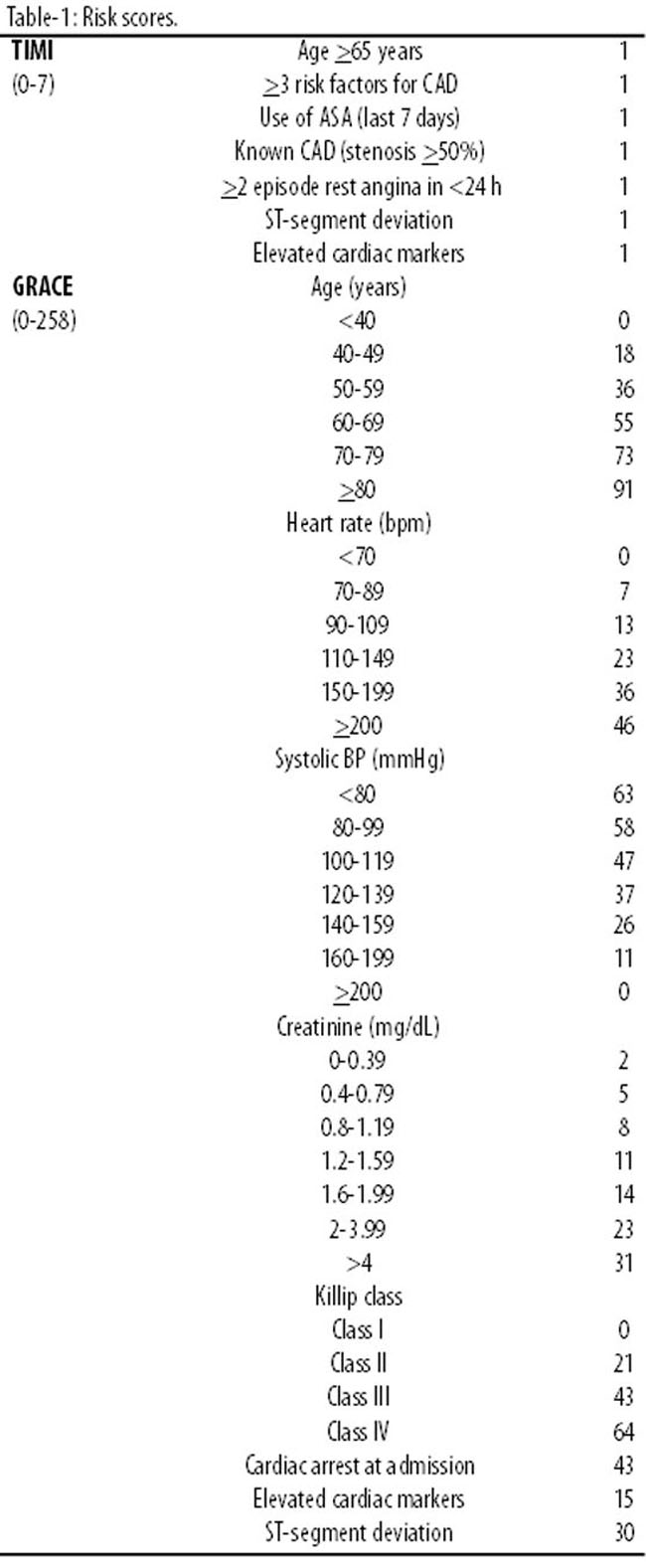
Patients without prior coronary angiography were assigned 1 point if there was a history of myocardial infarction, in accordance with the suggestion by the authors of TIMI RS.10 The GRACE risk score was similarly calculated by adding the score for each variable. Both the RSs were divided into two groups: TIMI <4 and >4; GRACE <133 and >133. The patient data was recorded on a proforma.
All the patients underwent coronary angiography and significance of CAD was classified as >70% stenosis in any of the three major epicardial coronary arteries or a left main (LM) coronary stenosis >50%. A large diagonal branch of the left anterior descending (LAD) artery or large obtuse marginal branch of the circumflex artery were also considered in the major epicardial artery category. Angiogram revealing coronary artery stenosis <70% in major epicardial coronary arteries were termed non-obstructive CAD. The extent of CAD was defined as single (SVD), two (2VD) or three vessel (3VD) CAD.
Data analysis was performed using SPSS version 19. Frequency and percentage were computed for categorical variables like gender, risk factors, diagnosis and angiographic findings and analysed by chi-square test. Mean and standard deviation were computed for quantitative variables and analysed by independent sample t test. TIMI score and GRACE score were categorised and correlated with angiographic findings by logistic regression. Odds ratio was computed to show the strength of relationship between angiographic findings and the two scores. The discriminatory accuracy of both the scores was analysed by the c-statistics. A p<0.05 was considered significant.
Results
The average age of 406 patients was 54.83±10.47 years. Of them, 252 (72.9%) were males and 93 (27.1%) were females. Hypertension was the commonest risk factor (n=216; 53.2%), followed by diabetes mellitus (n=137; 33.7%). CAD was observed in 316 (77.8%) patients; 98 (24.1%) patients had SVD, 79 (19.5%) had 2VD, 120 (29.6%) had 3VD and 19 (4.7%) had LM CAD. The mean TIMI score was 3.01±1.35 and the mean GRACE score was 112.8±37.08 (Table-2).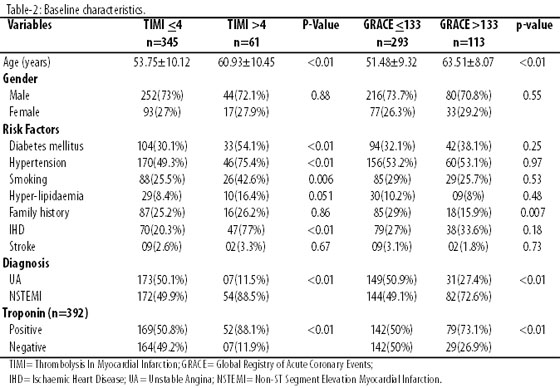
In TIMI score >4, SVD CAD occurred in 14 (23.0%) patients, while 2VD, 3VD and LM CAD occurred in 08 (13.1%), 32 (52.5%) and 06 (9.8%) patients respectively. In patients with TIMI score <4, SVD occurred in 84(24.3%), 2VD in 71(20.6%) while 3VD and LM CAD figured in 88(25.5%) and 14(4.1%) respectively. TIMI score >4 was significantly associated with 3VD and LM CAD, and 3VD was three times more likely to be observed in patients with TIMI score >4 than in patients with TIMI score <4 [OR= 3.22 95%CI: 1.84 to 5.63 p<0.01]. LM CAD was significantly more likely to be seen in patients with TIMI score >4 than in TIMI score <4 [OR=2.25 95%CI: 1.01 to 6.99 p=0.05]. Similarly, 3VD or LM diseases were 3.39 times more likely in patients with TIMI >4 than in patients with TIMI score 0 to 4. Moreover, significantly high percentage of patients (n=98; 25.8%) with TIMI score <4 had normal or non-obstructive CAD compared to only 1.6% (n=1) with TIMI score >4 (p<0.01) (Table-3).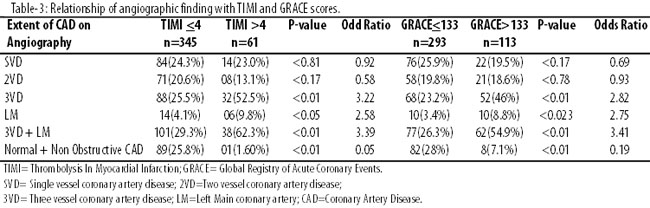
In GRACE score >133, SVD occurred in 22 (19.5%) patients, while 2VD, 3VD and LM CAD occurred in 21 (18.6%), 52 (46%) and 10 (8.8%) patients respectively. In patients with GRACE score <133, SVD occurred in 76 (25.9%), 2VD in 58 (19.8%), while 3VD and LM CAD figured in 68 (23.2%) and 10 (3.4%) respectively. Moreover, significantly high percentage of patients (n=82; 28%) with GRACE score <133 had normal or non-obstructive CAD compared to 7% with GRACE score >133 (p <0.01). GRACE score >133 was significantly associated with 3VD (p<0.01) and LM CAD (p=0.023), and 3VD and LM CAD was 3.4 times more likely observed in patients with GRACE score >133 than in patients with GRACE score <133 [OR=3.41 95%CI: 2.16 to 536 p<0.01].
The discriminator accuracy of both the risk scores to predict severe angiographic disease was analysed by c-statistics, which was 0.54 for TIMI score compared to 0.57 for GRACE score for predicting 2VD. Similarly, the c-statistics were 0.63 for TIMI and 0.67 for GRACE in predicting 3VD and 0.65 for TIMI and 0.72 for GRACE in predicting LM CAD. The difference of all the values were statistically significant (p<0.05), indicating the superiority of GRACE score over the TIMI score. There were no significant differences in the discriminatory accuracy of the two scores for the SVD (Table-4).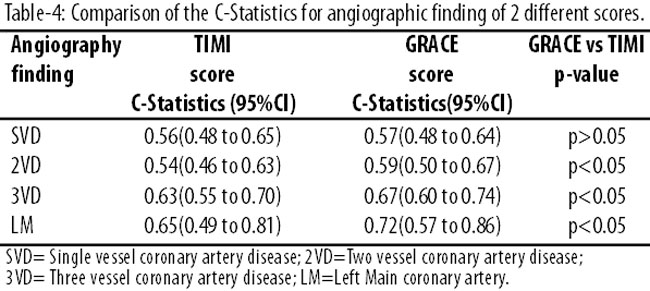
Discussion
This study, based on consecutive NSTE-ACS patients undergoing coronary angiography, demonstrated the superiority of the GRACE risk score compared with the TIMI in predicting a greater extent of CAD. However, even when analysed separately, both the TIMI and GRACE scores showed good performance in predicting extensive CAD.
The TIMI and the GRACE risk scores are the two most commonly used scores to risk-stratify NSTE-ACS patients at presentation. The risk stratification is important as it has been consistently proved that early coronary intervention in high-risk patients improves clinical outcomes.2,10,11 The TIMI risk score based on the TIMI IIB4 and Efficacy and Safety of Subcutaneous Enoxaparin Non-Q-wane Coronary Events (ESSENCE) trial12 incorporates seven variables, each having one point, while the GRACE risk score on the other hand is a more extensive scoring system, utilising variables like age, heart rate, systolic blood pressure, creatinine (mg/dl), killip class, cardiac arrest at admission, elevated cardiac markers and ST-segment deviation.5,13
In addition to predicting the clinical outcome after NSTE-ACS, these scores have also been studied with regards to their correlation with the extent and severity of CAD on coronary angiography.
The usefulness of TIMI score in predicting extensive CAD on angiography has been validated in several international studies14-16 and by one local study.17 These studies showed a strong association of TIMI score >4 with multivessel CAD and LM disease and the low TIMI score with normal or non-obstructive CAD; the findings which are also validated by our study.
No local study, however, had been done to compare the TIMI and the GRACE risk scores with the extent and severity of CAD and the international data available with regards to this comparison is also limited. A study showed that compared with the TIMI score, the GRACE score provides greater diagnostic information with regards to the extent of CAD in patients with NSTE-ACS; and especially for 3VD and multiple rapid progression in nonculprit lesions, the discriminatory accuracy of GRACE score was superior to that of TIMI score.9 The results of our study compare well with the study, suggesting that the GRACE score should be given preference in risk-stratifying NSTE-ACS patients as it is associated both with better assessment of mortality as well as prediction of the severity of CAD. This is important as patients with high scores are more likely to be benefited from the use of Gp IIb/IIIa inhibitors11,18 and early intervention2,3 and those with severe 3VD and LM disease are more likely to be managed with CABG. If there is high likelihood of 3VD or LM disease, the cardiologist may delay the loading dose of thienopyridines till the extent of the CAD is confirmed on coronary angiography to avoid the excess bleeding risk associated with urgent CABG with thienopyridine preloading.19
The common practice in the ED is to use the TIMI score because of its simplicity. However, the ideal score for risk stratification on admission for NSTE-ACS should have a good balance between complexity and utility. Scores that include continuous variables such as age, heart rate and serum creatinine are more powerful, but relatively more complex to calculate. But this should not preclude the use of GRACE score which will give a better assessment of the patient risk and will help in management.
The study had its limitations as the selection of cases for coronary angiography was on the discretion of the attending cardiologist, which could have resulted in selection bias because the selection criteria by cardiologists for sending the patients for coronary angiogram is not uniform and is subject to physician preferences, some including only high-risk patients, while others may include low and intermediate risk patients. The interpretation of the coronary angiogram and the severity estimation of CAD lesion was based on visual assessment of the attending cardiologist which could result in differences in the assessment of coronary lesion severity. The cutoff score for the two groups in GRACE RS was 133 in accordance with literature,7 which is somewhat lower than by some other studies.20,21 This could lead to variation in comparing the predictive accuracy of the two risk scores.
Conclusion
In NSTE-ACS patients evaluated by coronary angiography, both the TIMI and GRACE risk score have good discriminatory value in predicting the extent of CAD. However, when both the scores are compared, the GRACE score is found to be superior and correlates better with multivessel and LM disease. Therefore, the GRACE risk score is a more useful for better risk assessment and management of NSTE-ACS patients.
References
1. Cohen M, Antman EM, Murphy SA, Radley D. Mode and timing of treatment failure (recurrent ischemic events) after hospital admission for non-ST segment elevation acute coronary syndromes. Am Heart J 2002; 143:63-69.
2. Cantor WJ, Goodman SG, Cannon CP, Murphy SA, Charlesworth A, Braunwauld E, et al. Early cardiac catheterization is associated with lower mortality only among high-risk patients with ST- and non-ST-elevation acute coronary syndromes: observations from the OPUS-TIMI 16 trial. Am Heart J 2005; 149:275-83.
3. Antman EM, Cohen M, Bernink PJ, McCabe CH, Horacek T, Papuchis G, et al. The TIMI risk score for unstable angina/non-ST elevation MI: a method for prognostication and therapeutic decision making. JAMA 2000; 284: 835-42.
4. Antman EM, McCabe CH, Gurfinkel EP, Turpie AGG, Bernink PJLM, Salein D, et al. Enoxaparin prevents death and cardiac ischemic events in unstable angina/non-Q-wave myocardial infarction: results of the Thrombolysis In Myocardial Infarction (TIMI) IIB Trial. Circulation 1999; 100:1593-601.
5. Granger CB, Goldberg RJ, Dabbous OH, Pieper KS, Eagle KA, Cannon CP et al. Predictors of hospital mortality in the global registry of acute coronary events. Arch Intern Med 2003; 163:2345-2353.
6. Bradshaw PJ, Ko DT, Newman AM, Donovan LR, Tu JU. Validity of the GRACE (Global Registry of Acute Coronary Events) acute coronary syndrome prediction model for six month post-discharge death in an independent data set. Heart 2006; 92:905-9.
7. de Araújo Gonçalves P, Ferreira J, Aguiar C, Seabra-Gomes R. TIMI, PURSUIT, and GRACE risk scores: sustained prognostic value and interaction with revascularization in NSTE-ACS. Eur Heart J 2005; 26:865-872.
8. Ramsay G, Podogrodzka M, McClure C, Fox KA. Risk prediction in patients presenting with suspected cardiac pain: the GRACE and TIMI risk scores versus clinical evaluation. QJM 2007; 100:11-8.
9. Nakachi T, Kosuge M, Hibi K, Ebina T, Tsukahara K, Okuda J, et al. Comparison of GRACE risk score versus TIMI risk score on angiographic findings in patients with non-ST-segment elevation acute coronary syndrome. J Am Coll Cardiol 2010; 55: A115-E1071.
10. Morrow DA, Antman EM, Snapinn SM, McCbe CH, Theroux P, Braunwald E. An integrated clinical approach to predicting the benefit of tirofiban in non-ST elevation acute coronary syndromes. Application of the TIMI risk score for UA/NSTEMI in PRISM-PLUS. Eur Heart J 2002; 23:223-229.
11. Cannon CP, Weintraub WS, Demopoulos LA, Vicari R, Frey MJ, Lakkis N, et al. Comparison of early invasive and conservative strategies in patients with unstable coronary syndromes treated with the glycoprotein IIb/IIIa inhibitor tirofiban. N Engl J Med 2001; 344:1879-87.
12. Cohen M, Demers C, Gurfinkel EP, Turpie AG, Fromell GJ, Goodman S, et al. A comparison of low-molecular-weight heparin with unfractionated heparin for unstable coronary artery disease: efficacy and safety of subcutaneous enoxaparin in non-Q-wave coronary events study group. N Engl J Med 1997; 337:447-52.
13. Eagle KA, Lim MJ, Dabbous OH, Pieper KS, Goldberg RJ, Van de Werf F, et al. A validated prediction model for all forms of acute coronary syndrome: estimating the risk of 6-month postdischarge death in an international registry JAMA 2004; 291:2727-33.
14. Ben Salem H, Ouali S, Hammas S, Bougmiza I, Gribaa R, Ghannem K, et al. Correlation of TIMI risk score with angiographic extent and severity of coronary artery disease in non-ST-elevation acute coronary syndromes. Ann Cardiol Angeiol 2011; 60:87-91.
15. Mega JL, Morrow DA, Sabatine MS, Zhao XQ, Snapinn SM, Dibattiste PM, et al. Correlation between the TIMI risk score and high-risk angiographic findings in non-ST-elevation acute coronary syndromes: observations from the Platelet Receptor Inhibition in Ischemic Syndrome Management in Patients Limited by Unstable Signs and Symptoms (PRISM-PLUS) trial. Am Heart J 2005; 149:846-50.
16. Garcia S, Canoniero M, Peter A, de Marchena E, Ferreira A. Correlation of TIMI risk score with angiographic severity and extent of coronary artery disease in patients with non-ST-elevation acute coronary syndromes. Am J Cardiol 2004; 93:813-6.
17. Lakhani MS, Qadir F, Hanif B, Farooq S, Khan M. Correlation of Thrombolysis in Myocardial Infarction (TIMI) risk score with extent of coronary artery disease in patients with acute coronary syndrome. J Pak Med Assoc 2010; 60:197-200.
18. Platelet Receptor Inhibition in Ischemic Syndrome Management in Patients Limited by Unstable Signs and Symptoms (PRISM-PLUS) Study Investigators. Inhibition of the platelet glycoprotein IIb/IIIa receptor with tirofiban in unstable angina and non-Q-wave myocardial infarction. N Engl J Med 1998; 338:1488 -97.
19. Di Sciascio G, Patti G, Pasceri V, Gatto L, Colonna G, Montinaro A. Effectiveness of in-laboratory high-dose clopidogrel loading versus routine pre-load in patients undergoing percutaneous coronary intervention: results of the ARMYDA-5 PRELOAD (Antiplatelet therapy for Reduction of MYocardial Damage during Angioplasty) randomized trial. J Am Coll Cardiol 2010; 56:550 -7.
20. Mehta SR, Granger CB, Boden WE, Steg PG, Bassand JP, Faxon DP, et al. Early versus delayed invasive intervention in acute coronary syndromes. N Engl J Med 2009; 360:2165-75.
21. Pieper KS, Gore JM, Fitzgerald G, Granger CB, Goldberg RJ, Steg G, et al. Validity of a risk-prediction tool for hospital mortality: the Global Registry of Acute Coronary Events. Am Heart J 2009; 157:1097-105.
Related Articles
Journal of the Pakistan Medical Association has agreed to receive and publish manuscripts in accordance with the principles of the following committees:


