

Abdulbari Bener ( Department of Medical Statistics & Epidemiology, Hamad Medical Corporation, Hamad General Hospital, Qatar. Department of Evidence for Population Health Unit, School of Epidemiology and Health Sciences, The University of Manchester, Manchester, UK. )
Najah Mohammed Saleh ( Department of Obstetrics & Gynaecology, Hamad Medical Corporation, Qatar. )
Khalil Mohd Khalil Salameh ( NICU Unit, Women’s Hospital, Hamad Medical Corporation, Qatar. )
Basma Basha ( Department of Public Health & Medical Education, Weill Cornell Medical College, Qatar. )
Sharen Joseph ( Department of Public Health & Medical Education, Weill Cornell Medical College, Qatar. )
Rama Al Buz ( Department of Public Health & Medical Education, Weill Cornell Medical College, Qatar. )
May 2013, Volume 63, Issue 5
Original Article

Abstract
Objective: To examine socio-demographic and biological risk factors associated with mothers giving birth to a low birthweight newborn among Arab women in Qatar.
Methods: The case-control study was conducted at two main tertiary hospitals in Qatar in which participants were prospectively identified from January 2010 to April 2011. Data were collected by survey on maternal ethnicity, age, education, socioeconomic status, body mass index, consanguinity and gestational age. A total of 16,500 newborns were screened for low birthweight. A total of 863 mothers of low birthweight cases and an equal number of mothers of normal-weight babies were studied.
Results: Qatari mothers were found to be 1.2 times as likely to have a low birthweidht (<2500g) newborn compared to other Arab women (p<0.057). Mothers with a primary school education were 1.6 times as likely as university educated mothers to have a low birthweidht newborn (p<0.006). Likewise, obese mothers were 1.5 times as likely as their normal-weight counterparts (p<0.009). Consanguineous couples who were first-degree cousins were 1.9 times as likely as non-related couples to have a low birthweidht newborn (p<0.001). Newborns with a gestational age of <37 weeks were 19.6 times as likely as those >37 weeks to have a low birthweidht (p <0.001).
Conclusion: The majority of the risk factors associated with low birthweidht were modifiable. Health education campaigns need to target the most vulnerable groups to reduce the rates of low birthweidht among Arabs in Qatar.
Keywords: Low birthweight, Birth, Maternity, Risk factors, Short term interpregnancy. (JPMA 63: 598; 2013).
Introduction
Several studies have documented maternal risk factors associated with giving birth to a low birthweight (LBW) newborn. The majority of these studies have been conducted in developed nations. While the LBW rate in Qatar (8.3%)1 is comparable to rates found in developed nations such as Canada (6%), France (7%) and the USA (8%) and in the neighbouring nations, such as Bahrain (8%)2 and the United Arab Emirates (UAE) (7.1%),3,4 no study to date has been conducted in Qatar to document the specific maternal socio-demographic and biological risk factors associated with LBW.
It is particularly important to document the maternal risk factors associated with LBW in Qatar, as it is currently undergoing rapid economic development and is one of the highest per capita incomes in the world; and has a rapidly developing health infrastructure. A total of 17,210 live births were reported in Qatar during 2008, an increase of 53% compared to that of the year 2000 (11254 births).1 These swift changes are likely to have a major impact on maternal socio-demographic factors which may be related to LBW. As noted in international studies, LBW rates are significantly affected by socio-demographic factors such as ethnicity,5 socio-economic status6 and maternal complication.7
These economic changes may also have a large impact on the maternal, biological and epigenetic factors related to LBW. In particular, the obesity epidemic which is sweeping the Arabian Gulf region8 is likely to have an impact on the percentage of obese mothers. A number of studies have documented associations between LBW and maternal body mass index (BMI).9 Another compelling reason to investigate the LBW rates in Qatar is the high consanguinity rate (52%).10 A previous study conducted in the UAE3 found increased incidence of LBW among consanguineous unions.10-12 The current study aimed at verifying these relationships by investigating the maternal socio-demographic and biological risk factors associated with giving birth to an LBW infant among Arab women in Qatar.
Subjects and Methods
The case-control study in which participants were prospectively identified was carried out between January 2010 and April 2011. Because nearly all births occur in hospitals in Qatar,1 the infants selected from the two main territory hospitals - the Women\\\'s Hospital and the Al-Khor Hospital - which are the only hospitals with obstetric units in the country and cater to a population of around 1.7million, is expected to be representative of the birth patterns in Qatar. The overwhelming majority of births in Qatar take place in the above-mentioned hospitals.1 The percentage of births to Qatari\\\'s and Arabs is approximately 75% of the total births that take place in Qatar.1
During the study period, 16,500 babies were born. They were screened for LBW, and a total of 1216 mothers of LBW cases (birthweight <2500gm) were identified. Of them 863 (70.9%) gave consent to take part in the study. Thereafter, a consecutive series of 1158 mothers who gave birth to babies with birthweight >2500gm were considered as controls and approached; 863 mothers (74.5%) of normal birthweight gave consent to participate in the study.
LBW infants were defined according to the International Classification of Diseases, Tenth Revision (ICD-10).13 All singleton infants, irrespective of gestational age, who were either born below <2500grams (cases) or >2500grams (controls) and to Arab mothers during the study period were eligible to be included in the study. Infants born to mothers with any associated diseases during pregnancy such as gestational diabetes, hypertension, anaemia, pre-eclampsia and urinary tract infection (UTI) were excluded. Cases and controls were recruited from the same hospitals.
Gestational age was assessed for the cases and the controls using standard physical and neurological criteria. Anthropometric examination and measurements were performed by a trained nurse. Height was measured in centimetres using a height scale (SECA, Germany) while the woman was standing bare feet and with normal straight posture. Weight was measured in kilogrammes using a weight scale (SECA, Germany). Maternal BMI was calculated [weight (kg) / ht (cm)2] and were categorised into four groups: <18.5 being underweight; 18.5-24.99 as ideal weight; 25-29.9 as overweight; and >30 as obese. Maternal BMI which was taken at first antenatal visit was recorded by the nurse in the medical record, while research assistants recorded the postnatal BMI when they performed the face-to-face interviews.
Face-to-face interviews were conducted during the study period with mothers of newborn babies using a questionnaire covering the variables related to socio-demographic factors, family history, medical history, maternal complications and pregnancy outcome. The questionnaire used standard questions from those used in three previous studies conducted in the region.3,4,11 To test and validate the questionnaire, the first 50 mothers of neonates with birthweight <2500gm and 50 mothers of neonates with birthweight >2500gm were interviewed and completed the questionnaire as a pilot study.
The study was approved by the Research Ethics Committee of the Hamad Medical Corporation and Weill Cornell Medical College-Qatar\\\'s Institutional Review Board. Both institutions approved a waiver of signed informed consent form, and verbal informed consent was obtained from all the participants.
Statistical analysis was performed by using SPSS version 19.0. Student\\\'s t test was used to ascertain the significance of differences between mean values of two continuous variables, and non-parametric Mann-Whitney tests were used to determine if the results differed, indicating lack of normal distribution of the variable. Chi-square analyses were performed to test for differences in proportions of categorical variables between the cases and the controls. In 2X2 tables, the Fisher\\\'s exact test (two-tailed) replaced the chi-square test if the assumptions underlying chi-square were violated, namely small sample size, and when the expected frequency was less than 5 in any of the cells. Multiple logistic regression analysis was used to assess the relationship between LBW as the dependent variable (1=LBW, 0=normal birthweight) and seven socio-demographic factors as independent variables [mother\\\'s occupation, socio-economic status (SES), place of residence (urban or rural), maternal smoking habits, maternal age, maternal education and BMI]. The level p<0.05 was considered to be the cut-off value for statistical significance. Confounders were assessed statistically through change in beta coefficient (crude b-adjusted b), and if the change was more than 10%, the variable was considered a confounder and retained in the final model. Model fit was assessed through the Hosmer-Lemeshow goodness of fit test. An insignificant p value for Hosmer-Lemshow indicated that the model was good fit.
Results
The cases and the controls did not differ significantly in occupation, income or type of residence. However, in multivariable analyses, Qatari mothers were 1.2 times (95% CI 1.0-1.5) as likely as other Arab mothers to have an LBW newborn (<2500g) (Table-1).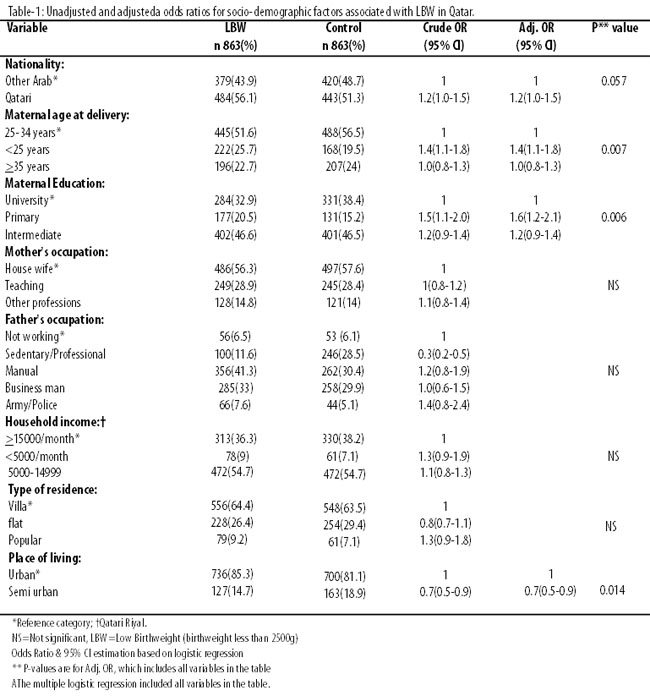
Mothers of LBW babies were 1.4 times (95% CI 1.1-1.8) more likely to be below the age of 25 years than women who gave birth to a normal-weight baby. An inverse dose-response relationship was observed between maternal education and LBW. Mothers who had delivered an LBW baby were 1.6 times (95% CI 1.2-2.1) as likely to have a primary school education as were women in the control group (p<0.006). Also, women who delivered an LBW were almost 30% less likely (0.7 95% CI 0.5-0.9) to live in semi-urban areas than were mothers in the control group (p<0.014). While a larger proportion of mothers who gave birth to an LBW child smoked cigarettes (5.3% cases vs. 3.8% controls), the difference was not statistically significant (p<0.164).
In multiple-logistic regression models, a direct dose-response relationship was observed between maternal BMI and LBW; mothers of LBW infants were 1.5 times (95% CI 1.1-1.9) as likely to be obese (BMI>30) than were the controls (p<0.009). Consanguinity was an independent risk factor for LBW (Table-2).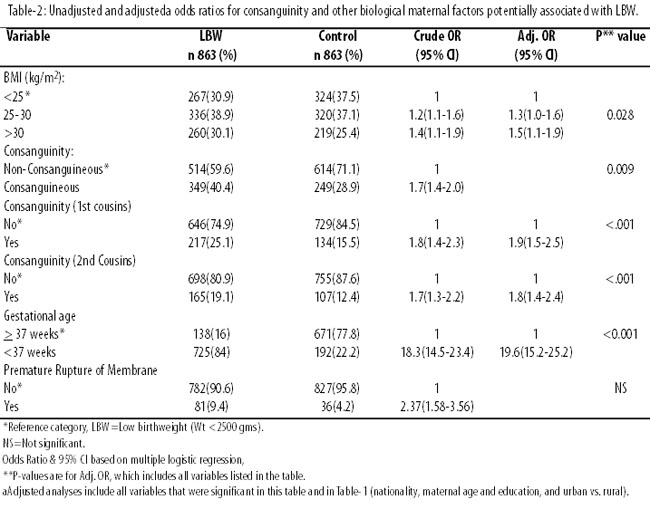
Mothers of LBW infants were 1.9 times as likely to be in a consanguineous marriage with a first-degree cousin than were mothers of normal-weight infants (p<0.001). The odds ratio for LBW was 1.8 among second-degree cousins compared to non-consanguineous parents. Similarly, the odds ratio for LBW was 19 (95% CI 15.2-25.2) among births that were <37 weeks of gestation as compared to >37 weeks of gestation (p<0.001) while adjusting for all the variables in the model.
Discussion
Multivariable analyses demonstrated that maternal ethnicity, age, education, BMI and consanguinity were positively related to the odds of LBW.
Maternal Qatari nationality was associated with 1.2 times the odds of LBW in comparison to other Arab nationalities. A possible explanation for this finding is the protective effect of \\\'foreign born status\\\' for LBW, which was documented in the USA among both Arab14 and Hispanic14 Americans. Because Qatar is a nation with a large expatriate population, the majority of the mothers with other Arab nationalities were likely to be foreign born.1 The \\\'foreign born status\\\' theory proposes that mothers who are born overseas are less likely to give birth to LBW newborns.14,15 While the exact reason for this protective effect is yet to be determined, the main reasons proposed by researchers in the field include maternal prenatal care habits, dietary differences, attitudes toward family and social support.14
Another possible explanation for the higher risk of LBW for Qatari mothers could be genetic. A number of studies conducted in the USA among Black mothers have found that, even after adjusting for SES factors, Blacks were consistently more likely to give birth to LBW newborns.5 In the Qatari context, genetic factors leading to LBW cannot be underestimated as this population has a high proportion of intermarriage within a clan or tribe, with a consanguinity rate of 52%.10 Furthermore, consanguinity was an independent risk factor for LBW in our study, with increased odds of LBW as the inbreeding coefficient increased. Our results thus confirmed the association between consanguinity and LBW, which was demonstrated in previous studies conducted in the UAE3 and Pakistan.15
Our results also confirm that higher maternal BMI was significantly associated with higher odds of giving birth to an LBW newborn. While some studies have documented a relationship between underweight mothers and LBW,17 a recent meta-analysis found that, after adjusting for publication bias, pre-term birth was associated with a higher BMI.9 In our study, very few mothers had low BMIs, and only those with high BMIs had higher odds of giving birth to an LBW newborn. Since Qatar is currently undergoing the \\\'nutrition transition\\\' phase, it may have different findings than developed nations.8 The \\\'nutrition transition\\\' phase is exemplified by nations such as Qatar where the obesity epidemic is dramatically increasing as a result of rapid economic development, while developed nations which traditionally had higher rates of obesity are stabilising and slowly reducing obesity rates.8 The rise of the obesity epidemic in Qatar has the potential for many maternal/foetal complications other than LBW and thus needs to be addressed urgently.
Similar to international studies, maternal education was significantly related to LBW in our study. In general, studies from Germany,7 Sudan,18 Italy,19 Sweden,20 and the USA21 have all noted that lower maternal education level was associated with increased risk of LBW. While no study has determined the exact mechanism that greater maternal education plays in reducing the risk of LBW, a number of studies have noted that fewer years spent in education are associated with teen pregnancy or younger age at first pregnancy for females.22
Younger maternal age was associated with higher odds of LBW in our study. This was a consistent finding in both the developed and the developing world. In the developed world, younger maternal age was mainly associated with lower SES and higher risk-taking behaviour.23 On the other hand, in the developing world, younger maternal age was associated with younger age at marriage, lower SES and education.22 The three main reasons reported by researchers relating younger maternal age with the risk of LBW include: biological factors such as immaturity of the female reproductive system and inadequate prenatal weight-gain; lower SES of younger age mothers; and lifestyle choices such as risk-taking behaviour of teenage mothers.24 In Qatar, we found that SES was not significantly associated with LBW; therefore it is unlikely that SES was a contributing factor to younger-aged mother\\\'s higher rate of LBW. Numerous other epidemiological studies conducted in the region have also found that SES was not a significant factor in public health problems in this oil-rich Arabian Gulf region. Hence, younger maternal age is probably associated with lower education, biological factors and risk-taking behaviour, although this was not specifically assessed in this study.
In contrast to the established finding in global literature documenting a significant relationship between maternal smoking and LBW,25 we did not find significant differences between the cases and the controls in relation to maternal smoking and LBW. One of the culture-specific aspects of smoking in the Middle East region generally, and Qatar specifically, is the recent rise in popularity of shisha/argileh smoking among women; previously it was only a man\\\'s domain, but is now gaining social acceptability among women. For instance in Lebanon, the rate of shisha-smoking among pregnant women has reached as high as 27%.26 In Qatar the rates of smoking shisha among pregnant women remain relatively low, but it is important that public health campaigns must attempt to address this issue before it gains wider popularity and causes detrimental health effects.
One of the main limitations of our study was that it only included female Arab residents in Qatar who were only recruited from the two main hospitals, as opposed to including home births, other hospitals and the many other ethnicities that reside in Qatar. While this limits, to a degree, the generalisability of our findings to all women who reside in Qatar, the study nonetheless provides a base for future studies to build on as it presents an accurate assessment of LBW risk factors for a large sub-section of women in Qatar. In addition, the nature of our study design invariably limited our capacity to control for confounding factors, especially lifestyle habits such as physical activity and diet. Moreover, data collection had the potential for recall bias (in relation to family medical history) and social acceptability bias of self-reported information (such as SES, education level and consanguinity). Nevertheless, after comparison of these self-reported data with other studies conducted in Qatar, the proportions in each category of these variables in our study appear to be similar to those from the prior studies.12 Also, we are unable to provide a comparison between responders and non-responders as we did not collect data on the non-responders. However, this should not greatly affect our findings as we had a high response rate (>70% for both cases and controls).
Conclusion
The maternal and socio-demographic factors independently associated with LBW in Qatar included ethnicity, consanguinity, higher BMI, lower maternal education level and younger maternal age. Many of these factors are modifiable and require culturally sensitive interventions and health education campaigns to lessen the risk of LBW.
Acknowledgement
We are grateful to Qatar Foundation for financial assistance.
References
1. Bener A. Annual Health Report. Ministry of Health and Hamad Medical Corporation. Department of Epidemiology and Medical Statistics, Doha, State of Qatar, 2009. (Online) 2009 (Cited 2009 August 22). Available from URL: http://www.hmc.org.qa/msrc/ahr2009/2009.html.
2. UNICEF/WHO. Low Birthweight: Country, regional and global estimates, UNICEF, New York; 2004.
3. Bener A, Abdulrazzaq YM, Dawodu A. Socio-demographic factors associated with low birthweight in United Arab Emirates. Biosocial Science 1996; 28: 339-46.
4. Dawodu A, Abdulrazzaq YM, Bener A, Kappel I, Liddle L, Varghese M. Biologic risk factors for low birthweight in Al Ain, United Arab Emirates, Am J Hum Biol 1996; 8: 341-5.
5. Foster HW, Wu L, Bracken MB, Semenya K, Thomas J, Thomas J. Intergenerational effects of high socio-econmic status on low birthweight and preterm birth in African Americans. Natl Med Assoc 2000; 92: 213-21.
6. Dawodu A, Bener A, Koutouby G. A, Varady E, Abdurazzaq Y. Size at birth in a rapidly developing economy: Intrauterine growth pattern of UAE infants. Ann Hum Biol 2008; 35: 615-23.
7. Raum E, Arabin B, Schlaud M, Walter U, Schwartz FW. The impact of maternal education on intrauterine growth: a comparison of former West and East Germany. Int J Epidemiol 2001; 30:81-7.
8. Popkin BM, Gordon-Larsen P. The nutrition transition: worldwide obesity dynamics and their determinants. Int J Obes Relat Metab Disord 2004; 28: S2-9.
9. McDonald SD, Han Z, Mulla S, Beyene J; Knowledge Synthesis Group. Overweight and obesity in mothers and risk of preterm birth and low birthweight infants: systematic review and meta-analyses. BMJ 2010; 341: c3428.
10. Bener A, Hussain R, Teebi AS. Consanguineous marriages and their effects on diseases: studies from an endogamous population. Med Princ Pract 2007; 16: 262-7.
11. Bener A, Hussain R. Consanguineous unions and child health in Qatar. Paediatr Perinat Epidemiol 2006; 20: 372-8.
12. Arbab AA, Bener A, Abdulmalik M. Prevalence, awareness and determinants of contraceptive use in Qatari women. East Mediterr Health J 2011; 17: 11-8.
13. El-Sayed AM, Galea S. Explaining the low risk of preterm birth among Arab Americans in the United States: an analysis of 617 451 births. Pediatrics 2009; 123: e438-45.
14. Acevedo-Garcia D, Soobader MJ, Berkman LF. Low birthweight among US Hispanic/Latino subgroups: the effect of maternal foreign-born status and education. Soc Sci Med 2007; 65: 2503-16.
15. Hussain R, The impact of consanguinity and inbreeding on perinatal mortality in Karachi, Pakistan. Paediatr Perinat Epidemiol 1998; 12: 370-82.
16. El Gilany A, Hammad S. Body mass index and obstetric outcomes in Saudi Arabia: a prospective cohort study. Ann Saudi Med 2010; 30: 376-80.
17. Elshibly EM, Schmalisch G. The effect of maternal anthropometric characteristics and social factors on gestational age and birthweight in Sudanese newborn infants. BMC Public Health 2008; 8: 244.
18. Nobile CG, Raffaele G, Altomare C, Pavia M. Influence of maternal and social factors as predictors of low birthweight in Italy. BMC Public Health 2007; 7: 192.
19. Gisselmann MD. Education, infant mortality, and low birthweight in Sweden 1973-1990: emergence of the low birthweight paradox. Scand J Public Health 2005; 33: 65-71.
20. Savitz DA, Kaufman JS, Dole N, Sieqa-Riz AM, Thorp JM Jr., Kaczor DT. Poverty, education, race, and pregnancy outcome. Ethn Dis 2004; 14: 322-9.
21. Edirne T, Can M, Kolusari A, Yildizhan R, Adali E, Akdog B. Trends, characteristics, and outcomes of adolescent pregnancy in eastern Turkey. Int J Gynaecol Obstet 2010; 110: 105-8.
22. Chen XK, Wen SW, Fleming N, Dernissie K, Rhoads GG, Walker M. Teenage pregnancy and adverse birth outcomes: a large population based retrospective cohort study. Int J Epidemiol 2007; 36: 368-73.
23. Roth J, Hendrickaon J, Schilling M, Stowell DW. The risk of teen mothers having low birthweight babies: implications of recent medical research for school health personnel. J Sch Health 1998; 68: 271-5.
24. Harville EW, Boynton-Jarrett R, Power C, Hypponen E. Childhood hardship, maternal smoking and birth outcomes: a prospective cohort study. Arch Pediatr Adolesc Med 2010; 164: 533-9.
25. Chaaya M, Awwad J, Campbell OMR, Sibai A, Kaddour A. Demographic and psychosocial profile of smoking among pregnant women in Lebanon: public health implications. Matern Child Health J 2003; 7: 179-86.
Related Articles
Journal of the Pakistan Medical Association has agreed to receive and publish manuscripts in accordance with the principles of the following committees:


