

Servet Kesim ( Faculty of Dentistry, Department of Periodontology, Erciyes University, Kayseri, Turkey. )
Demet Unalan ( Halil Bayraktar Health Services Vocational College, Erciyes University, Kayseri, Turkey. )
Cagri Esen ( Faculty of Dentistry, Department of Periodontology, Erciyes University, Kayseri, Turkey. )
Ahmet Ozturk ( Medical Faculty, Department of Biostatistics, Erciyes University, Kayseri, Turkey. )
December 2012, Volume 62, Issue 12
Original Article

Abstract
Objective: To determine the relationship between the paroxysm related to periodontal disease and the state-trait anxiety level in patients attending a periodontology clinic in Turkey.
Methods: The cross-sectional study involved 141 patients >18 years old attending the periodontology clinic at the Dental Faculty of Erciyes University, Turkey, between January and March 2009. A questionnaire developed by the researchers, the State-Trait Anxiety Inventory Index and the Community Periodontal Index were used for data collection. SPSS 15, chi square test and unpaired students\\\' t test were used for statistical analysis.
Results: Gingivitis was present in 101 (71.6%) patietns, while periodontitis was found in 40 (28.4%). The mean age of periodontal patients was significantly higher than those of gingivitis patients (p<0.05). Graduates were less likely to develop periodontitis than those who had only primary education (p<0.05). Gingivitis was seen to be significantly higher in patients having poor oral hygiene (p<0.05). State-Trait Anxiety Inventory scores of periodontal patients was significantly higher than those of gingivitis patients (p <0.05). Patients with high state anxiety scores were more likely to have periodontitis. The most important variables associated with periodontitis and gingivitis were age, State-Trait Anxiety Inventory, income level and needs for treatment, respectively.
Conclusion: Periodontal treatment will improve if anxiety is diagnosed and relieved by different methods.
Keywords: Anxiety level, Dental fear, Periodontal disease, Suffering. (JPMA 62: 1304; 2012).
Introduction
Fear is defined as a physical and emotional response which is a reaction to known outward dangers. However, anxiety is defined as a condition that has symptoms similar to fear, but its cause is unknown or subconscious.1 Individual\\\'s behaviour is very important in the development and treatment of periodontal disease. Anxiety, as in all branches of medicine, is a serious problem for both dentists and patients. The manner of patient\\\'s contact with hospital, behaviour of staff, atmosphere of the clinic, dental equipment, treatment methods and related pain and fear are all counted among factors that may influence patients negatively. In addition, bad childhood experiences are among the factors which affect anxiety levels.2 Dental fear, which is mainly a psychological problem, is a serious condition that also influences patients\\\' physical health.3 People have a tendency to postpone their treatment when the dental anxiety levels increase.4,5 This confronts dentists with a negative state in the practice and interferes with the accomplishment of periodontal treatment. Dentists\\\' understanding and information about patients\\\' anxiety levels are factors that affect the treatment process and its accomplishments. Periodontal diseases are infections which can cause bacterial plaque to accumulate on the teeth.6 It is possible to prevent these diseases with proper oral hygiene. Periodical dental visits, implementing specific dental care programmes and providing sufficient motivation for these patients is obligatory in order to maintain an individual\\\'s oral hygiene.3 Previous studies have indicated that people with dental phobia also had poor oral health.1,7 The current study was undertaken to determine the relationship between the paroxysm related to periondontal disease and the state and trait anxiety level in patients attending a periodontology clinic in Turkey.
Patients and Method
The cross-sectional study was conducted at the periodontology clinic of the Dental Faculty, Erciyes University, Turkey, between January and March 2009. All patients >18 years of age were recruited at their first attendance at the periodontology clinic. Of the 173 patients who met the inclusion criterion, 141 (81.5%) agreed to participate in the study and represented the final sample size. A questionnaire developed by the researchers was used for data collection, including socio-demographic data (educational level, social and economical status, smoking habits) and dental data (frequence of dental visits, general oral evaluation, need for treatment, information level on oral hygiene, and frequency of practice). Besides, the State Trait Anxiety Inventory (STAI) and the Community Periodontal Index (CPI) were also used.
The STAI inventory\\\'s Turkish version8 was used in the study. STAI 1 is a Likert-type scale having 20 items which are easy to apply by the patients on their own, and ranges from 1 to 4 points for each item. Inventories have direct or reverse statements. Both inventories have a total score ranging from 20 to 80 points, with high scores indicating high levels of anxiety.9 STAI 1 is a person\\\'s complex effusive reaction to a danger or threat emerging as a result of stress associated with environmental circumstances. STAI 2 is a person\\\'s tendency to perceive or comment on situations around him/her mostly under stress.10
The CPI11 has been recommended by the World Health Organisation (WHO) for use in epidemiologic studies to assess the state of periodontal tissues. According to CPI evaluation; 0=healthy periodontal conditions; 1= gingival bleeding; 2=calculus and bleeding; 3=shallow periodontal pockets (4 to 5 millimetres) and 4=deep periodontal pockets (6 millimetres or more). Within this index, the mouth is divided into 6 sections and each section has the value of the tooth with the highest score. CPI values are evaluated as gingivitis (Code 1 and 2) and periodontitis (Code 3 and 4).
After the subjects had filled in the STAI and questionnaire completely in the waiting rooms, CPI assessment was done in clinic prior to the periodontal treatment.
Statistical analysis was performed with SPSS version 15.0. Differences between sectional variables were compared by using a chi-square test, while an unpaired Student\\\'s t test was used to compare regular variables. Univariation and multiple-binary logistic regression (backward stepwise procedure) were used to investigate the risk factors affecting CPI scores. A two-tailed p-value of <0.05 was considered to be statistically significant.
Results
Among the patients, 82 (58.2%) were women; 46 (32.6%) were high school graduates; 56 (39.7%) had a moderate income level (701-1500 TL); the mean age was 34.51±11.6 years; and 36 (25.5%) were current smokers. Of the patients, 120 (85.1%) had visited a dentist in case of complaints; 84 (59.6%) had a moderate general oral health; 83 (58.9%) were in urgent need of treatment; 72 (51.1%) were informed on the oral hygiene; and 96 (68.1%) used to brush their teeth daily. The prevalence of gingivitis and periodontitis was 94 (71.6%) and 47 (28.4 %), respectively. The mean age of the periodontal patients was higher than that of gingivitis patients (p<0.05). According to the logistic regression analysis (LRA), the older subjects were more likely to develop periodontitis. Developing periodontitis probability was lower among secondary school and high school graduates than primary school graduates (p<0.05).
The STAI scores of periodontal patients were significantly higher than those of the gingivitis patients. According to LRA, the patients with higher scores were more likely to develop periodontitis. STAI scores were similar between periodontal and gingivitis patients (p>0.05). The probability of developing periodontitis in those with moderate income was less than in those with poor income (p<0.05).
The incidence of gingivitis was higher in patients having a poor oral hygiene (p<0.05). The frequency of gingivitis was significant in patients who stated that they needed only limited treatment. According to LRA, the probability of developing periodontitis in patients who believed that they required only limited treatment was less than those who said they needed more treatment.
There were no significant differences for gender, smoking habits, frequency of dental visits, being informed on oral hygiene or the frequency of brushing teeth between periodontal and gingival patients (p<0.05). In accordance with multi-logistic regression analysis, the most important variables affecting the development of periodontitis and gingivitis were age, state anxiety level, income level and the need for treatment, respectively (Table).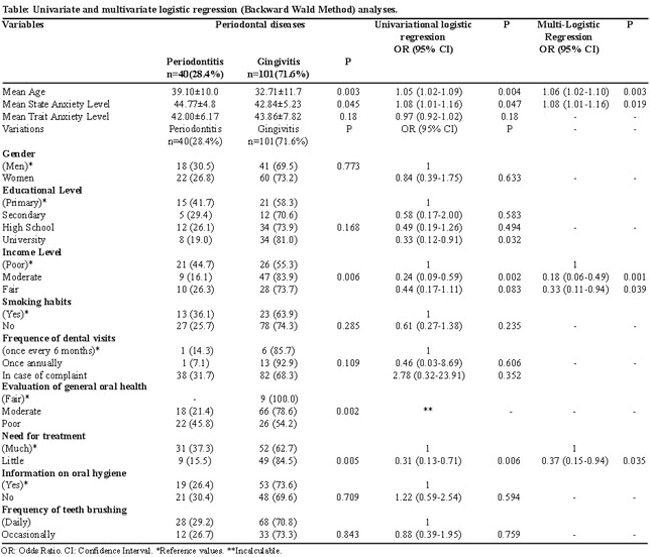
Discussion
The most important factors in providing and maintaining oral health are timing and frequency of dentist-patient meetings. As periodontal diseases require more complicated and time-consuming treatments, if treatment starts late, early diagnosis and regular checks are that much more important. One of the factors preventing visits to periodontologists is dental fear. Dentist-patient meetings will be made easier by improving strategies for determining and coping with state-trait anxiety levels of patients. The factors affecting the anxiety levels have not been completely understood. Various and detailed scales are needed to explore these factors.
Dental originated anxiety affects daily life and social activities and it may also lead to problems in family relations.2 On the other hand, dental anxiety and/or fear related physiological, mental and behavioural alterations may have significant effects on either oral health or general health.12
Dental phobia is also increased due to people being afraid of dental visits and postponing them.13,14 Thus, delayed treatment requires more painful interventions.15,16 This vicious circle may be broken if dentists are aware of the problem and explain it to the patients that interventions are likely to be less painful and disturbing because of new dental techniques. In the current study, the STAI scores of periodontal patients were significantly higher than those in gingivitis patients, and the higher the state anxiety level scores, the more likely patients were to develop periodontitis.
Throughout our study, there were no significant differences between STAI scores of periodontal and gingivitis patients (p>0.05). Dental phobia cannot be treated with anything other than behavioural therapy,1,17 and pharmacological methods like sedation18 were effective in facilitating dental procedures and related anxiety. It is crucial for dentists to treat patients with a high STAI level with more care to ensure their cooperation.
The study detected the incidence of gingivitis and periodontitis to be 71.6% and 28.4%, respectively. Earlier studies have19 stated the frequency of periodontal disease as 45.8 % for 15-year-old children, and 84.4 % in 35-44-year-old adults.19 In the current study, the mean age of periodontal patients was significantly higher than that of the gingival ones. The frequency of paroxysm associated with periodontal diseases increased with age.20,21 Results indicated that as the patient gets older, the inner mouth pathology and the likelihood of oral hygiene awareness increased.
The study indicated that the probability of patients with a moderate income developed less periodontitis compared to patients with a low income (p<0.05). Social and economic status are among the underlying causes of periodontal diseases.22 Economic status has positive contributions to oral and dental care and treatment and awareness of the importance of oral hygiene. These are among the leading factors.
The incidence of gingivitis was significantly higher in patients having a poor oral hygiene (p<0.05). This can be evaluated within the cause-effect relationship. i.e. while poor oral hygiene encourages the development of gingivitis, the existence of gingivitis causes poor oral hygiene.
The incidence of gingivitis was significantly higher in patients who stated that they needed only limited treatment and, thus, the probability of patients who needed only limited treatment, developing periodontitis was less than in those who needed more treatment. This indicated a parallelism that a decrease in the need for treatment revealed a tendency to gingivitis and an increase in periodontitis.
The probability of any school graduates developing periodontitis was significantly lower than in those who were primary school graduates (p<0.05). Some studies have indicated a positive relationship between education level and oral dental health.23,24 As education status decreases, the number of patients in need of treatment increases.25 With an increase in education status, an increase is also expected in people taking precautions and seeking medical help in case of health problems.
Conclusion
The most important factors in developing periodontitis and gingivitis in our study were age, state anxiety level, income level and a need for treatment. Patients\\\' state anxiety level is an important factor in the development of periodontal diseases. The determination of anxiety level and the increased awareness will have a positive impact on the success of periodontal treatment. High state anxiety scores are a sign of general anxiety in patients visiting dentists. Dental phobia is also likely to increase in cases of drastic oral interventions.
References
1. Eitner S, Wichmann M, Paulsan A, Holst S. Dental anxiety-an epidemiological study on its clinical correlation and effects on oral health. J Oral Rehabilitation 2006; 33: 588-93.
2. Buchanan H, Niven N. Validation of a Facial Image scale to assess child dental anxiety. Int J Ped Dent 2002; 12: 47-52.
3. American Psychiatric Associatio. Diagnostic and Statistical Manual of Mental Disorders. 4th ed. Washington DC: APA: 1994.
4. ter Horst G, de Wit CA. Review of behavioural research in dentistry 1987-1992: dental anxiety, dentist- patient relationship, compliance and dental attendance. Int Dent J 1993; 43: 265-78.
5. Abrahamsson KH, Berggren U, Carlsson SG. Psychosocial aspects of dental and general fears in dental phobic patients. Acta Odontol Scand 2000; 58: 37-43.
6. Socransky SS, Haffajee AD. Microbiology of periodontal disease. In: Ed. Lindhe J, Karring T, Lang NP. Clinical Periodontology and Implant Dentistry. 4th ed. Oxford: Blackwell Munksgaard 2003: 106-39.
7. Wisloff TF, Vassend O, Asmyhr O. Dental anxiety, utilisation of dental services, and DMFS status in Norwegian military recruits. Community Dent Health, 1995; 12: 100-3.
8. Oner N, Le Compte, A. Sureksiz Durumluluk/Surekli Kaygi Envanteri El Kitabi. Bogazici Yayinlari, Istanbul; 1983.
9. Oner N, Le Compte A. Durumluk-Sürekli Kaygi Envanteri El Kitabi. Ikinci Baski, Bogazici Universitesi Yayinlari, Istanbul; 1998.
10. Sman AY, Ozturk M, Polat S. An assessment of dental anxiety in oral surgery patients. Gulhane Med J 2002; 44: 395-8.
11. Ainamo J, Barmes D, Beagrie G, Cutress T, Martin J, Sardo-Infirri J. Development of the World Health Organization (WHO) community periodontal index of treatment needs (CPITN). Int Dent J 1982; 32: 281-91.
12. Berggren U. Psychosocial effects associated with dental fear in adult dental patients with avoidance behaviours. Psychol Health 1993; 8:185-96.
13. Sohn W, Ismail AI. Regular dental visits and dental anxiety in an adult dentate population. J Am Dent Assoc 2005; 136: 58-66.
14. Thomson WM, Stewart JF, Carter KD, Spencer AJ. Dental anxiety among Australians. Int Dent J 1996; 46: 320-4.
15. Armfield JM, Stewart JF, Spencer AJ. The vicious cycle of dental fear: exploring the interplay between oral health, service utilization and dental fear. BMC Oral Health, 2007; 7: 1.
16. Weinstein P. Breaking the worldwide cycle of pain, fear and avoidance: uncovering risk factors and promoting prevention. Ann Behav Med 1990; 12: 141-7.
17. Flores-de-Jacoby L, Mengel R, Joannou U, Zafiropoulos GG. CPITN application in regular dental practice. Deutsche Zahn-, Mund-, und Kieferheilkunde Mit Zentralblatt, 1992; 80: 13-20.
18. Muglali M, Kömerk N. Agiz Cerrahisi ve Anksiyete. Cumhuriyet Üniversitesi Dis Hekimligi Fakultesi Dergisi 2005; 8: 83-8.
19. Gokalp S, Dogan BG, Tekcicek M, Berberoglu A, Unluer S. The oral health profile of adults and elderly, Turkey-2004. J Hacettepe Faculty Dentistry 2007; 31: 11-8.
20. Burt BA. Periodontitis and aging: reviewing recent evidence. J Am Dent Assoc 1994; 125: 273-9.
21. Papapanou PN. Risk assessments in the diagnosis and treatment of periodontal diseases. J Dental Educ 1998; 62: 822-9.
22. Genco RJ. Current view of risk factors for periodontal diseases. J Periodontal 1996; 67: 1041-9.
23. Phipps KR, Reifel N, Bothwell E. The oral health status, treatment needs, and dental utilization patterns of Native American elders. J Public Health Dent 1991; 51: 223-8.
24. Sahin S, Saygun I, Enhos S, Altug A, Tekbas OF. The evaluation of the effect of educational status on oral health in young adult males. The Journal of Gazi University Faculty of Dentistry 2009; 26: 133-9. (Online) (Cited 2012 Oct 3). Available from URL: http://www.guidesdergi.gazi.edu.tr/yayinlav.
25. Demirci M, Ozturk FC, Tuncer S, Yaman B. The prevelance of indications on the patients who applied Istanbul University Faculty of Dentistry. J Istanbul University Faculty Dentistry, 2010; 44: 89-102. (Online) (Cited 2012 Oct 3). Available from URL: http://www.iudergi.com/tv/index.php/disdergi/.
Journal of the Pakistan Medical Association has agreed to receive and publish manuscripts in accordance with the principles of the following committees:


