

Faizah N. Bhatti ( Department of Medicine, The Aga Khan University, Karachi. )
Ikram A. Burney ( Department of Medicine, The Aga Khan University, Karachi. )
M. Imran Moid ( Department of Medicine, The Aga Khan University, Karachi. )
Tariq Siddiqui ( Department of Medicine, The Aga Khan University, Karachi. )
September 1998, Volume 48, Issue 9
Student's Corner

Abstract
Patients on cytotoxic therapy often develop neutropenia and fever. Our interest was to identify the common pathogens isolated from such patients and to study the sensitivity patterns of these organisms to the antibiotics used in their treatment. Thus, guidelines can be established by hospitals to identify which antibiotics can be used in the treatment of these patients when the results of cultures and sensitivities are not available. We conducted a retrospective study of neutropenic pediatrics presenting to AKUH from July, 1990 to June, 1996. A total of 153 isolates in 35 different patients were studied. Samples for culture were taken from the sites at risk. The majority of samples consisted of blood, stool, pus and urine. Twenty stool samples were also sent for microscopy. Malignancies were both hematological and non-he.matological. Gram negatives were isolated in 52.9%, gram positives in 33.9% and parasites in 13.2%. Salmonella paratyphi B was the most commonly isolated organism, followed by Pseudomonas aeroginosa, Giardia lamblia was the most common parasite. Sensitivity patterns of these organisms to antibiotics studied showed that Escheria coli had the lowest sensitivity rate being only 40% sensitive to Aztreonani and 64% sensitive to Ofloxacillin. A comparison was made between our findings and those reported in literature, as well as the risk factors for developing neutropenia. A guide to management is also discussed (JPMA 48:287,1998).
Introduction
Cytotoxic drugs are the mainstay of treatment for patients with malignant disease. The development of neutropenia is one of the outcomes of chemotherapy, with the potential hazard of developing infection. This has somewhat been offset by the use of Colony Stimulating Factors and antibiotics1. However, despite these measures the treatment of neutropenic patients still presents a problem for the health professionals. Once febrile, about 80% of patients will develop infection, even if a clinical focus is not detectable at that time2,3. Because culture and sensitivity reports are available after a few days, it is imperative that individual institutions be aware of the predominant pathogens in their setup and their sensitivities to various antibiotics. Of even greater interest is the situation encountered when treating pediatric patients. Pediatrics, especially in our part of the world, present a unique subset because of their own risks and management problems.
At present, while data from the West2,3 still forms the major portion of literature, data from developing parts of the world is still scarce. The purpose of this paper is thus to identify the major pathogens that am responsible for infection in neutropenic children in our hospital and to look at the sensitivity patterns to antibiotics that are commonly used in their treatment. This knowledge can be useful when initiating empiric therapy immediately upon admission of the neutropemc patient, which can then be modified upon culture and sensitivity reports, when they become available.
Materials and Methods
We earned out a retrospective analysis of all the pediatric patients presenting to the Oncology service with culture proven bacterial isolates presenting with fever secondary to neutropenia during a seven-year period from July, 1990 to June, 1996. A total of 153 isolates were documented from 351 atients. Neutropenia was defined as a WBC count <500mm . Neutropenic fever developed either as a result of chemotherapy or secondaiy to bone marrow infiltration due to the underlying neoplastic process. All the patients had either hematological or non-hematological underlying neoplasms. The data were analyzed on Epinfo Version 6 and SPSS for Windows.
Results
We documented 153 positive isolates from 35 pediatric patients. This included 133 cultures and 20 microscopy samples.Underlying neoplasms included acute lymphocytic leukemia, acute myeloid leukemia, Ewing’s sarcoma, Hodgkin’s lymphoma and Osteogenic sarcoma.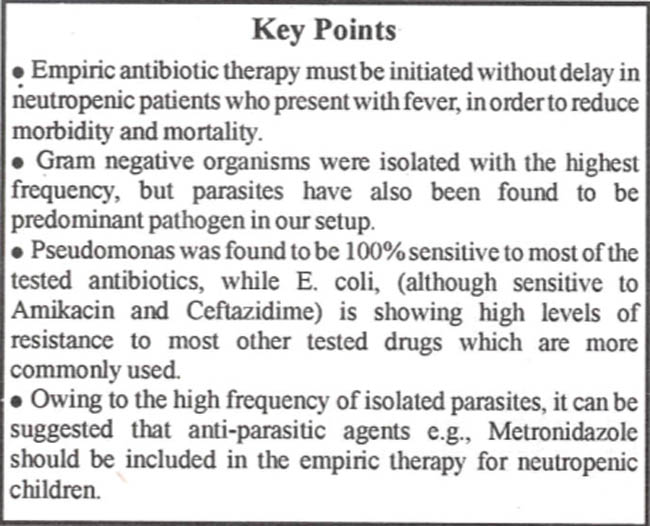
Twenty-five patients were male and 10 were female. Fifty-four (40.6%) cultures were from the blood and 23 (17.3%) were from pus/wound sites (Table 1).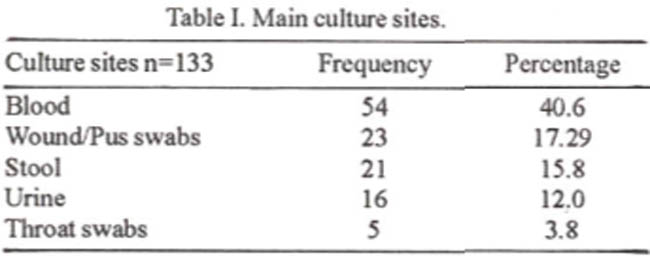
Amongst the isolates, 52.9% were gram negatives and 33.9% were gram positives. Parasites were 13.2%. Individually, the most common organisms isolated were Salmonella paratyphi B (15%) and Pseudomonas aeroginosa (12.8%). Giardia lamblia (75%) was the most common parasite (Table II).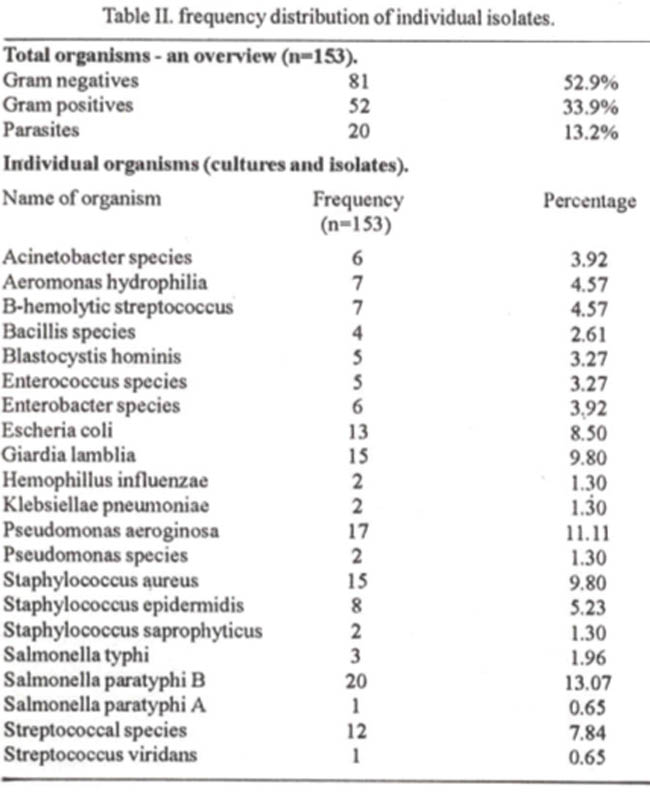
Fifty-four organisms were cultured from blood of which 10 (18.5%) were Staphylococcal species. Of the 23 organisms from pus and wound swabs, there were 9 (39.1%) Pseudomonas aemginosa. Salmonella paratyphi B was isolated from 19 (90.5%) of 21 stool specimens and E. coil from 9(56.3%) of 16 urine specimens (Table III).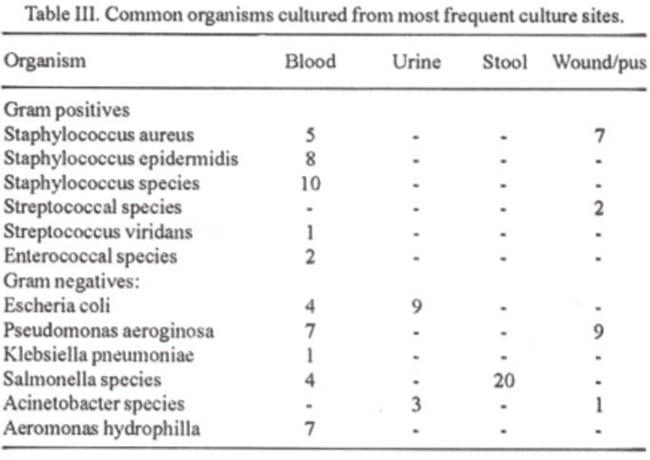
On microscopy 15 (75%) of stool specimens were positive for Giardia lamblia. Antibiotic sensitivity rates are presented in Table IV.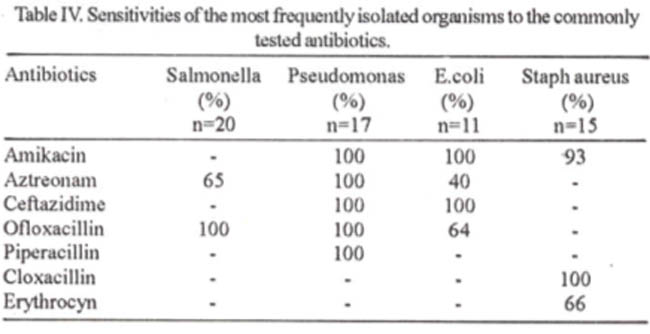
The most common antibiotics to be tested were Amikacin, Aztreonarn, Ceftazidime, Ofloxacillin, Piperacillin, Cloxacillin and Erythrocyn. Pseudomonas was 100% sensitive to all these antibiotics.
Discussion
Malnourishment due to impoverish, lack of personal and social hygiene, presence of unique internal flora due to diseases which are endemic in our region, as well as a trend towaitis outpatient management in an attempt to minimize cost of treatment are some of the factors which cause the management of pediatrics to be a challenge. Children with cancer are prescribed different chemotherapy programs than adults and have different underlying diseases but are overall in better general health. Thus there are specific considerations which must be made for children who present with neutropenia and fever. Identification of infective organisms must be prompt because various studies have shown that once a patient presents with neutropenia, there is a 10-80% chance of his being infected by a pathogen2,3. Infections are a consequence of several factors, which are outlined in Table V.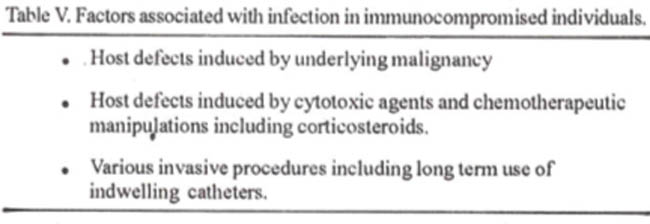
A clinical focus of infection may not be present at the time of presentation, which may be the case in upto 75-80% of patients4,5. Furthermore documented infection is only seen in 25- 30% of patients3. Of the hospitalized patients, 67% are seen to develop infection7,8. Because the defence systems of such patients are unable to mount a substantial inflamniatoiy response, fever is most often the only sign of infection9,109,10 The risk of infection is increased in the presence of oral mucositis or diarrhea, along with clinical instability, advanced disease and overt organ dysfunction”. Infections account for nearly 50%of all cancermortalities in the hospital setting12,13. Unless broad-spectrum empirical antibiotic therapy is initiated within the first 24-48 hours, the risk of septicemic mortality increases by 50-60%14, When neutrophils are less than 100 mm3, there is a 20% chance of bacteremia5, sepsis being lethal in 47% of infected neutropenics versus 14%4 when granulocytes are greater than 1000 mm3.
Western literature reports an increase in Gram positive infections as compared to Gram negative infections in the last decade or so2,7,9,11,13,15,20 although Gram negative infections still prevail17. This is due to better control of Gram negative infections. Gram positive infections are associated with a lower morbidity and mortality and represent 55-60% of all episodes of bacteremia seen in these patients15. Some of the risk factors involved in the rise of Gram positive infections are shown in Table VI.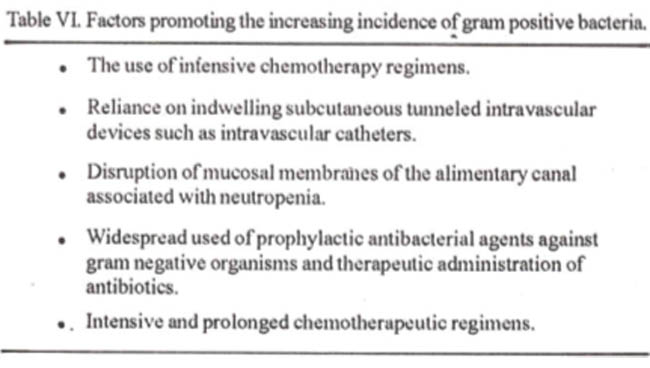
We documented 52.9% of Gram negative infections versus 33.9% Gram positives. A study done by Bumey et al in the same institution documeted 54% Gram negative infections in adults, compared with 46% Gram positive infections (N=127)1.
E. coli, Kiebsiella and Pseudomonas are the most common Gram negative infections2,17. Of these Pseudomonas and Enterobacter infections show the gravest prognosis21. Our study however, documented Salmonella paratyphi B followed by Pseudomonas aeroginosa, Staph. aureus and E. coil. Enterobacter is reproted to have been isolated more frequently at several centers17 ,although we only documented 45%of this organism. The widespread use of third generation Cephalosporins are also causing the emergence of unusual bacteria such as Acinobacter6, which was also isolated in our study.
Of paramount interest is our finding that parasites accounted for 13.2% of our total organisms. Western literature attributes the finding of parasites due to the increasig usage of corticosteroids as part of the chemotherapy regime22. They report the isolation of organisms such as Pneumocystis carnii, Toxoplasma gondii, Strongyloides stercoralis, Ciyptosporidia and Chagas disease, especially in AIDS patients. Perhaps the endemic nature of this disease makes it a more common finding in our part of the world. This would require that drugs such as Metromdazole also be initiated empirically, at the time of presentation.
Appropriate empirical antibitoics should be selected on the basis of knowledge of antibiotic susceptibilities at each institution as much on the basis of studies from other institutions13. Parenteral antibiotics shouldbe prescribed fora minimum of 7 days in the hospital setting18 but the resolution of fever, control of infection, clinical assesment and a neutrophil count greater than 500 to 1000 cells per mm3 all need to be taken into consideration11,23. However many Western studies now prove that earlier discharge from hospital with continuation of treatment on an outpatient basis shows much promise as regards to diminishing the cost of treatment as well the general wellbeing of the patient11,12,24,25. However, this program needs to be approached with caution in our setting. Lack of patient education and inadequate compliance, along with unhygienic living conditions, precludes this form of treatment. In our series the aminoglycoside Amikacin showed high susceptibility. A surprising finding was that E. coli was only 40% sensitive to Aztreonam. E. coli thus seems to be showing increasing resistance to a large number of antibiotics. Routine administration of aminoglycoside as well as the more powerful Vancomycinisa contmversial issue13,26,27. Use of Vancomycin is morn commonly being adivsed only in cases where there is no response to initial treatment, or when Gram positives have been isolated27. The use of anaerobic agent is advocated in cases where necrotizing gingivitis, perianal tenderness and acute abdominal pain (suggestive of typhlitis) occur9. In the end it is uncommon for the development of bacterial infection after the final course of chemotherapy, although Pneumocystis and viral infections do occur11.
It is likely that with the advent of cytokines and even more with possibility to insert drug-resistant genes into hematopoeitic stem cells, the risk of infection will be decreased because the severity and duration of neutropenia will be minimized. Nevertheless attempts at decreasing hospital stay by outpatient management is yet not possible in our society and until then attempts at decreasing the risk of neutropenia and adequate antimicmbial therapy will remain the mainstay of treatment for the febrile neutropenic pediatric.
References
1. Bume IA, Farooqui BJ, Khursheed M. Bacterial isolates in neutrophenic patients: a retrospective analysis (in press).
2. RackoffWR, Gonin R, Robinson C et al. Predicting the risk of bacteremia in children with fever and neutropenia. J. Clin.Oncol., 1996; 14:919-24.
3. Giamat ellou H. Empiric therapy for infections in the febrile, neutropenic, compromised host. Med. Clin. North Am., 1995;79:559-80.
4. Schimpff SC. Empiric antibiotic therapy for granulocytopenic cancer patients. Am. J. Med., 1986;80(Suppl 5C):133-20.
5. Meunier F. Infections in patients with acute leukemia and lymphoma. In Mandeli, GL, Douglas RG and Bennet JE (eds): Principles and practiceofinfectious diseases. 3rd ed., New York, Churchill Livingstone, 1990, pp. 2265-75.
6. Singer C, Kaplan MH andArmstrong D. Bacteremia and fungemia complicating neoplastic disease. Am. K. Med., 1977;62731.
7. Whimbey E, Kiehn TE, Brannon P et al. Bacteremia and fungemia in patients with neoplastic disease. Am. J.Med., 1987;82:723-25.
8. Pizzo PA, Robichaud KJ, Wesley Ret al. Fever in the pediatric and young adult patient with cancer. A prospective study of 1001 episodes. Medicine, 1982; 161: 153-65.
9. Louria DB. Controversies in the management of infectious complications of neoplastic disease: Introduction and epidemiology. Am. J.Med.,1984;76:4 14-20.
10. Buchanan OR. Approach to treatment of the febrile cancer patient with low risk neutropenia. Hematol. Oncol. Clin. North Am., 1993;7:919-35.
11. Anaissie EJ and Vadhan-Raj S. Is it time to redefme the management of febrile neutropenia in cancer patients? Am. J. Med., 1995;98 :221-23.
12, Bodey GP. Empirical antiboitic therapy for fever in neutropenic patients. Clin. Infect. Dis., 1993;17:S378-S84.
13. Brown A. Neutropenia, fever and infections Am. J. Med., 1984;76:421-28.
14. Schimpff SC. Infections in the immunocompromised host- an overview. In Mandell GL, Douglas RG and Bennet JE (eds): Principles and practice of infectious diseases. 3rd ed., New York, Churhcill Livingstone, 1990, pp. 2258-65.
15. Del Favero A, Menichetti F, Bucaneve G et al. Septicemia due to gram-positive cocci in cancer patients. J. Antimicrob. Chemother., 1988;21 (SC): 157-61.
16. Koll BS, Brown AE. Changing patterns of infections in the immunocompromised patient with cancer. Hematol. Oncol. Clin. North Am., 1993;7:753-69.
17. Pizzo PA, Hathom JW, Hiemenz J et at. A randomized trial comparing ceftazadime alone with combination antibiotic therapy in cancer patients with fever and neutropenia. N. EngI. J. Med., 1986;315:552-55.
18. Pizzo PA, Ladish S, Simon RM et at. Increasing incidence of gram positive sepsis in cancer patients. Med. Pediatr, Oncol., 1978;5:241-43.
19. Viscoli C, Vander-Auwera P. Meunier F. Gram positive infection in granulocytopenic patients: An important issue? J, Antimicrob. Chemother. 1988;21(SC): 149-53.
20. Wong B. Parasitic diseases in irnmunocompromised hosts. Am. J. Med., 1984;76:479-82.
21. Awada A, Vander-Auwera P. Meunier F et al. Streptococcal and enterococcal bacteremia in patients with cancer. Clin. Infect. Dis., 1992;15:33-36.
22. Hughes WT, Bodey GP, Meyers JD et at. Guidelines for the use of antimicrobial agents in neutropenic patients with unexplained fever. J. Infect. Dis., 1990;161 :381-83.
23. Grifin TC, Buchanan OR. Hematological predictors of bone marrow recovery in neutropenic patients hospitalized for fever: implications for discontinuation of antibiotics and early hospital discharge. J. Pediatr., 1992;121:28-32.
24. Mullen CA , Buchanan OR. Early hospital discharge of children with cancer treated for fever and neutropenia: identification and management of the low risk patient. J. Clin. Oncol., 1990;8:1998.
25. Karp JE, Dick JD, Angelopoulos C et at. Empiric use of Vancomycin during prolonged treatment induced granulocytopenia. Am. J. Med., 1986;81 :237-42.
26. Rubin M, Hathom JW. Marshall D et al. Gram positive infections and the use of vancomycin in 550 episodes of fever and neutropenia. Ann. Intern. Med., 1988; 108:30-35.
27. Brown, AE. Neutropenia, fever and infection. In Brown AE and Anristrong D (ads): Infectious complications of neoplastic disease, controversies in management. New York, Yorke Medical Books, 1985, p. 19.
Journal of the Pakistan Medical Association has agreed to receive and publish manuscripts in accordance with the principles of the following committees:


