

Erum Furqan ( Department of Haematology, Ziauddin Medical University Hospital, Karachi. )
Tahir S. Shamsi ( Department of Haematology, Ziauddin Medical University Hospital, Karachi. )
Altaf Ahmed ( Department of Haematology, Ziauddin Medical University Hospital, Karachi. )
Serajuddaula Syed ( Department of Haematology, Ziauddin Medical University Hospital, Karachi. )
Syed Iqbal Ahmed ( The Laboratory, Garden Road, Karachi. )
September 1998, Volume 48, Issue 9
Short Reports

The Rhesus (Rh) blood group system is one of the most complex systems. Over 46 different antigens have been serologically defined. Rh antigens are associated with the red cell membrane and are considered important fortheir integrity. The genes for Rh antigens are encoded together on the short arm of chromosome1. One gene codes for Rh D antigen while the other gene encodes the polypeptide carrying the Rh C/c as well as Rh E/e polymorphism. The absence of the entire or atleast part of the Rh D gene causes Rh D negative phenotype1,2.
The Rh blood group system is the second most important in blood transfusion after ABO blood group system. The Rh system is involved in the haemolytic disease of the newborn, haemolytic transfusion reaction and in autoimmune haemolytic anaemia and in forensic work. Among Rh antigens, Rh D, C/c and Etc antigens are most important. In a given population, it is important to know the frequency of different Rh antigens because of its clinical significance. In Caucasians, Rh D is present on the red cells of 85°A of the population. In the Orient, almost 100% of the population are Rh D positive2. In Pakistan, though ABO and Rh D frequency has been worked out in last 20 years but Rhesus phenotype has not been well characterized. Rh phenotypes are elucidated in this brief report.
Material, Method and Results
Three hundred and thirty-nine consecutive blood samples were processed for Rh-phenotyping. Two hundred and ten samples were received specifically for Rh-genotyping at “The Laboratory” from 1977-1996. These samples were of husbands of Rh negative wives; clinicians were specifically interested to know the phenotype so as to assess the risk of Rh HDN in the newborn. One hundred and thirty samples were received for blood grouping and compatibility testing at Dr. Ziauddin Hospital blood bank on which Rh Phenotyping was done. Anti D, anti C, anti c, anti E and anti e anti sera from Orthodiagnostic USA. Dade USA and Immucor Inc.. USA were used. Rh-phcnotyping was done by spin tube method. Agglutination of red cells was observed microscopically on 269 samples and macroscopically on 70 samples by gentle agitation tip and roll method3. Negative results were confirmed by microscopic observation in these 70 samples.
Out of three hundred and forty samples CCDee (38%) and CcDec (31%) are more than two third of all the phenotypes.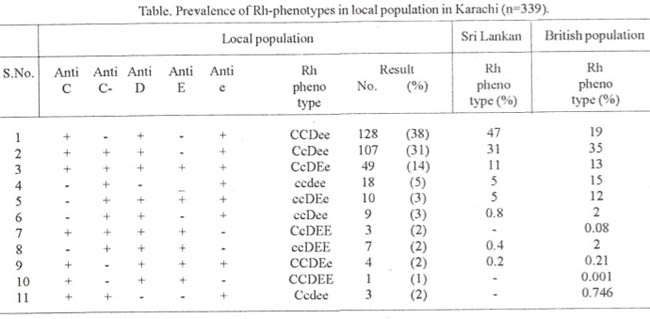
Table shows the results found in this study and also the comparison with Sri Lankan and Caucasian populations.
Discussion
Rhesus antigens are clinically important because of their iminunogenicily and association with haeinolytic disease of the newborn (HDN), haemolvtic transfusion reaction and autoinimune hacmolvtic anaemia and forensic pathology work4. Knowledge of the prevailing Rh phenotypes/genotypes help in the management of such clinical problems. Rh phenotypes have been calculated from probability tables which were developed based 011 family studies in the Western countries, USA and other developed Asian nations many years ago2,5.
Blood banks and transfusion services in Pakistan cannot supply Rh genotype matched blood on demand; sometimes selection of blood for patients with autoimmune haemolytic anaemia or to transfusion dependent thalassaemia who have developed anti-Rh antibodies become extremely difficult. Although few laboratories perform Rh phenotype on request but no serious attempt has been taken to develop probability tables for Rh genotypes. Until the frequency of different Rh haplotypes are known inagivenpopulation, probability tables of Rh genotypes cannot be developed as Rh genotypes cannot be calculated. This can be done by performing Rhesus grouping in families and frequency of various antigens are noted,
So far Rh-D blood group has been reported to be 92-97.7% in different studies in Pakistan6,7 but Rh phenotype genotype work lacks behind. It is concluded that a population based screening for Rh phenotype/genotype should be carried out locally to understand the incidence and prevalence of disease associated with it and to develop a blood donor pool with complete Rh genotype. This blood can be selected for transfusion in sensitized patients, in case of autoimmune haemolytic anaemia and in cases of HDN.
Acknowledgements
We are thankful to Mr. AtifSiddiqui for processing this manuscript.
References
1. Carton JP. Defining the Rh-blood group antigen. Biochem.Molec.Genet. Blood Rev., 1994;8:199-212.
2. Mollison PL, Engelfriet CP. Contreras M. Blood transfusion in clinical medicine. Oxford, Blackwell Scientific Publications, 1993, pp. 204-45,321-76.
3. Waters AH, Lloyed EE. Laboratory aspects of blood transfusion. In: Practical Haematology. Eds. Dacie, JV and Lewis SM ed: 8th edition, Edinburgh, Churchill Livingstone, 1994, pp. 455-57.
4. Andrew G, Hadley.Belinda MK. The role ofRh-antigen in haemolytic diseases of the new born. Baillieres Clin.. Haematol., 1993;6:423-43.
5. Boorman KE, Dodd BE. Lincoln PJ. Blood group serology - Theory, Techniques, Practical Applications, 5th Edition, Edinburgh, Churchill Livingstone, 1977: pp. 73-89.
6. Hussain M, Begum N, Akhtar F. ABO and Rhesus blood grouping in NWFP. J.Pak.Med.Assoc., 1985;35:253-54.
7. Nasim FH Ashraf M, Shaikh QI et al. Distribution of ABO and Rh blood groups in the resident of Bahawalpur. J.Pak.Med.Assoc., 1987;37:7-8.
8. De-Zoysa NS. Prevalence of Rhesus blood groups in Sri Lanka. Ceylon Med.J., 1993;38: 129-30.
Journal of the Pakistan Medical Association has agreed to receive and publish manuscripts in accordance with the principles of the following committees:


