

Anwar-ul-Huda ( Department of Anaesthesia, Royal Bournemouth Hospital, United Kingdom. )
Mohammad Hamid ( Department of Anaesthesia, Aga Khan University, Karachi. )
Saboor Ahmed ( Department of Anaesthesia, Aga Khan University, Karachi. )
Mohammad Baqir ( Department of Emergency Medicine, Aga Khan University, Karachi. )
Aysha Almas ( Department of Medicine, Aga Khan University, Karachi. )
October 2012, Volume 62, Issue 10
Original Article

Abstract
Objective: To assess the pain management by medical team, emergency room (ER) team and Acute Pain team in a tertiary care hospital.
Methods: The cross-sectional study was done in Medical Ward, Surgical Ward and Emergency Room of Aga Khan University, Karachi, in March-April 2010. The assigned research medical officer visited the three locations every day and selected patients by way of convenient sampling. The study comprised 75 patients; 25 each in three groups. Information was collected on patient\\\'s demographics, general characteristics, type of drugs and modalities used. Specific queries about pain were sorted out like adequacy of pain assessment done by primary physician, pain intensity, any intervention done and pain relief post-intervention. SPSS version 17, analysis of variance and Chi square test were used for statistical purpose.
Results: The mean current pain score on the visual analogue score (VAS) was lowest in the Surgical Ward which was being managed by the Acute Pain Management Service (APMS) team followed by the Medical Ward and then Emergency Rooms. The difference was found to be statistically significant. The mean of worst pain score was also the lowest in the Surgical Ward. There was significant difference between wards in terms of the use of pain medications. Proper documentation for pain was done for all patients in the Surgical Ward, followed by the Emergency Room and then the Medical Ward.
Conclusion: Better pain assessment, re-assessment, documentation and patient satisfaction were observed in the Surgical Ward compared to the other two locations of the study.
Keywords: Pain management, Pain assessment, Wards. (JPMA 62: 1065; 2012).
Introduction
The assessment and treatment of pain are increasingly recognised as high priorities. The Joint Commission and the American Pain Society advocate using pain as \\\'the fifth vital sign.\\\'1 Relief of pain is and will remain one of the most important roles of health professionals. It is not a new concept, but it is only recently that services have been developed with the specific aim of managing pain as a symptom. These services have concentrated their resources and development in three areas; palliative care, chronic pain and post-operative pain. Little is written about the occurrence of pain in other areas of the hospital, for example the Medical Wards, and the Acute Pain Ward round rarely ventures into such areas. Many organisations have developed strategies to embrace adequate pain relief as an obtainable goal for all.2,3 In many ways, the subject of acute pain and its treatment encapsulates a whole range of issues that affect delivery of healthcare.3 A study reported inadequate pain management in the Emergency Department which appears to be related to poor staff assessment of pain and may be improved by routinevisual analogue score (VAS) recording and by a nurse-based pain protocol.4
Reasons for measuring the quality of care include obtaining more detailed informations about patient care, determining whether standards are being achieved, identifying potential areas for improvement and thereby securing resources for future services. Important clinical aspects of care may vary from one department to another, based on the patient population and services provided. Documentation of pain scores in a systematic and consistent manner is an important mechanism for promoting identification of unrelieved pain at the individual patient-care level. It is also the first step towards the implementation of a single standard of care and a systematic approach for improving pain management.5 This study was done to assess pain management by the Medical team, Emergency Room (ER) team and Acute Pain team in a tertiary care hospital.
Patients and Methods
The observational study was done in Medical Ward, Surgical Ward and Emergency Room of Aga Khan University Hospital, Karachi, in March-April 2010. For sample size calculation, we took the known proportion of patients in hospitals reporting pain as 55%,6 and we hypothesised the proportion in our hospital as 40%. We calculated the total sample size as 68 at significance level of 5% and power of 80. We finally included 75 patients for our study with 25 patients in each of the three groups.
Inclusion criteria consisted of patients of either gender aged 18 years or above who had complaint of pain in the Emergency Room, Medical Ward and Surgical Ward which was being managed by the Acute Pain Management Service (APMS), and who had come to the hospital Emergency Room at least 2 hours before assessment. We excluded critically ill patients like those on ionotropic support and patients for whom pain consult was generated by the primary team.
The assigned research medical officer visited the three destinations every day. At every visit, he first identified patients who had complaint of pain in the preceding 12 hours with the help of incharge registered nurse of the location concerned. For Emergency Room, patients identified should have come at least 2 hours before assessment. Every day, excluding weekends, one of the three groups was selected and named groups A, B and C. Group A consisted of patients from the Medical Ward; Group B consisted of patients from the Surgical Ward; and Group C consisted of patients in the Emergency Room. The assigned research medical officer selected patients using convenient sampling from that particular group. He selected first patient from the sample available after identification of all patients on one day in the order of bed numbers and then from there every 3rd patient was included. Institutional ethical committee approval was obtained and written informed consent were taken from each patient.
The assigned research medical officer took a brief history about the patient\\\'s pain, assessed pain and its management and patient satisfaction with pain management. Information was collected on patient\\\'s demographics, general characteristics, as well as the type of drugs and modalities used. Specific queries about pain were sorted out like adequacy of pain assessment done by the primary physician, pain intensity, any intervention done and pain relief after that. VAS score of 1-3 was considered as mild pain; 4-6 as moderate pain; and 7 to 10 as severe pain. We also recorded any rescue medication i.e, any pain medication other than the usually prescribed regular pain medications. All data were entered and analysed through SPSS version 17.
Quantitative variables were measured for means and compared using ANOVA. Qualitative variables were measured for proportions and compared using chi square test. P value of less than 0.05 was considered significant.
Results
A total of 75 patients - 25 patients in each group - were included in the study. Baseline characteristics like age and gender were not statistically different among the groups. Majority (n=13; 52%) of patients in ER had pain in abdomen followed by pain in peripheral parts of body (n=7; 28%). Majority (n=9; 36%) of patients in Medical Ward also had pain in the abdomen (n=9; 36%) followed by pain in back (n=6; 24%) and peripheral body parts (n=6; 24 %). While all patients in the Surgical Ward had pain related to their respective surgical sites. This difference was found to be statistically significant. Mean current pain score on VAS was the lowest in Surgical Ward being managed by APMS team, 2.08 ± 1.46 followed by 3.6 ± 1.52 in Medical Ward and 3.84 ± 1.81 in the ER and this was found to be statistically significant. In ER, 10 (40%) patients had mild pain, 12 (48%) patients had moderate pain; 2 (8%) had severe pain; and 1 (4%) had no pain at the time of questioning. In the Medical Ward, 13 (52%) patients had mild pain; 11 (44%) had moderate pain; 1 (4%) had severe pain; and no one was pain-free. In the Surgical Ward, 16 (64%) patients had mild pain; 4 (16%) had moderate pain; no one had severe pain; and 5 (20%) had no pain at all. This difference in pain score was found to be statistically significant (p= 0.024). The mean of worst pain score on VAS in the preceding 24 hours was also the lowest in the Surgical Ward (Figure).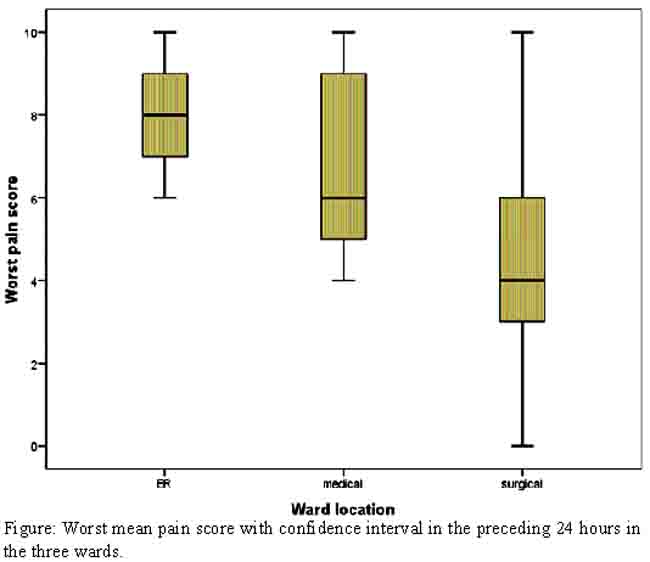
In the ER, the worst pain score was severe in 21 (84%) patients; and moderate in 4 (16%). In the Medical Ward, the worst pain grade was moderate in 15 (60%) patients; and severe in 10 (40%) patients. In the Surgical Ward, the worst pain grade was moderate in 13 (52%) patients; and mild in 12 (48%). This difference was statistically significant. The mean pain score on VAS before pain medication given was lower i.e, 6.12 ± 2.45 in the Medical Ward compared to 6.84 ± 2.15 in the ER. All patients in the Surgical Ward received pain medication immediately in the post-operative period. In the ER, pain grade before medication was severe in 18 (72%) patients; moderate in 4 (16%); and mild in 3 (12%) patients. In the Medical Ward, pain grade before pain medication was moderate in 14 (56%) patients; severe in 9 (36%); and mild in 2 (8%) patients. This difference was found to be statistically significant (p= 0.013).
In the ER, 20 (80%) patients received pain medication and the most commonly used pain medications were Pethidine, followed by combination therapy in 6 (30%), paracetamol in 2 (10%) and NSAIDs in 2 (10%). In Medical Ward, 18 (72%) patients received pain medication and the most commonly used medications were combination therapy in 11 (61%) patients followed by tramadol in 3 (16%) paracetamol in 2 (11%) and Gabapentin with NSAIDS in 1 (5.5%) each. In the Surgical Ward, all patients received pain mediation and the most commonly used ones were combination therapy in 15 (60%) followed by epidural in 8 (32%) and then patient-controlled intravenous analgesia (PCIA) morphine in 2 (8%). There was significant difference between wards in terms of use of pain medications. The main drugs in combination therapy was tramadol in the ER and the Medical Ward, while it was epidural local anaesthetics in the Surgical Ward (Table). 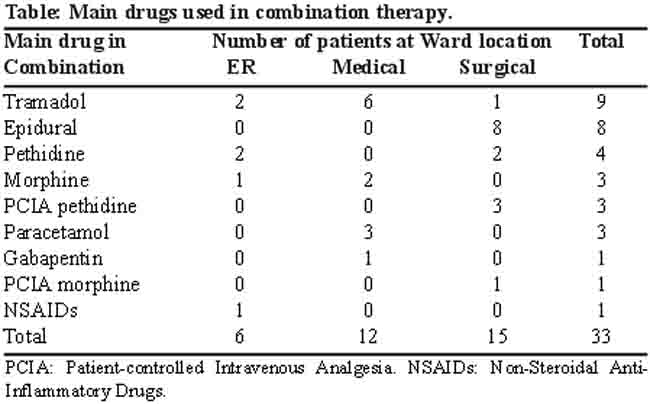
This difference was statistically significant (p= 0.002). In the ER, 18 (72%) patients received rescue medication while in pain, followed by 12 (48%) patients in the Surgical Ward and 8 (32%) patients in the Medical Ward (p= 0.017). Among ER patients who received rescue medications, 13 (72%) received narcotics followed by 5 (28%) who received NSAIDs. In the Medical Ward, 7 (87%) received narcotics followed by 1 (13%) who received NSAID as rescue medication. In the Surgical Ward, 7 (58%) patients received NSAIDs as rescue medication, followed by 5 (42%) receiving narcotics. The major route of administration for pain medication in the ER was as IV bolus followed by 10% as intravenous infusion and 5% as oral route. In the Medical Ward, 70% were IV bolus followed by 23% as oral route and then 7% as intravenous infusion. In the Surgical Ward, the major route of administration was epidural as 64% followed by PCIA as 28% and intravenous infusion as 8% (p= 0.00). In the ER, 90% patients had written prescription for pain as pro re nata (PRN) dosage, while only 10% had a written prescription as regular pain medication. In the Medical Ward, 22 (88%) patients had regular prescription, while everyone in the Surgical Ward had a written regular pain medication (p= 0.00).
Re-assessment of pain by physicians or nurses was done for all the patients in the Surgical Ward followed by 15 (60%) patients in the ER and 6 (24%) patients in the Medical Ward. The difference was found to be statistically significant (p= 0.00). Proper documentation for pain was done for all patients in the Surgical Ward, followed by 19 (76%) patients in the ER, and 10 (40%) patients in the Medical Ward (p= 0.00).
In the ER, there was no patient who was \\\'very satisfied,\\\' 1 (4%) patient was \\\'mostly satisfied\\\' and 10 (40%) patients were only \\\'satisfied,\\\' while 14 (56%) patients were \\\'unsatisfied.\\\' In the Medical Ward, there was no one who was \\\'very satisfied,\\\' 1 (4%) patient was \\\'mostly satisfied,\\\' 18 (72%) were only \\\'satisfied\\\' and 6 (24%) were \\\'unsatisfied.\\\' In the Surgical Ward, there were 3 (12%) patients who were \\\'very satisfied,\\\' 7 (28%) were \\\'mostly satisfied,\\\' 15 (60%) patients were \\\'satisfied\\\' and no one was \\\'unsatisfied.\\\' The difference was found to be statistically significant (p= 0.001).
Discussion
Pain is a subjective experience. Therefore, for most patients self report is the most appropriate way of describing their pain. However, patients need to understand what they are being asked and why.6,7 Knowledge, attitudes and behaviours influence effective pain management. Knowledge deficits regarding pharmacology, the risk and likelihood of side effects and addiction, and pain assessment are common.9,10 Allison et al reported common reasons for poor pain management as inadequate staff training, knowledge deficits, unhelpful staff and patient attitudes, poor pain assessment, fear of analgaesic side effects, and lack of accountability.11
Pain assessment and management following surgery are central to the care of post-operative patients.12 Post-operative pain management should be based on a well-organised healthcare system that emphasises documentation of the management outcome for each individual patient.13,14 Pain is the most common symptom reported by patients in surgical wards. Nevertheless, the patient should receive substantial relief from pain.15
Studies suggest that in the hospital setting, 52% to 74% of patients in medical wards or medical surgical units experience pain.6,16 Carey et al reported the means for pain intensity from 5.09 to 5.7517 compared to 2.08 to 3.84 in our study which is as a whole better. Of the total patients, 12% in Medical Ward in the survey by Dix et al reported unbearable pain18 compared to 36% reported severe pain in the Medical Ward in our study.
Maier et al in one study19 reported unacceptable levels of pain in 55% of all surgical patients and 58% of non-surgical patients compared to 16% patients having moderate level and above pain in the Surgical Ward, and 48% with moderate level and above pain in Medical Ward and ER in our study. The rate of patients with severe resting pain was notably lower (4% in ER, 8% in the Medical Ward and none in the Surgical Ward) than in earlier studies, which reported proportions of up to 36%.20,21 The epidural route was used for post-operative pain in 31% patients in a study by Idvall et al22 which was also much lower than 64% in the Surgical Ward in our study. Maier et al reported 85% of surgical patients receiving painkilling drugs. This was significantly less often (57%) the case for non-surgical patients without malignancies19 while it was 48% for the Surgical Ward and 72% in ER and 32% in the Medical Ward in our study.
Studies confirm that high levels of symptom distress are associated with a diminished quality of life and decreased satisfaction with inpatient care.6,17 Maier et al. reported that 70.3% of surgical patients categorised their analgaesia as effective and less than 5% rated it as ineffective. Of the non-surgical patients with or without malignancies, only half felt they had received effective treatment19 as compared to 100% satisfaction with treatment in the Surgical Ward in our study. The level of satisfaction was also reasonably good in the Medical Ward (76%) although it was almost the same (44%) for ER as reported by Maier et al for non-surgical patients.19 Approximately 50% of post-operative patients have been inadequately treated for pain23 while if we compare this with patients in our surgical ward, no one was unsatisfied with pain management.
There is good evidence that careful and regular assessment of pain improves the perception of nurses and physicians concerning the impact of pain on their patients\\\' lives, and enhances the quality of its management24 and it was done for all the patients in the Surgical Ward and was also reasonably good in the ER (60%) but much lower (24%) in the Medical Ward.
The early, accurate recognition and assessment of a patient\\\'s pain are the most important aspects of effective acute pain management.25 Poor communication and assessment frequently result in poor documentation in studies by Camp et al.26,27 Unfortunately, studies revealed that pain documentation by nurses and physicians in different healthcare settings is infrequent, and the use of pain scales is limited.28 Dalton et al. audited 787 patient charts at six sites to evaluate documentation of practice provided by a multi-disciplinary team of nurses, physicians, and pharmacists who participated in an educational programme on pain management. The results revealed documentation of assessment, treatment, and outcome data was infrequent and inconsistent29 as it was quite true for non-surgical patients in our study as well.
Better pain assessment, reassessment, documentation and patient satisfaction were observed in the Surgical Ward compared to other locations in our study. Getting new information about pain management is somewhat limited, especially considering heterogeneity of pain issues in different wards in our study. Also, as we did not randomise the selection our subjects, this may have influenced the results. We did not analyse proper selection of pain medication against patient\\\'s comorbids and WHO guidelines. Furthermore, the generalisablity of the findings beyond a single centre is limited.
Conclusion
Better pain assessment, re-assessment, documentation and patient satisfaction levels were observed in the Surgical Ward than the Medical Ward or the Emergency Room. This was probably because the Surgical Ward was being managed by a team of Acute Pain Management Service.
References
1. Miaskowshi C, Bain M, Chau R, D;Arcy Y, Hartwick C, Huffman L, et al. Principles of analgesic use in the treatment of acute pain; and cancer pain. 4th ed. Glenview (IL): American Pain Society; 1999.
2. The Royal College of Anaesthesists. Guidelines for the Provision of Anaesthetic Services. Guidance on Pain Management Services, 1999; 55-9.
3. Pain assessment is the 5th vital sign. Nursing councils \\\'news a nursing publication for Hartford hospital community, 2003; 5.
4. Bruster S, Jarman B, Bosanquet N, Weston D, Erens R, Delbanco TL. National survey of hospital patients. BMJ 1994; 309: 1542-6.
5. Stalnikowicz R, Mahamid R, Kaspi S, Brezis M. Undertreatment of acute pain in the emergency department: a challenge. Int J Qual Health Care 2005; 17: 173-6.
6. Kris AE, Dodd MJ. Symptom experience of adult hospitalized medical-surgical patients. J Pain Symptom Manage 2004; 28: 451-9.
7. Brown ST, Bowman JM, Eason FR. Assessment of nurses\\\' attitudes and knowledge regarding pain management. J Contin Educ Nurs 1999; 30: 132-9.
8. Sloman R, Rosen G, Rom M, Shir Y. Nurses\\\' assessment of pain in surgical patients. J Adv Nurs 2005; 52: 125-32.
9. Brunier G, Carson MG, Harrison DE. What do nurses know and believe about patients with pain? Results of a hospital survey. J Pain Symptom Manage 1995; 10: 436-45.
10. McCaffery M, Ferrell BR. Nurses\\\' knowledge of pain assessment and management: how much progress have we made? J Pain Symptom Manage 1997; 14: 175-88.
11. Taylor A, Stanbury L. A review of postoperative pain management and the challenges. Curr Anaesthesia Crit Care 2009; 20: 188-94.
12. Ferrell BR, Eberts MT, McCaffery M, Grant M. Clinical decision making and pain. Cancer Nurs 1991; 14: 289-97.
13. Dalton JA, Carlson J, Blau W, Lindley C, Greer SM, Youngblood R. Documentation of pain assessment and treatment: how are we doing? Pain Manag Nurs 2001; 2: 54-64.
14. Stomberg MW, Wickstrom K, Joelsson H, Sjostrom B, Haljamae H. Postoperative pain management on surgical wards--do quality assurance strategies result in long-term effects on staff member attitudes and clinical outcomes? Pain Manag Nurs 2003; 4: 11-22.
15. Manias E, Botti M, Bucknall T. Observation of pain assessment and management--the complexities of clinical practice. J Clin Nurs 2002; 11: 724-33.
16. Kroenke K, Stump T, Clark DO, Callahan CM, McDonald CJ. Symptoms in hospitalized patients: outcome and satisfaction with care. Am J Med 1999; 107: 425-31.
17. Carey SJ, Turpin C, Smith J, Whatley J, Haddox D. Improving pain management in an acute care setting. The Crawford Long Hospital of Emory University experience. Orthop Nurs 1997; 16: 29-36.
18. Dix P, Sandhar B, Murdoch J, MacIntyre PA. Pain on medical wards in a district general hospital. Br J Anaesth 2004; 92: 235-7.
19. Maier C, Nestler N, Richter H, Hardinghaus W, Pogatzki-Zahn E, Zenz M, et al. The quality of pain management in German hospitals. Dtsch Arztebl Int 2010; 107: 607-14.
20. Lynch EP, Lazor MA, Gellis JE, Orav J, Goldman L, Marcantonio ER. Patient experience of pain after elective noncardiac surgery. Anesth Analg 1997; 85: 117-23.
21. Bruster S, Jarman B, Bosanquet N, Weston D, Erens R, Delbanco TL. National survey of hospital patients. BMJ 1994; 309: 1542-6.
22. Idvall E, Hamrin E, Sjostrom B, Unosson M. Patient and nurse assessment of quality of care in postoperative pain management. Qual Saf Health Care 2002; 11: 327-34.
23. Apfelbaum JL, Chen C, Mehta SS, Gan TJ. Postoperative pain experience: results from a national survey suggest postoperative pain continues to be undermanaged. Anesth Analg 2003; 97: 534-40.
24. Barak M, Poppa E, Tansky A, Drenger B. The activity of an acute pain service in a teaching hospital: Five years experience. Acute Pain 2006; 8: 155-9.
25. Miner J, Biros MH, Trainor A, Hubbard D, Beltram M. Patient and physician perceptions as risk factors for oligoanalgesia: a prospective observational study of the relief of pain in the emergency department. Acad Emerg Med 2006; 13: 140-6.
26. Camp LD. A comparison of nurses\\\' recorded assessments of pain with perceptions of pain as described by cancer patients. Cancer Nurs 1988; 11: 237-43.
27. Camp LD, O\\\'Sullivan PS. Comparison of medical, surgical and oncology patients\\\' descriptions of pain and nurses\\\' documentation of pain assessments. J Adv Nurs 1987; 12: 593-8.
28. Chanvej L, Petpichetchian W, Kovitwanawong N, Chaibandit C, Vorakul C, Khunthong T. A chart audit of postoperative pain assessment and documentation: the first step to implement pain assessment as the fifth vital sign in a University Hospital in Thailand. J Med Assoc Thai 2004; 87: 1447-53.
29. Dalton JA, Carlson J, Blau W, Lindley C, Greer SM, Youngblood R. Documentation of pain assessment and treatment: how are we doing? Pain Manag Nurs 2001; 2: 54-64.
Journal of the Pakistan Medical Association has agreed to receive and publish manuscripts in accordance with the principles of the following committees:


