

Gian Chand ( ENT Department, Sindh Government Hospital, Korangi-5, Karachi. )
Muhammad Shafiq ( ENT Department, Sindh Government Hospital, Korangi-5, Karachi. )
Atif Khan ( ENT Department, Sindh Government Hospital, Korangi-5, Karachi. )
October 2012, Volume 62, Issue 10
Original Article

Abstract
Objective: To compare the outcome of submucosal resection of nasal septum under local and general anaesthesia.
Methods: The retrospective study was conducted at the Sindh Government Hospital, Korangi, Karachi, from November 2008 to June 2010. A total of 100 patients (50 male and 50 females) having unilateral or bilateral nasal obstruction with moderate deviation of the nasal septum and unilateral or bilateral inferior turbinate hypertrophy, undergoing surgical treatment were inducted. They were divided into two groups: 50 patients of either gender operated under local anaesthesia; and the rest who were operated under general anaesthesia. All these patient came for post-operative follow up in July and August 2010, and both groups were compared. SPSS 18 was used for statistical analysis.
Results: Of the 100 patients, there were 19 complications: 1 (5.26%) among those who had undergone local anaesthesia, and 18 (94.73%) among those who had been given general anaesthesia. Besides, in Group I, the cost of the drugs averaged Rs500 per patient, the average time consumed was 20 minutes, and bleeding at time of surgery was mild (10 to15 ml). In Group II, the average cost of drug Rs1500 per patient, the average time consumed was 40 minutes, and bleeding at time of surgery was moderate (15 to 100ml). No mortality was seen in either group.
Conclusion: Local anaesthesia was found to be a far more safe, effective and economical option for submucosal resection of nasal septum.
Keywords: Nasal septum, Surgery, Anaesthesia, Outcome. (JPMA 62: 1020; 2012).
Introduction
Nasal septal deviation is frequently encountered in the general population. The major symptoms of septal deviation is nasal obstruction causing difficulty in breathing. Surgical correction of this problem has been utilised for over a century. In 1757, Quelmaltz\\\'s advocated daily digital pressure for gradual correction.1 A century later in 1875, Adam advocated fracture and splinting of the nasal septum.2 In 1882, Ephraim Fletcher removed a triangular piece of cartilage from the nasal septum.3 In 1889, Krieg advocated removing the deformity and the nasal mucosa.4 In 1899, Asch suggested actually altering the spring of the cartilage with full thickness cruciate incision.5 In 1902, Freer6 and in 1904 Killian7 should be credited with the concepts of submucous resection (SMR) that to this day form the basis of most techniques. They proposed that cartilage and bone should be carefully identified between the layers of the mucous membrane and then to be removed, with a retention of both dorsal and caudal struts of cartilage to prevent any subsequent change in the external shape of the nose. Most of the surgeons adopted Killian\\\'s technique with preservation of caudal and dorsal struts of the septal cartilage to minimise the complications. This study was carried out to compare the SMR under local and general anaesthesia.
Patients and Methods
The retrospective study was conducted at the Department of ENT and Head & Neck Surgery, Sindh Government Hospital Korangi-5, over 20 months between November 2008 and June 2010. A total of 100 patients male 50% and female 50% - between 18 and 35 years of age and with history of nasal obstruction (unilateral or bilateral), diagnosed as cases of nasal septal deviation of moderate type along with unilateral or bilateral inferior turbinate hypertrophy were included in the study. All the patients belonged into Karachi\\\'s Korangi area to ensure follow-up.
People outside the study age group were left out, and so were those with gross external nasal deformity, anxious personality, revision surgery, septal deviation with nasal allergy, and symptomatic deviation of nasal septum. None of the patients in the study had any systemic disease like diabetes mellitus, hypertension, tuberculosis and bleeding or coagulation disease. Also, none of the patients had any acute or chronic disease in the nose, paranasal sinus or ear and throat.
Clinical evaluation included detail history of patients, Examination included physical general health, pulse, blood pressure and body temperature. Systemic examination, including chest, abdomen for any organomegely revealed normal. ENT examination included external examination of the nose, anterior and posterior rhinoscopy. Nasal patency was tested; throat and neck were examined. Investigation, including blood complete picture and erythrocyte sedimeutation rate (ESR) bleeding and coagulation profile, urine detail report were done. X-ray para-nasal sinus (PNS) (occipitomental view) and X-ray (chest posterior anterior view) were also done.
Pre-operative counselling included obtaining consent of the patient regarding the type of anaesthesia. For local anaesthesia, intravenous line was maintained with ringer lactate solution 1000cc. Surface anaesthesia with 4% xylocaine mixed with adrenaline hydrochloride 1:1000 was added in equal measure. Packs soaked with these agents were left for half-an-hour before operation in the nasal cavity. Further anaethesia was achieved by infilterating 2% xylocaine with 1:1000 adrenaline hydrochloride 5cc with dilution 5cc distilled water in the mucous membrane of the nasal septum at various sites (3-4 sites) on both sides after the removal of packing and pre-medication. Injection Diclofenac Sodium 3cc intramuscular, injection Promethazine intramuscular and injection Diazepam intravenous were given. Blood pressure and pulse were checked with pulse oximeter before the SMR and inferior turbinate hypertrophy (unilateral bilateral) started.
For general anaesthesia, intravenous line was maintained with ringer lactate solution 1000cc. Plain xylocaine 4% surface (5-8ml) anaesthesia packing in the nasal cavity was given with 1 ampoule of 1:1000 adrenaline hydrochloride solution. For the induction of anaesthesia propofol 2.5mg/kg body weight was given, followed by injection nelbuphen 0.1mg/kg bodyweight and then the endotracheal intubation was performed. Anaesthesia was maintained with oxygen, nitrous oxide and halothane 0.5 mac and atracurium maintenance dose 0.25mg/kg bodyweight was given before SMR and inferior turbinate hypertrophy (unilateral and bilateral) started. After completing the procedure, nasal packing was removed with finger gloves struts along with the application of bilateral nasal splints. Patients recovered normally and their outcome were reviewed. All statistical analyses were performed using SPSS version 18. Descriptive statistics were shown as mean ± standard deviation, and frequencies and percentages respectively.
The absence of any sampling methodology in the study was a serious limitation, and so was the lack of any designated parameter to divide the study population into two groups. Besides, the data was not subjected to any detailed statistical analysis.
Results
The mean age was 22.36 ± 4.0 years ranging from 18 to 35 years. The male-to-female ratio was 1:1.
The surgical procedures were noted in detail (Table-1).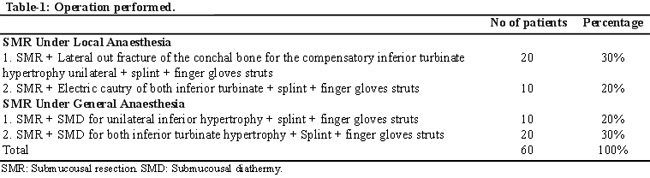
Of the 100 procedures, complications related to anaesthesia, procedure and recovery phases were seen in 19 cases (Table-2).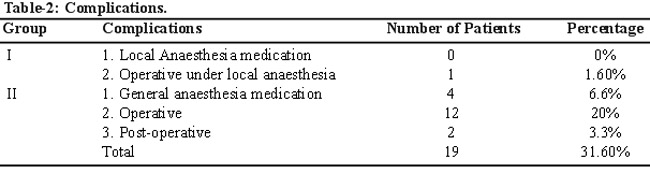
Characteristics of the two groups were compared along several lives (Table-3).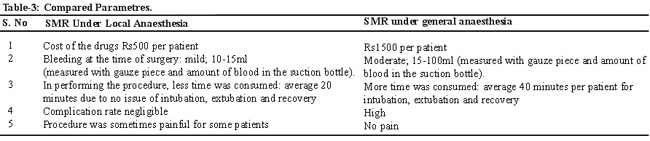
During the two-month follow up, Group I 35 (70%) patients were \\\'very satisfied;\\\' 15 (30%) patients were satisfied; and no patient was dissatisfied. In Group II, 25 (50%) patients were very satisfied; 20 (40%) were satisfied; and 5 (10%) patients were dissatisfied.\\\' Relief of nasal obstruction in both groups remained equal.
Discussion
The part of the nose which separates the two air ways and the nostrils is known as nasal septum. It is ideally located at the centre of the nose. It plays a key role in the development and growth of the nose, the mid face and the maxilla. It also supports the dorsum, columella and the tip of nose and, as such, contributes to cosmesis.8 Deviations are common in Caucasians, but uncommon in other races.9 The males are more frequently affected than females. It is seen more in Europeans than the Asians and Africans.10 Deviation of the nasal septum are commonly found and are often responsible for various anatomical, physiological and pathological changes in the nose.11 When the deviation is sufficiently marked to obstruct respiration and drainage or to produce pressure and consequent irritation upon the turbinates, a nasal septal surgery is needed. SMR can be done purely under local anaesthesia or it can be done with local anaesthesia supplemented by general anaesthesia.12
In this study 1 (5.26%) of the patients was found to have septal adhesion due to lack of nasal cleaning as a result of delayed followup after removal of the splint. This was comparable with a previous study in which 2 patients out of 60 (3.3%) were found to have septal adhesion (both without splint) due to delayed followup.13 In this study, 2(10.53%) patients were found to have nausea and vomiting due to general anaesthesia medication. A previous study that had 48 patients, reported nausea and vomiting due to general anaesthesia medication in less than 2%.14 In our study, the incidence of septal perforation was 7. Septal perforation due to excessive bleeding makes it difficult to separate the mucosa of the septal cartilage and bony portion of the nasal septum. An earlier study reported this complication to be 17-25%.15 In another study of 75 patients, 2 (2.66%) had a septal perforation.16
Conclusion
SMR done under local anaesthesia had lesser complications and was more economical and effective for the patients.
Reference
1. Roy B. the nasal septum in charles w comings John M, Fredrickson Lee A. Harker Charles J. Krause David E. Schuller oto Laryngology - Head and neck surgery. 2nd ed. London: 1993; 1: pp 786.
2. Adams W. On the Treatment of Broken Nose by Forcible Straightening and Mechanical Retentive Apparatus. Br Med J 1875; 2: 421-2.
3. Blaugrund SM. Nasal Observation. The nasal septum and concha bullosa. Oto Laryngol Clin North Am 1989; 22: 291-306.
4. Kreig R. Resection der cartilago quadrangularis septi nasem zur heilung der scoliosis septi. Medizinishes co crepondenz blatt wurtenburgishem artzlichen verein Stuttgart 1889; 56: 201.
5. Asch M. Treatment of nasal stemosis due to deflective septum with and without thickening of the convex side. Laryngoscope 1899; 6: 340-61.
6. Freer OT. The correction of defections of the nasal septum with a minimum of traumatization. JAMA 1902; 38: 636.
7. Killiam G. Die submucosa Fensterresektion der Nasencheidewand, Arch Laryngologic Rhinologic 1904; 16: 362-87.
8. Adriaan F. The Laryngology Head & Neck Surgery. 7th ed. London: Hodder Arnold, 2008; 2: pp 1569.
9. Ballenger JJ. Surgical Correction of the Obstructive lesions of the septum. Disease of the Nose, throat & Ear, Head & Neck. 13th ed. Philadelphia, USA: Lea Febiger, 1985; pp 88.
10. Tuli IP. Disease of the nasal septum. In: Mohammad M, Suhail M. 11th ed. Text Book of Ear Nose & Throat. New Delhi: Japees 2007; pp 52.
11. Maqbool M.Disease of the nasal septum, Text Book of the ear, nose & throat diseases. 9th ed. New Delhi, India: Jaypees, 2000; pp 163.
12. Simson Hall I, Bernard H. Diseases of the nose, throat & ear a hand book for students & practitioners, 13th ed. New York: Churchill Living Stone, 1987; pp 30.
13. Adnan A, Anwar H, Naisrullah K, Zubair A, Faisal M, Shahid P, Muhammad Akbar. Comparison of complication of septal surgery with and without use of Itra-nasal splint. Pak J Otolaryngol 2009; 25: 14-6.
14. Srinvasan V, Arasaranum RB, Jankelowitz GA. Day-case septal surgery under general anasthesia and local anasthesia with sedatian. J Laryngol Otol 1995; 109: 614-7.
15. Goh AY, Hussain SS. Different surgical treatment for the nasal septal perforation and their out comes. J Laryngol Otol 2007; 121: 419-26.
16. Low WK, Willatt DJ. Submucous resection for deviated nasal septum: a critical appraisal. Singapore Med J 1992; 33: 617-9.
Journal of the Pakistan Medical Association has agreed to receive and publish manuscripts in accordance with the principles of the following committees:


