

Ezegwui Hyginus ( Reproductive Health Unit, Department Obstetrics Gynaecology, University of Nigeria Teaching Hospital Enugu, Nigeria. )
Nwogu-Ikojo Eric ( Reproductive Health Unit, Department Obstetrics Gynaecology, University of Nigeria Teaching Hospital Enugu, Nigeria. )
Ikeako Lawrence ( Department of Obstetrics and Gynaecology, Anambra State Teaching Hospital , Amaku, Awka, Nigeria. )
Nweze Sylvester ( Reproductive Health Unit, Department Obstetrics Gynaecology, University of Nigeria Teaching Hospital Enugu, Nigeria. )
October 2012, Volume 62, Issue 10
Original Article

Abstract
Objective: To determine the morbidity and mortality associated with multiple (four and higher order) caesarean section.
Methods: A group of 92 women who had undergone four or more caesarean sections was compared with another group of 184 women who had three or less such procedures at the obstetric unit of the University of Nigeria Teaching Hospital, Enugu, Nigeria, between January 1, 1999 and December 31, 2007. The record were retrieved by trained staff and data was extracted using pre-tested forms. SPSS 15 and Z test were used for statistical analysis.
Results: There were a total of 1,755 caesarean sections out of which 92 (5.24%) were higher order repeat caesarean. Three women had the 6th caesarean section, while one had her seventh. Women in the study group were three times more likely to have primary postpartum haemorrhage (p= 0.001); to spend more time on the operation table; and to receive blood transfusion (p= 0.001) compared to the control group.
More neonatal morbidities were observed among the controls. Hypertensive disorder was the second most common indication for caesarean section in the control group. There was no clear difference in terms of hospital stay, pre-operative haemoglobin concentration, and caesarean hysterectomy in the two groups. No death was observed during the period.
Conclusion: Higher order caesarean section was associated with increased maternal morbidity but there was no mortality. Every effort to reduce primary and repeat caesarean sections should be encouraged, as this will reduce the higher order caesarean section rate, especially in the developing world which places high premium on child-bearing and large family size. Counselling on different methods of contraception during visits to antenatal clinics must be done to limit family size.
Keywords: Higher order, Caesarean section, Morbidity. (JPMA 62: 1016; 2012).
Introduction
Caesarean section is the most common major surgical procedure in sub-Saharan Africa.1 Over the last decade, there has been a rising rate of caesarean section. This has been a source of major concern to healthcare providers in many developed and developing countries. The concern stems from the fact that caesarean delivery is associated with a significantly higher risk of maternal morbidity and mortality than vaginal delivery.2
There is an aversion to surgical deliveries among women in our community.2,3 Delivery other than through the natural route is regarded as role failure on the part of the women. Many women keep away from hospitals to avoid first or repeat caesarean section and to attempt delivery, sometimes resulting in serious morbidities and mortalities.3,4
Multiple repeat caesarean sections are associated with technical difficulties during the abdominal dissection and separation of the bladder from the lower segment and lead to increase in the operation time and blood loss.5
The number of women who require more than three caesarean sections is growing rapidly as indications for primary and secondary caesarean sections have become so much relaxed to the point where mothers\\\' request is sufficient reason for a caesarean section.5,6 No absolute upper limit for the number of repeat caesarean sections can be given.7
This study was undertaken to evaluate the morbidities and mortalities associated with higher order caesarean section; to offer suggestions on how to reduce the rising rate; and to emphasise the need for proper counselling and public health education for mothers embarking on high order repeat caesarean sections.
Subjects and Methods
The retrospective review of all women who underwent four or more caesarean sections (higher order caesarean section) was conducted at the obstetric unit of the University of Nigeria Teaching Hospital (UNTH), Enugu, southeastern Nigeria, over a nine-year period from January 1, 1999 to December 31, 2007.
A total of 92 women who had undergone four or more caesarean sections were part of the study and was called the Study Group. Their socio-demographic characteristics, clinical features such as pre- and post-haemoglobin levels, blood loss at surgery, operation time, hospital stay, presence of abdomino-pelvic adhesions, maternal mortality and foetal outcome, among others, were compared with those of 184 women who had undergone three or less caesarean sections - the Control Group. A case of higher order caesarean section mandates the selection of two cases below that had three or less caesarean sections in the obstetric theatre record. The records were reviewed by trained staff and data was extracted using pre-tested and piloted data-extraction forms. Data was analysed using SPSS version 15. Proportions were compared using chi-square test at a significance level of <0.05. The mean were compared using Z test.
Results
There were 1,755 caesarean sections during the study period out of which 92 were higher order repeat sections giving a higher order caesarean section rate of 5.24%. All data related to the 92 women (Study Group) was retrieved, while four of the controls (184) were excluded on account of incomplete records. Mean socio-demographic characteristics of all the subjects were worked out (Table-1).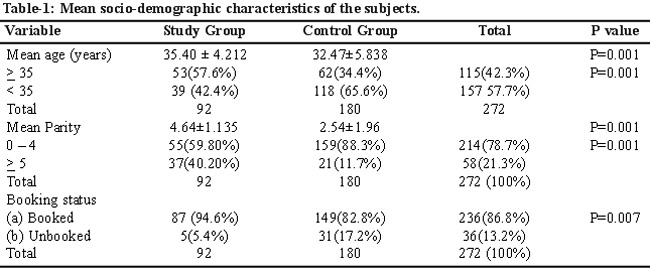
The mean number of caesarean sections in the Study and Control groups were 4.35 60 and 1.77 0.93 (P= 0.001) respectively. In the Study Group, 67 (72.8%) had elective caesarean section compared with 72 (40%) among the controls. Emergency caesarean section formed the bulk of the procedure in the controls (n=108; 60%).
The status of the surgeons who operated on the Study Group was: consultants 30 (32.6%), and senior registrars 62 (67.4%). For the controls, the status of the surgeons was: consultants 40 (22.2%), senior registrars 120 (66.7%), and 20 (11.1%) junior residents.
Spinal anaesthesia was administered to 41 (44.6%) in the Study Group and 41 (22.8%) in the Control Group. The rest were given general anaesthesia.
In the Study Group, the commonest indication was repeat section 91 (98%), as was the case in the Controls, (n=57; 31.7%) (Table-2).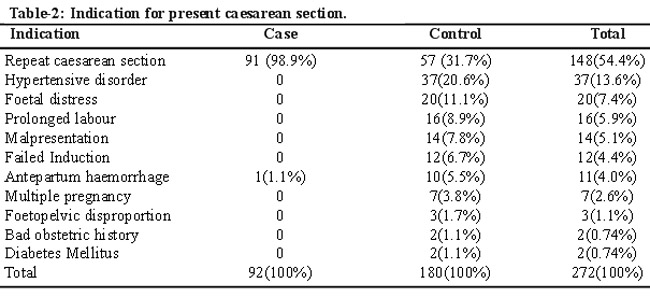
The mean pre-operative and post-operative haemoglobin along with the mean blood loss, mean operation time and mean hospital stay of both groups is shown in Table-3.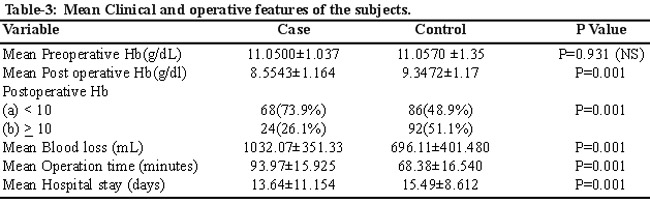
Majority of the patients in the Study Group (n=42; 45.7%) had moderate to severe adhesion compared to 25 (13.9%) in the controls. Only 2 (2.2%) of the cases had no adhesion as against 118 (65.6%) in the controls.
There was no difference in the incidence of hysterectomy in the two groups: cases, 3 (3.3%); controls, 3 (1.7%) (P= 0.410). However, greater number of women accepted bilateral tubal sterilisation in the Study Group, 16 (17.4%) than the controls, 3 (1.7%). There was no maternal death in either group.
The mean 5th minute APGAR score was 9.07 2.03 in the Study Group, and 7.73 2.96 (p= 0.001) in the Control Group. The infants of the study and control groups had mean birth weights (kilograms) of 3.38 0.48 and 2.87 0.86 (p= 0.001) respectively.
Three (3.3%) women delivered stillbirth in the Study Group against 7 (4.4%) in the Control Group.
Discussion
The Nigerian Demographic Health Survey8 shows that fertility in Nigeria has remained at a high level over the last several years from 5.9 births per woman in 1991 to 5.7 births in 2008. This cultural desire for a large family size was also noticed among the study group in this review where despite the risks associated with multiple caesarean section[5,6] majority of the women (40%) had five or more children and the mean parity was 4.46±1.14. The study showed that only a small proportion of women (1.1%) had no children. The concept of large family size persists, and coupled with the low contraceptive use in Nigeria,9 the phenomenon of four or higher order caesarean section is likely to persist. This calls for proper public awareness and counselling of women undergoing higher order caesarean section on the likely risks involved so that they may be able to make an informed choice.
The commonest indication for current caesarean section in both the Study and Control groups was repeat caesarean section. This has been partly attributed to the policy of elective caesarean section after two or more previous sections.10 A review of vaginal delivery after two or more previous caesarean in Zaria, Nigeria,11 showed that the risk of fatal outcome related to labour in patients with multiple caesarean sections was low and could be eliminated by careful patient selection and close intrapartum care. A positive review of policy towards a trial of vaginal delivery in multiple caesarean section was, therefore, advocated in view of advances in patient management in contemporary obstetrical care. Availability of equipment for intrapartum monitoring during labour in patients with primary caesarean section will reduce the apprehension with which such labour are monitored.
There was no maternal death in this review. This is contrary to a previous report12 from this centre which showed that a woman undergoing the fourth or higher number repeat caesarean section in Nigeria is 4 times more likely to die than one undergoing the first or second section. Most of the deaths in that review were related to anaesthesia complications. General anesthesia was used in 98.3% of the \\\'cases\\\' and 97.6% of the \\\'controls\\\'. In this review, 44.6% of the \\\'cases\\\' and 22.8% of the \\\'controls\\\' were administered regional anaesthesia, thus reducing the risk of death from wrongful intubation. In this centre, there is currently a shift from general to regional anaesthesia since a few years ago. At the time of this writeup, however, general anaesthesia was used. It was also possible that more senior anaesthetists were involved in the operations. The cadre of the surgeons may have been contributory as most of the operations were done by experienced obstetricians.
Intraperitoneal adhesions increased as the number of caesarean sections rose. This agreed with other reports.5,6,12,13 In this review, 45.7% had massive adhesions in the Study group as against 13.9% in the Control. Such adhesions lead to difficulty in separating the lower segment and corresponding increase in operation time and blood loss with consequent postpartum anaemia and blood transfusion which were also observed in this review. This points to the need for effective adhesion prevention measures and efficient blood banking system.
Majority of the women in both groups stayed more than 7 days in the hospital. This is contrary to earlier observations.14 The reason for prolonged hospital may not be far from the increased morbidity that is associated with caesarean section. A woman with post-operative anaemia and those with low birthweight babies or who had hypertensive disorders are likely to stay longer in the hospital. Poverty and high hospital bills may be the other reasons. Currently, the protocol in the obstetric unit of the hospital is to keep normal patients without complications for seven days after caesarean section. However, when they develop complications they stay longer because they come from distant rural areas. When they are discharged earlier, they are lost to follow-up.
The infants of the Study group had better APGAR scores, higher mean birthweight and lower stillbirth rates than the Controls. This may be attributed to the greater number of women in the Study group who were booked (94.6%) and had elective procedures (72.8%) under regional anaesthesia (44.6%). In contrast, many women had hypertensive disorders (20.6%), were unbooked (17.2%) and had emergency (60.0%) procedures under general anaesthesia. The contributions of unbooked mothers to increased perinatal and maternal morbidity and mortality has been expressed in several reports.15,16 In addition, the respiratory depressant effect of general anaesthesia may have worsened the condition of the already asphyxiated babies in the unbooked mothers.
Conclusion
Every effort to reduce primary and repeat caesarean section rates should be encouraged as this will reduce the higher order caesarean section rate. These include adequate training of medical workers to undertake procedures like instrumental deliveries and trial of vaginal birth after caesarean section (VBAC) in all patients with lower-segment scars. Adequate adhesion preventive techniques such as securing effective haemostasis during caesarean section should be encouraged, and improved training in anaesthesia will enhance the utilisation of regional anaesthesia since this has better foetal and maternal outcomes. Women should be counselled about the risks involved in multiple caesarean section and high parity, and urged to embrace modern contraceptive techniques.
References
1. Fenton P M, Whitty CJM, Reynolds F. Caesarean section in Malawian; Prospective study of early maternal and perinantal mortality. Brit Med J 2003; 327: 587-98.
2. Ezechi CO, Fasubaa OB, Kalu B., Nwokoro C, Obiesie LO Caesarean delivery: Why the aversion? Trop J Obstet Gynaecol 2004; 21: 164-7.
3. Chukudebelu WO, Preventing maternal mortality in developing countries In: Okofua F., Odunsi K. (eds) Contemporary Obstetrics and Gynaecology for Developing Countries. Benin. Women\\\'s Health and Action Research Centre 2003; 644-57.
4. Onah HE. Formal education does not improve the acceptance of caesarean section among pregnant Nigeria women. Int J Gynaecol Obstet 2002; 76: 321-33.
5. Makoha FW, Felimban HM, Fathuddien MA, Roomi F, Ghobra T. Multiple caesarean section morbidity. Int Gynaecol Obstet 2004; 87: 227-32.
6. Khashoggi TY: Higher order multiple repeat caesarean section: maternal and fetal outcome. Ann Saudi Med 2003; 23: 278-82.
7. Kirkinen P. Multiple caesarean sections: Outcomes and complications. Brit J Obstet Gynaecol 2005; 95: 778-82.
8. National Population Commission, ORC Macro. MEASURE DHS +. Nigeria Demographic and Health Survey 2003. Abuja Nigeria. National Population Commission 2003.
9. Okunola MA, Oyugbo IA, Owonikoko KM. Knowledge, attitude and concerns about voluntary surgical contraception among healthcare workers in Ibadan, Nigeria. J Obstet Gynaecol 2007; 27: 608-11.
10. Okafor U, Onwusulu DN. Rising caesarean section rates: Any hope for decline? The NAUTH Nnewi experience. Nig Med J 2006; 47: 38-40.
11. Emembolu JO Vaginal delivery after two or more previous caesarean sections: is trial of labour contraindicated? J Obstet Gynaecol 1998; 18: 20-4.
12. Onah HE, Eze J.N. Risks associated with four and higher order caesarean sections in Nigerians. Trop J Obstet Gynaecol 2000; 17: 14-7.
13. Msenblat V, Barak S. Griness OB. Maternal complications associated with multiple caesarean deliveries. Obstet Gynecol 2006; 108: 21-6.
14. Rashid M, Rashid RS. Higher order repeat caesarean section. How safe are 5 or more? Brit J Obstet Gynaecol 2001; 111: 1090-4.
15. Aisien AO, Lawson JO, Adebayo AA. A five year appraisal of caesarean section in a northern Nigeria University Teaching Hospital. Niger Postgrad Med J 2002; 9: 146-50.
16. Igberase GO, Ebeigbe PN, Andrew BO. High caesarean section rate: a ten year experience in a tertiary hospital in Niger Delta, Nigeria. Nig J Clin Pract 2009; 12: 294-7.
Journal of the Pakistan Medical Association has agreed to receive and publish manuscripts in accordance with the principles of the following committees:


