

Zeba Hasan Hafeez ( Department of Dennatology, Dow Medical College and Civil Hospital, Karachi. )
January 1998, Volume 48, Issue 1
Original Article

Abstract
Peniphigus has an average age of onset in the fifth and sixth decades of life, with a mean age of onset of about 50 to 60 years. In this study of 108 patients conducted in Karachi, Pakistan, 82 had pemphigus vulgaris, 24 pemphigus foliaceus and 2 pemphigus vegetans. Other types of pemphigus were not seen. Seventy cases were under 41 years with the mean age at the time of diagnosis being 33.8 years, which is considerably low compared to that mentioned in standard western literature. Considerable variation in the age incidence of the disease exists in different geographic locations (JPMA 48:9, 1998).
Introduction
Pemphigus is a chronic atutoimmune, blistering disease of middle age, commonly occunng between the fourth and sixthorfifth and sixth decades as mentioned in standard works of Dermatology1-3. It has a mean age of onsetof about 50 to 60 years but the disease can occur in the elderly and children4. Children as young as three years5 and adults upto the age of 89 have been reported to have pemphigus6. In a review published in 1979, it was mentioned that nine cases of pemphigus vulgaris in childhood have been reported since 19553. Childhood pemphigus foliaceus resembling either impetigo or seborrhoeic dermatitis has also been described7. In this study, two patients had disease onset in theirfirst decade. A threeyear old boy had pemphigus foliaceus and a ten year old girl had pemphigus vulgans.
Materials and Methods
One hundred eight patients admitted in Civil Hospital, Institute of Skin Diseases and Jinnah Post-Graduate Medical Centre (JPMC), Karachi from 1992 to 1996 were examined, except for two cases which were seen at JPMC in 1987. The diagnosis was based on clinical features, Tznack test and skin biopsy as Immunofluorescence ,an expensive investigation is not routinely available. All these patients were treated with systemic corticosteroids for the control of their disease.
Additional immunosuppressives e.g., Azathiopnne were required in some cases.
Results
This is indicated in Table and Figure.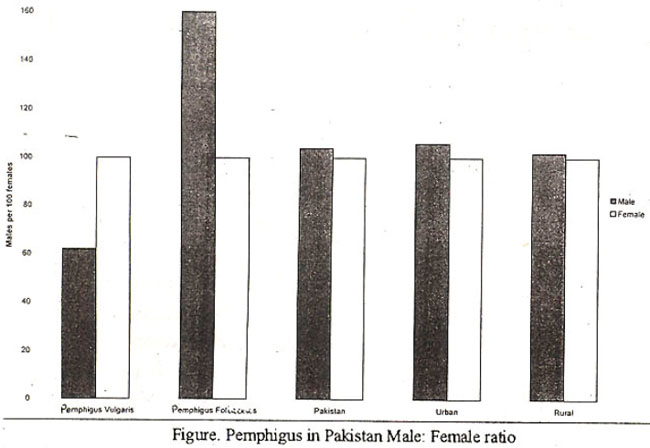
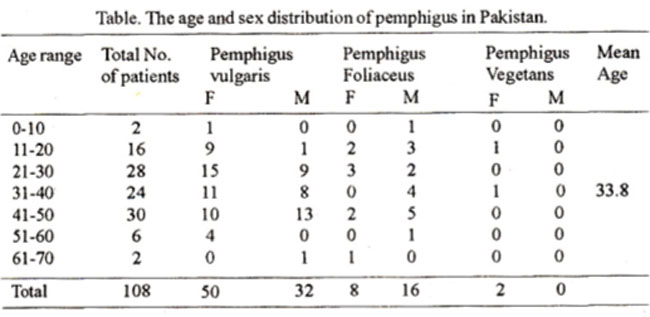
The mean age of pemphigus was 33.8 years. The youngest patient was a three year old male with pemphigus foliaceus and the oldest was a 63 year old male having pemphigus vulgaris. For pemphigus vulgaris, the meanage infemales was 32.88 years±12.26(SD) and in males 37.56 years±l0.74 (SD) whereas, in pemphigus foliaceus the mean age for females was 31.75 years±16.92 (SD) and for males 33.31 years±15.05 (SD). Other types of pemphigus were not seen. The male to female ratio of pemphigus vulgaris was 1:1.56 and that of pemphigus foliaceus 1:0.5. P values less than 0.05, were significant.
Discussion
Pemphigus has a worldwide distribution. Its prevalence is high in Jews particularly Ashkenazy Jews8, as reported from America and Russia, but itis also found in other ethnic groups, e.g., of Mediterranean and Indian origin2. The incidence of pemphigusvariesfrom0.5 to 3.2 casesper 100,000 population year6. It affects both sexes equally, although under the age of 20. there is a predilection for females8. However, in a report from Australia, of 73 patients having pemphigus vulgaris, it was found that the frequency of pemphigus was higher in women, peaking in the sixth decade9. In this study also (Table), there were more females (50) having pemphigus vulgaris and fewer males (32); however, the maximum number of cases were seen in the age group of 21 to 30 years. There was a preponderance of pemphigus foliaceus under the age of2l in males. The distribution of pemphigus was equal in both sexes between 0 to 10 years, 21 to 30 years and 61 to 70 years. Inanothersurvey of 110 cases in Italy, the medianageat diagnosis was 54 years and the male to female ratio was 0.710. In an epidemiological study of patients treated in a Finnish hospital between 1969 and 1978, the mean age of onset was found to be 57.5 years and the male to female ratio was 0.9:1.00. The number of patients having pemphigus vulgaris and foliaceus were equal11, ma previous comparative study of disease characteristics conducted in New Delhi, India and Oxford, UK it was found that in New Delhi pemphigus vulgaris predominated, but in Oxford pemphigus vulgaris and foliaceus had equal prevalence. The age of onset of the disease was considerably lower in New Delhi12. In the HLA typing of the two populations no differences were found in the class 1 antigens, yet the genetic predisposition was the same12. The mean age of onset of pemphigus reported herein was 33.8 years and the male to female ratio (in all types) was 1:1.25. HLA typing was not routinely possible on economic grounds. Recently, in a comparative study of pemphigus in Tunisia and France, it was observed that in France pemphigus vulgaris accounted for 73% of all cases, incidence increased with age and the male to female ratio was 1:1.2. However, in Tunisia pemphigus foliaceus was more frequent (6 1%) in females, the male to female ratio was 1:4.1. Women between 25-34 were more frequently affected13. It has also been suggested that an endemic form of pemphigus foliaceus restricted to women exists in Tunisia (and possibly all of North Africa)14. In these statistics (Table) more males had pemphigus foliaceus, the male to female ratio being 1:0.5 and the incidence was maximum between the ages of 41 - 50 years. In a previous review of 234 cases of pemphigus in North America, it was observed that the frequency was 5.5 times higher in young females (under 20) than males. The sex incidence was equal after the second decade, whereas 80% of cases were between 31 and 70 years15. Table in this series shows a predominance of females upto the age of3O, peaking between 11 and 20 years in which females were three times more affected than males. The above comparisons indicate a considerable variation in the age distribution of pemphigus in different geographic locations. There are a few questions which arise from the results of this study. Is the early onset of pemphigus related to the low life expectancy in Pakistan? (Mean age males: 60.8, females: 60.6 years, 1994). Are the weather conditions such as heat, sunlight and humidity significant factors in the pathogenesis of this disease? These queries could be answered by more studies and research in this field.
References
1. Mosehella, S.L. Dermatology. Eds. Mosehella, S.L., Phillsbury, D.M. and Harley, H.J.. London, WE. Saunders Co., 1975, p.460.
2. Tappeiner. G.W. Dermatology. Eds. Orkin, M., Maibach, HI. and DahI, M.V. 1st ed., Connecticut, Prentice-Hall International Inc., 1991, p. 487.
3. Arnold, H.L Odom, RB. and James, W.D. Andrew’s Diseases of the Skin. 8th ed.,London, Saunders WE. Co., 1990, p. 535.
4. Stanley, JR. Dermatology In General Medicine, Eda. Fitzpatrick. TB., Eisen, AZ., Wolff, K. et al. 4th ed. New York, McGraw - Hill Inc., 1993, p. 606.
5. Berger, B.W., Msier, H. S.. Ksntor, I. et al. Pemphigus vulgsris in a 3-1/2 year old boy. Arch, Dermstol., 1973:107:433-434.
6. Korman,N.J. Pemphigus, Dermstologie Clinics. Immunodermatology. Eds. Sauder, D.N. Vol. 8, No.4, London, Ssuder WE. Co., 1990,p. 689.
7. Jones, S.K., Schwab, H.P and Norris, D.A. Childhood pemphigus foliseeus ease report and review of the literature. Pedistr. Dermatol., 1986;3 459-63.
8. Pye, R.J. Textbook of Dermatology. Eds. Champion, RH., Burton, J.L., Ebling, F.J. G. et al. 4th ed., London, Blaekwell Scientific Publications, 1992, p. 1638.
9. Kyriskis, K., Toses, A., Lehou, J et a1. A five year retrospective study on pemphigus and pemphigoid Austrslss.J. Dermatol., 1989;30:33-6.
10. Naldi, L., Bertoni, M. and Csinelli, T. Feasibility of a registry ofpemphigus in Italy: Two years experience. Int. J. Dermstol., 1993;32:424-7.
11. Hietanen, J. and SaIo, OP. Pemphigus. An epidemiologieal study of patients treated in Finnish Hospitals between 1969 and 1978. Acts. Derm. Venereol., I 982;62:491 -6.
12. Wilson, C., Wojnsrowsks, F., Mehra, N.K. et al. Pemphigus in Oxford, UK and New Delhi; India: A comparative study of disease characteristics and HLA antigens. Dermatology, 1994; 189 (Suppl I ): 108-10.
13. Bastuji, G.S., Souissi, R., Blum, L. et aI. Comparative epidemiology of pemphigus in Tunisia and France. Unusual incidence ofpemphigusfoliaeeus in young Tunisian women. J. Invest. Dermatol., 1995;104:302-5.
14. Morini, JR. Jomsa, B., Gorgi, Y. etal. Pemphigus folisceus in young women. An endemic focus in the Sousse area ofTunisia. Arch. Dermatol., 1993; 129:6973.
15. Butner, E.H. and Chorzelski, T.P. Studies on etiologie factors in pemphigus. J. Cutsn. Pathol., 1976;3:67-74.
Journal of the Pakistan Medical Association has agreed to receive and publish manuscripts in accordance with the principles of the following committees:


