

Saleema Hashwani ( The Aga Khan University, School of Nursing, Stadium Road, Karachi. )
Tasnim Hiran ( 44 Festival Drive, Toronto, Ontario, M2R 3VI Canada. )
Musarat Fatima ( C/o Kalsoom Nawaz Maternity Dome, Jamil Colony P.O. Badin - 72010, Sindh. )
July 1999, Volume 49, Issue 7
Original Article

Abstract
Introduction: Sexually Transmitted Dieseases (STDs) are a major public health problem in developing countries (Adler, 1996). The purpose of this study was to asses women’s knowledge level about STDs.
Methdology: A cross sectional survey was done and data collected through a semi-structured interview. A convenient sample of 30 sexually active females between the ages of 15 - 45 years from an urban community in Karachi was selected for the study.
Results: The survey findings showed that 30% of the women reported that they had adequate knowledge and 20% partial knowledge. Thus almost three-quarters of the respondents indicated either inadequacy or lack of knowledge about STDs.
Conclusion: Our results establish a need for STD clinics at Community-based Primary Health Care (PHC) Centers. These clinics need to address screening, treatment and health education issues in relation to STDs for the target population (JPMA 49: 161, 1999).
Introduction
Sexually Transmitted Diseases (STDs, are the most common communicable diseases with the incidence having risen over the past two decades, despite the improved methods of diagnosis and treatment1. STDs represent a major public health problem in the developing countries but the actual prevalence rate is hard to determine because of inadequate surveillance systems.
As literature reveals that most developing countries lack effective disease control programs and notification systems for STDs. The World Health Organization (WHO) has estimated the size of the problem at 333 million new STDs per year (this excludes genital papilloma virus, herpes and chancroid). Prevalence is especially high in South East Asia at 150 million new cases in 1995 and Sub-Saharan Africa at 65 million cases2.
This study was conducted to determine the knowledge level of the community regarding STDs. It was carried out in an urban community in Karachi where Baccalaureate of Nursing (BScN) students, from the Aga Khan University School of Nursing, acquired their clinical experience in Community Health Nursing. During family assessment and interactions, it was found that the community had certain social/health problems such as high divorce rate, prostitution, polygamy and problems related to fertility: The illliteracy rate was 92.6% and there was minimal awareness about Primary Health Care3. Based on the above findings, the authors found that there was hardly any awareness about and a high probability of STDs in the community. Moreover, the healthcare infrastructure was not adequately established in the area and therefore, it was not possible to find the existing casess of STDs or to conduct a study to determine prevelence rate of STDs in the area.
Studies have demonstrated that the endemicity of various STDs could be sustained by a relatively small group of population engaged in high-risk sexual practices such as polygamy, multiple sex partners, prostitution and unprotected sex4. The number of sex partners is an important behavioral risk factor since it increases the risk of contact with an infected partner.
Social and economic issues play a major part in the transmission of STDs, often women are so poor and disernpowered that they have sex on commercial basis against their will and are unable to effectively negotiate the use of condoms with their clients2.
Awareness about STDs is minimal in most of the developing countries and even in communities where STD clinics were present and the limited resources that were there, were challenged towardss treatment rather than health education programmes on the prevention of STDs.
Studies have shown that clients left STD clinics with unanswered questions about the prevention of STDs and were not able to recall what they had been told. Furthermore, studies done by O’Donnel showed that the level of education was a major predictor of knowledge and attitude about the use of condoms and had a marginal impact on risk perception5.
Over the last twenty years the focus of the prevention of STDs and its control has shifted from treatment and partner notification to health education. In most developing countries services for STDs are integrated with primary health care programmes and therefore. sophisticated diagnostic facilities are not available. This means that simple management protocols based on a problem-oriented approach are required6. Keeping this in view the objectives of the study were:
1. To ascertain the knowledge level about STDs in the selected sample in Rehri Goth.
2. To identify the specific health educational needs of the community and make appropriate recommendations to the primary Health Care (PHC) Center in the community.
Material and Method
The study design selected for research purpose was a descriptive cross sectional survey. The knowledge level about STDs was assessed in the target population of married females between the ages 15 - 45 from selected areas (sectors) in an urban community of Karachi (Rehri Goth) during the month of December, 1996 and in January, 1997. A convenient random sample size of thirty females was selected from a population of sixty (these were the families that we had interacted with and who had provided us with background information upon which our study question was based). For our study a modified questionnaire was formulated with reference to the Management Advanced Programme (MAP) Module User: Guide number 2 by Reynolds7. Majority of the questions were close ended to enable coding and computation of the data. Relevant demographic data was incorporated in the questionnaire and the questions were sequenced such that there was a flow from definition of the condition to the treatment options. These questions were then translated in Urdu / Sindhi languages to ensure the original concept was not lost or misrepresented.
This questionnaire was then verbally pilot tested in a Sindhi community for clarity. comprehensiveness and constraints of responses. According to the feedback certain questions were modified to increase clarity and comprehension. The final version was verbally administrated to the target population.
Prior to the administration of the questionnaire, the target population was given an explanation of the study, its purpose and aims and their verbal consent was obtained. Due to the sensitive nature of the subject matter under study, complete client confidentiality was maintained. Data was analyzed in EPI INFO package and frequencies and percentages were obtained.
Results
The sample population comprised of women with the age range of 15 to 45 years and the mean age was 23 years. Of the sample 87% of women were married (to single partners) and were housewives with illiteracy rate at 63.3%, 10% could read and write only, 16.7% had primary level education and 10% had secondary education.
After data collection, the questionnaire was analyzed and the responses were further separated into three categories.
The responses included in each category are given below:
1. Adequate knowledge: This included right responses to the questions and all correct answers chosen from questions with multiple correct answers.
2. Partial knowledge: For questions with multiple correct answers, only one correct answer was chosen.
3. No knowledge: This included incorrect answers, “no” responses and ‘don’t know” responses.
Cumulative percentages from three categories were obtained. Adequate knowledge level was 30%, partial knowledge level was 20% and no knowledge was at 50%. Moreover, the categories of responses in percentages are given in the table.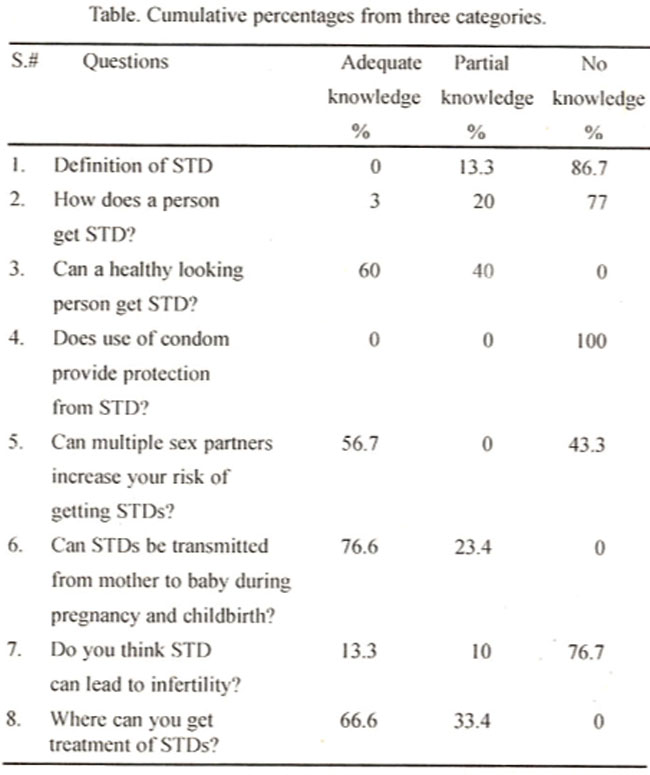
Discussion
Correct responses to questions were given mostly based on general knowledge about diseases rather than specific awareness about STDs. This could be seen from the fact that the question regarding the definition of STDs had an 86.7% “don’t know” response while other questions were answered correctly. The question regarding whether STDs could be transmitted to the baby during pregnancy and childbirth had 76.6% “correct” response. Upon further probing it was found that the high rate of correct response was due to the presence of general knowledge that diseases from mothers could be transmitted to babies. General knowledge also existed regarding health facilities for treatment of diseases. The question regarding whether a healthy looking person could be infected with STDs had a 60% “correct” response. But this answer was also found to be based on general knowledge as well.
Due to the small sample size and the fact that 63.3% of the sample was illiterate, a correlation between literacy and awareness about STDs was not obtained. It was noted that some indirect awareness of STDs was present due to media coverage about Acquired lmmuno-deficiency Diseases (AIDS) as the community related AIDS to STDs.
The question regarding whether people treated for STDs could get it again and its responses were not appropriately formatted and worded. Hence, respondents had difficulty in understanding and answering the question. Due to the sensitive nature of the topic, respondents were uncomfortable in answering certain questions, for example the question about whether use of condom provides protection from STDs. This was considered to be an issue pertaining to males and the females did not want to respond to it. Also, due to the sensitivity of the topic. questions were limited to the married females only.
Though the study results could not he generalized to the community, it could still he inferred that less knowledge about STDs even in a small number of people could lead to increased spread of STDs (if STDs were present in the fi,-st place). In cases where STDs are present, they are more likely to cause complications related to STDs due to lack of early detection and treatment secondary to knowledge deficiency about the symptoms of STDs.
The survey revealed that there was not sufficient knowledge about STDs among the selected sample of sexually active women between the ages of 1 5 - 45 in the selected community. Based upon the study the following recommendations are made:
• A large scale cross sectional study that addresses the Knowledge, Attitude and Practice (KAP) aspects in relation to STDs needs to be carried out.
• An analytical study to see the co-relation between education level and awareness of STDs is recommended.
• STDs clinics within the PHC centers should be established which would include screening, treatment and health education about STDs to both genders in a culturally appropriate context.
Acknowledgements
Upon completion of a study, it is difficult to list people who have played a significant role in making this study a success. First, special thanks to our Community members who were the target group of this study. We would like to acknowledge the guidance and support of administration and faculty members of the Aga Khan University School of Nursing.
Finally, we would like to thank Dr. Israr Ahmed and Mr. Iqbal Azam from the Community Health Sciences Department of the Aga Khan University without whose on going feedback and support the authors would have been unable to develop a better understanding of the need of this study.
References
1. Glanze D, Anderson N, Ander E. Moshy’s Medical Nursing and Allied Health Dictionary (3rd ed.), Delhi; Jaypee;1995.
2. Adler MW. Suxually transmitted diseases control in developing countries. Gcntiourin. Med., 1996;72:83-88.
3. Urban health care proposal report. Unpublished manuscript, Karachi, The Aga Khan University, Community Health Sciences Department, Karachi, 1996.
4. Sachs P, Beard R, Papiemik E, et al. Reproductive health care for women and babies: Policy and ethics. Oxford Pub., New York, 1995.
5. O’Donneli L, San Dovel A, Vornfett R, et al. STD prevention and the challenge of gender and cultural diversity: Knowledge, attitude, and risk behavior among black and hispanic inner-city STD clinic patients. J.Sex. Transmit. Dis.. 1994;21:137-48.
6. Catchpole MA. The role of epidemiology and surveillance system in the control of sexually transmitted diseases, Genetourin, Med.. 1996;72: 32 1-29.
7. Reynolds S. Assessing community health needs and coverage: Module 2, user’s guide. Washington, Aga Khan Foundation. 1993.
Journal of the Pakistan Medical Association has agreed to receive and publish manuscripts in accordance with the principles of the following committees:


