

Riaz-ur-Rehman ( Department of Neurosurgery, Hayatabad Medical Complex, Peshawar. )
Azmatullah ( Department of Neurosurgery, Hayatabad Medical Complex, Peshawar. )
Farooq Azam ( Department of Neurosurgery, Hayatabad Medical Complex, Peshawar. )
Mushtaq ( Department of Neurosurgery, Hayatabad Medical Complex, Peshawar. )
Mewat Shah ( Department of Neurosurgery, Hayatabad Medical Complex, Peshawar. )
October 2011, Volume 61, Issue 10
Original Article

Abstract
Objective: To assess the effectiveness of transpedicular screw fixation in neurological recovery and pain control in thoracolumbar junction injuries.
Method: This audit was carried out in the Neurosurgery Department of Postgraduate Medical Institute, Hayatabad Medical Complex Peshawar from November 2008 to April 2010. Written informed consent was taken from all patients. Detail history, clinical examination, x-ray dorsolumbar spine (or CT scan dorsolumbar spine) and MRI dorsolumbar spine were done in all cases. Neurological status was assessed using the Frankel grading for spinal cord injury. Post traumatic unstable thoracolumbar junction fractures were included in this study. Open fractures, fractures with significant kyphotic deformity, fractures with anterior retropulsed fragments, multiple level fractures requiring long segment fixation, pedicles fractures and pathological fractures were excluded from study.
The short-segment transpedicular fixation was performed in all patients. Effect of transpedicular screw fixation on pain relief was measured by improvement in Dennis pain scale. History of pain relief and neurological assessments of patients were done on each follow up visit. The data was analyzed in SPSS 16.0.
Results: Transpedicular screw fixation was performed in 80 patients including 55 males and 25 females. Mean age was 35±6.75 years (range 15-61 years). The level of injuries were D11=6(7%) cases, D12 =13(16%) cases, L1=40(50%) cases, L2=15(19%) cases, D12 & L1=6(8%) cases. There were 43(54%) Wedge fractures, 9(11%) fracture subluxations, burst fracture in 14(17%), translational injuries in 8 (10%) while distraction injuries in 6(8%) cases.
Pre operative neurological status according to Frankel grading was: grade A, 48(60%) cases, grade B 12(15%) cases, grade C 6(7%) cases, grade D 4(5%) cases and grade E 10(13%) cases. Six months post operatively, there were 16(20%) cases in grade A, grade B 34(42.5%) cases, grade C 16(20%) cases, grade D 4(5%) cases and grade E 10(12.5%) cases. Pain control was assessed by improvement in Dennis pain scale. Pre operatively there was no patient in P1, 4(5%) patients in P2, 16(20%) in P3, 24 (30%) in P4 and 36(45%) in P5.Six months later there were 56(70%) patients in P1,16 (20%)in P2,4(5%) in P3 and 4(5%) patients in P4.There was no patient in P5 .
Conclusion: Thoracolumbar junction injuries are common in young male patients. Transpedicular screw fixation is useful choice for achieving better neurological recovery and good pain control in traumatic thoracolumbar fractures.
Keywords: Unstable thoracolumbar junction fractures, Transpedicular screw fixation, Neurological improvement, Pain control (JPMA 61:1005; 2011).
Introduction
The primary objectives of the treatment of unstable thoracolumbar fractures is optimizing neural decompression, early stability, pain relief and good nursing care.1,2 The optimum treatment of unstable fractures and fracture dislocations of thoracolumbar spine remains controversial.3 There are different types of management of spinal injuries including operative and non-operative techniques.4 Non-operative treatment can be employed in patients with less vertebral body compression using thoracolumbar orthosis and restriction of activities.5 Either anterior, posterior or both approaches can be used to achieve fusion.6,7 However, posterior approach is less extensive.8 Pedicle screw fixation is safe procedure, which achieves reduction and stability and provides early pain relief and mobility.9,10
The aim of this study was to know the functional outcome of transpedicular screw fixation in unstable thoracolumbar junction fractures in terms of neurological recovery and pain relief.
Material and Methods
This descriptive study was carried out in Neurosurgery Department of Postgraduate Medical Institute, Hayatabad Medical Complex Peshawar from November 2008 to April 2010. Written informed consent was taken from all patients. Detail history, clinical examination, x-ray dorsolumbar spine (or CT scan dorsolumbar spine) and MRI dorsolumbar spine were done in all cases. Neurological status was assessed using the Frankel grading for spinal cord injury. Fractures were classified according to Denis10 (3-column classification). Involvement of 2 or more columns was defined as unstable fractures.
Post traumatic unstable thoracolumbar junction fractures were included in this study. Open fractures, fractures with significant kyphotic deformity, fractures with anterior retropulsed fragments, multiple level fractures requiring long segment fixation, pedicles fractures and pathological fractures were excluded from the study.
Mcafee\\\'s classification of thoracolumbar injuries were used and fractures divided into wedge fractures, burst fractures, fractures subluxation, translational injuries and distraction injuries.
The short-segment transpedicular fixation was performed in all patients. All the patients were given prophylactic antibiotics preoperatively and post operatively.
The neurological status of the study patients was documented at the time of admission and on the day of discharge and subsequent follow up visits. Outcome was assessed on Frankel grading system11 as follows.
Grade Description
A: Complete (no sensory or motor function is preserved)
B: Incomplete (Sensory, but no motor function is preserved below the neurological)
C: Incomplete (Motor function is preserved below the neurological level, and the majority of key muscles below the neurological level have a muscle power grade of <3)
D: Incomplete (Motor function is preserved below the neurological level, and the majority of key muscles below the neurological level have a muscle power grade of > 3)
E: Normal (sensory & motor function is normal)
Severity of pain was measured pre operatively at the time of admission using Dennis pain scale12 as under.
P1: No pain
P2: Occasional minimal pain; no need for medication
P3: Moderate pain, occasionally medications; no interruption of work or activities of daily living
P4: Moderate to severe pain, occasionally absent from work; significant changes in activities of daily living
P5: Constant, severe pain; chronic pain medications
Effect of transpedicular screw fixation on pain relief was measured by improvement in Dennis pain scale. All the patients were advised to come to Neurosurgery OPD for follow up visits after one month, 3 months and six months. History of pain relief and clinical examination i.e. neurological assessment of patients were done on every visit. All above preoperative and postoperative data was entered in a semi structured proforma and analyzed by SPSS version 16.
Results
Fixation was performed in 80 patients including 55 males and 25 females with male to female ratio of 2.2:1. Mean age was 35±6.75 years (range15-61years). The level of injuries were D11=6 (7%) cases, D12 =13(16%) cases, L1=40 (50%) cases, L2=15(19%) cases, D12 and L1=6(8%) cases. The types of thoracolumbar fractures are shown in Figure-1.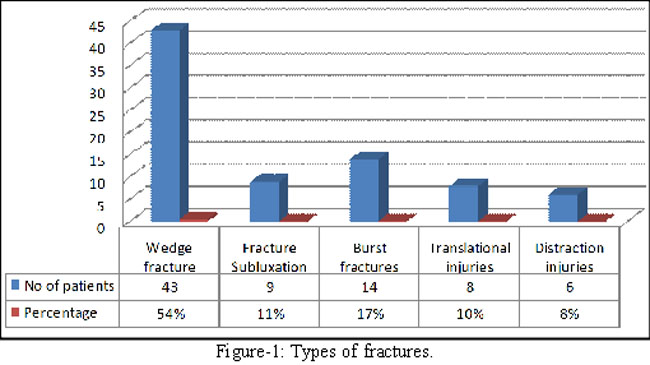
Majority of patients, 48 (60%) in the pre-operative period were in Grade-A. This reduced to 16 (20%) patients after 6 months (p < 0.005). The neurological status of the patients according to the Frankel Grade is given in Table-1.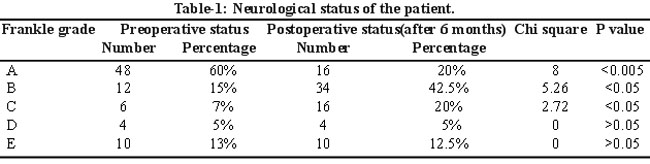
Improvement in pain was assessed with Dennis pain scale. Pre operative and post operative pain levels of patients are listed in Table-2.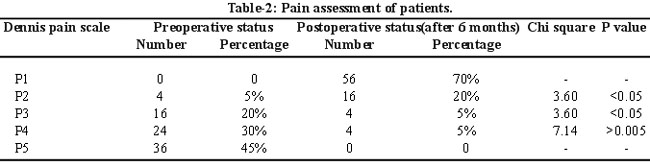
There were 6 patients (7.5%) with wound infection. Four of these six patients had superficial surgical site infections and they were treated with debridement and antibiotics. The remaining two had deep infections and implants were removed from these patients. Pull out of rods from screw was seen in two patients (2.50%) (Figure-2).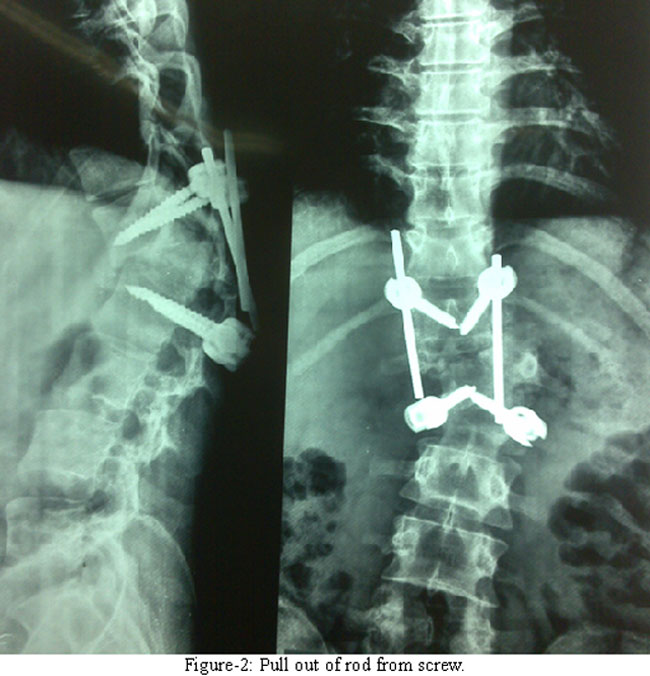
One patient developed Deep Vein Thrombosis and one (1.25%) had depression.
Discussion
Surgical intervention in thoracolumbar unstable fractures is advocated for decompression of neural elements, prevention of possible late neurological injuries in unstable fractures and early mobilization to avoid the complications of prolonged bed rest.13-15
Anterior, posterior and combined anterior and posterior approaches are available for thoracolumbar factures.15
Anterior surgery is good for correction of kyphotic deformity and in patients with anterior cord compressions such as due to retropulsed bone fragments in unstable burst fractures, or fractured endplates or discs.15 However these patients were excluded from this study and hence not being mentioned here.
Various methods of posterior fixation e.g. hooks and Harrington rods have evolved over the past few decades. However, pedicle screw instrumentation has revolutionized spine surgery.16 Short segment instrumentation has the benefit of incorporating fewer motion segments and biomechanical studies have shown that transpedicular screws are more rigid than posterior distraction instrumentations like Harrington rods.15
A comparative study was conducted by Sasso et al ,analyzing Harrington rods, hooks, Luque rods, sub laminar wires and pedicle screws which revealed that pedicle screw fixation was the posterior fixation that could be applied to shorter segments than could other posterior fixation tools.17 This is because pedicle screw fixation achieves reduction and stability in both anterior and posterior column injuries, does not require anterior decompression and does not affect extra motion segments.18 For this reason transpedicular screw fixation has been done in our patients of unstable thoracolumbar junction injuries.
Males were more than double of females in this study. This is because of the fact that males are mainly constituting the working population in our society. So they are more prone to trauma than females. Similar findings were noted in previous studies19 as well.
We can see from the study results that young people are mostly affected because they are involved in labourious works and are more prone to injuries. Same trend can be seen in studies conducted in other parts of the country.9
L1 vertebra was affected in half of our patients. These findings are in accordance with other study results. This is because load transmission from higher rigid dorsal vertebrae to flexible lumbar vertebrae occurs at this point.
Wedge fracture followed by burst fractures were common types of spinal fractures observed in the present study. Arif M et al showed wedge and burst fractures in 73.68% and 15.78 % patients respectively.20
Various studies showed different results regarding neurological improvement after spinal fixation. In the present study, neurological improvement was seen in several patients. There were only 48 patients in Frankel grade A whereas at 6 months follow-up, there were only 16 patients in Frankel grade A. Many other national9,10,18 and international studies21 proved the benefits of spinal fixation regarding improvement in neurology status. Additional benefit with surgery in patients other than Frankel grade A is that decompressive laminectomy can also be performed which releases pressure on spinal cord and increases chances of neurological recovery.
Helton et al22 in his study found that 44% patients had no pain and 17% had moderate to severe pain according to Denis pain scale two years after surgery while in another study,20 57.9% patients had no pain one year after surgery, 2.6% had moderate to severe pain, with occasional loss of work days and significant changes in daily activities. In the present study, follow up time was 6 months and is significant pain control after surgery was noted. Seventy percent patients were completely pain free (P1), 6 months after surgery and no patient was in P5 (chronic pain medication) after 6 months follow up.
In our study, infection was the most common complication which was observed in 6(7.5%) patients while in other local studies 10.5% infection rate has been seen.20 Pull out of rods from screw was seen in 3.75% in the present study. This is higher than the results of Arif et al.20 This could be due to the use of short segment fixation instead of long segment fixation in our study.
This study is confined to limited number of patients with a short follow up period. Neurological assessments were done by different doctors and we had to rely on their assessment. Similarly the operations have been performed by different surgeons. Randomized clinical trials are needed to provide evidence based findings.
Conclusion
Thoracolumbar junction injuries are common in young and male patients. Transpedicular screw fixation is a useful choice for achieving better neurological recovery and good pain control in post traumatic thoracolumbar fractures.
References
1.Sasso RC, Renkens K, Hanson D, Reilly T, McGuire RA Jr,Best NM. Unstable thoracolumbar burst fractures: anterior-only versus short-segment posterior fixation. J Spinal Disord Tech 2006; 19: 242-8.
2.Verloan JJ, Diekerhof CH, Dhert WJ, et al. Surgical treatment of traumatic fractures of thoracic and lumber spines. Spine 2004; 29: 803-14.
3.Yue JJ, Sossan A, Selgrath C, Deutsch LS, Wilkens K, Testaiuti M, et al. The treatment of unstable thoracic spine fractures with transpedicular screw instrumentation: a 3-year consecutive series. Spine 2002; 27: 2782-7.
4.Berry GE, Adams S, Harris MB. Are plane radiographs of spine necessary after blunt trauma?Accuracy of screening torso computer tomography in thoracolumbar spine fracture diagnosis. J Trauma 2005; 59: 1410-3.
5.Karaikovic EE, Pacheco HO. Treatment options for thoracolumbar spinefractures. Bosn J Basic Med Sci 2005; 5: 20-6.
6.Danisa OA, Shaffrey CI, Jane JA, Whitehill R, Wang GJ, Szabo TA, et al. Surgical approaches for the correction of unstable thoracolumbar burst fractures: a retrospective analysis of treatment outcomes. J Neurosurg 1995; 83: 977-83.
7.Sar C, Bilen FE. Flexion was more painful than extension.Thoracolumbar flexion-distraction injuries combined with vertebral body fractures. Am J Orthop 2002; 31: 147-51.
8.Wesley AC, William TH. Injuries to thoracic and lumbar spine.In: Wilkins RH, Rengachary SS, editors. Neurosurgery. 2nd ed.New York: McGraw-Hill, 1996; pp 2987-95.
9.Javed S, Mahmood A, Akram R, Ahmad MS, Aziz A. Functional outcome of transe pedicular screw fixation in patients with unstable Thoracolumbar junction injuries. JPOA 2010; 22: 7-13.
10.Khan AZ, Khanzada K, Ayub S, Ali M. Surgical outcome of transpedicular fixation in thoracolumber fractures. JAMC 2008; 20: 104-7.
11.Frankel HL, Hancock DO, Hyslop G, Melzak J, Michaelis LS, Ungar GH, Vernon JD, Walsh JJ. The value of postural reduction in the initial management of closed injuries of the spine with paraplegia and tetraplegia. I Paraplegia 1969; 7: 179-92.
12.Defino HL, Scarparo P. Fractures of thoracolumbar spine: monosegmental fixation. Injury 2005; 36(Suppl 2): B90-B97. doi: 10.1016/j.injury.2005.06.019.
13.Denis F, Armstrong GW, Searls K, Matta L. Acute thoracolumbar burst fractures in the absence of neurologic deficit. A comparison between operative and nonoperative treatment. Clin Orthop Relat Res 1984; 189: 142-9.
14.Gertzbein SD, Macmicheal D, Tile M. Harrington instrumentation as a method of fixation in fractures of the spine. J Bone Joint Surg Br 1982; 64: 526-9.
15.Rengachary SS, Ellenbogun RG. Principles of Neurosurgery. China: Elsevier Health Sciences; 2005.
16.Whang PG, Vaccaro AR. Spinal Pedicle Fixation Revisited:The Role of X-rays and Other Surgical Factors. Spine 2006; 31: 717-21.
17.Sasso RC, Costler HB: Posterior Instrumentation and fusion for unstable fractures and fracture-dislocations of the thoracic and lumbar spine. Spine 1993; 18: 450-60.
18.Khan I, Nadeem M, Rabbani ZH. Thoracolumbar junction injuries and their management with pedicle screws. JAMC 2007; 19: 7-10.
19.Khan AA, Khanzada K, Ayub S, Ali M. Surgical outcome of transpedicular fixation inthoracolumber fractures. JAMC 2008; 20: 104-7.
20.Arif M, Inam M, Satar A, Saeed M, Shabir M.Management of thoracolumbar spinal fractures by pedicular screws and rods. GJMS 2009; 7: 109-13.
21.Olumide AD, Christopher IS, John AJ. Surgical approaches forthe correction of unstable thoracolumbar burst fractures: a retrospective analysis of treatment outcomes. Neurosurg 1995; 83: 977-83.
22.Helton LA, Defino Fabiano RTC. Low thoracic and lumbar burst fractures: radiographic and functional outcomes Eur Spine J 2007; 16: 1934-43.
Journal of the Pakistan Medical Association has agreed to receive and publish manuscripts in accordance with the principles of the following committees:


