

Sharmeen H. Feerasta ( Final Year Medical Students, The Aga Khan University, Karachi. )
Arashk Motiei ( Final Year Medical Students, The Aga Khan University, Karachi. )
Shaheen Motiwala ( Final Year Medical Students, The Aga Khan University, Karachi. )
Nadeern F. Zuberi ( Department of Obstetrics and Gynaecology, The Aga Khan University, Karachi. )
April 2000, Volume 50, Issue 4
Student's Corner

Abstract
Objectives: To identify risk factors for uterine atony following assisted or unassisted vaginal delivery.
Design: This hospital based case control study was done at The Aga Khan University Karachi, Pakistan. Cases were defined as all women with uterine atonv within 24 hours of an assisted or unassisted vaginal delivery. Controls were based on women with normal assisted or unassisted vaginal delivery without uterine atonv. Data abstracted form the medical records; adjusted odds ratios were estimated by multiple logistic regression.
Results: Factors having a significant association with uterine atony were gestational diabetes mellitus (odds ratio 7.6, 95% Cl 6.9-9.0, p=0.003) and a prolonged second stage of labour in multiparas (odds ratio 4.0,95% Cl 3.1-5.0, p=0.002). No associations were found with high parity, age, preeclampsia , augmentation of labour, antenatal anemia and a history of poor maternal or perinatal outcomes.
Conclusions: Among previously documented risk factors for uterine atony, only a prolonged second stage of labour in multiparas was found to he significant in this study. Gestatiortal diabetes mellitus, a previously undocumented factoi; has also been identified as an independant risk factor Multiparity and age were not found to he significant risk factors. The study underlines the importance of confirming these findings for better prevention and management of uterine atony UPMA 50:132, 2000).
Introduction
In Pakistan, obstetric hemorrhage is the most common cause of maternal mortality, accounting for2l% of all maternal deaths as determined from hospital based data1. Postpartum hemorrhage (PPH). which complicates 4-8% of all deliveries in western studies, ranks high on the list of causes of maternal death2,3. While PPH in industrialized countries is more often due to obstetric interveiitions, such as induction of labor, epidural anesthesia and caesarian section, the leading causes of PPH in developing countries are uterine atony, retained placenta and genital tract injury4.
Uterine atoll)’ is the leading cause of PPH, accounting for up to 90% of all cases in developed countries3 and 18-30% of all cases in developing countries4. Knowledge of the factors predisposing to uterine atony has application at two levels-the antenatal period and the management of labor. in a country like Pakistan, where trained medical personnel do not supervise a majority of all births, an understanding of the risk factors can help in antenatal identification of women at a high risk for PPH due to uterine atony. These women can then be advised to deliver at centers which have appropriate facilities for careful management of labor and, should the need arise, for the treatment of PPH.
Predisposing factors for uterine atony include macrosomia3,6, multiple gestation2,3,6, polyhydramnios3, prolonged labor2-43-4, arrest of descent2, oxytocin use in labor7-17-1, uterine leiomyomas3 multiparity6,11 and pre-eclampsiayed by studies on the factors associated with uterine atonv. the relative importance of many of these is not clear. Tills, in addition to the reason stated above underlines tile importance of evaluating factors that may predispose to uterine atony in our setting. Therefore, the objective of this study was to determine the risk factors associated with uterine atony following vaginal deliver’ at Tile Aga Khan University Hospital.
Methods and Materials
A hospital-based case control study was carried out at the Aga Khan University Hospital. Cases consisted of all women with uterine atoll)’, occurring \\\\v ith ill twenty—four hours of assisted or unassisted vaginal delivery admitted to The Aga Khan University Hospital between January 1987 to December 1997. Controls consisted of women with assisted or unassisted vaginal delivery not complicated by uterine atony admitted to The Aga Khan University Hospital during the same time period.
Information was collected on socio-demographic factors, obstetric history, antenatal events, labour and delivery. The variables used are listed in appendix 1, which is a copy of the performa used to abstract data from tile medical records of the study population. Approximately 10% of the performas filled by one investigator were reviewed by the others. A high degree of agreement of abstraction was seen and this controlled for observer bias.
Induction of labor at AKUH is carried out by prostaglandin E2 with or without insertion of a Foley’s catheter if the Bishop’s score is less than 6 and by artificial rupture of membranes and Syntocinon (Oxvtocin) infusion if the Bishop’s score is more thaii 6. Labour is augmented in women with spontaneous rupture of membranes by infusing Syntocinon. All women are routinely given intravenous syntometrine (5 units of oxytocin and 0.4 mg ergometrine) after delivery of the anterior shoulder. An oxtytocin infusion is continued for about 6 hours in the post partum period.
For the purposes of this study. a duration of greater than 10 hours in primiparous women and 8 hours in multiparous women was considered to be a prolonged first stage12,13, a duration greater than 180 minutes in primiparous women or 30 minutes in multiparous women is categorized as a prolonged second 0stage12,13, whereas a prolonged third stage was defined as a duration greater than 30 minutes in either primiparous or multiparous women12,13.
Analysis
Using the Epi-Info software for statistical analysis, univariate analysis based on chi-square(X2) was carried out and risk factors for uterine atony were identified. These risk factors were then tested against each other for covariance. Finally, one of the covariant variables and other significant variables were selected for multiple logistic regression analysis using the SPSS software for statistical analysis. Marginally associated (.05
Results
Post partum uterine atony was identified in 112 vaginal deliveries between January 1987 and December 1997. These were compared with 220 controls. Comparing cases with controls, there were significant differences in clinically estimated blood loss (676+533 versus 209+73 ml).
On univariate analysis there were no significant differences between cases and controls in maternal age. height. weight or body mass index (Table 1);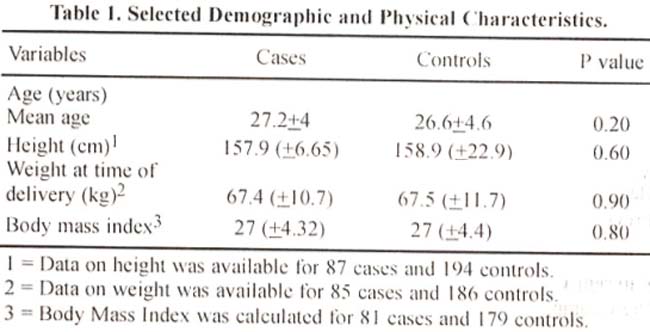
multiparity, poor obstetrics history, previous postpartum hemorrhage or previous cesarean section. Similarly there were no significant differences with pre-eclamptic toxemia, antenatal anemia or preterm labor; induced, augmented or spontaneous labor; artificial or spontaneous rupture of membranes.
Strong associations were found for Gestational diabetes mellitus, prolonged second stage of labor in mu Itiparas. instrumental deliveries and a birth weight greater than 3000 grams. A total duration of labor less than 3 hours was found to be protective (Tables 2 and 3).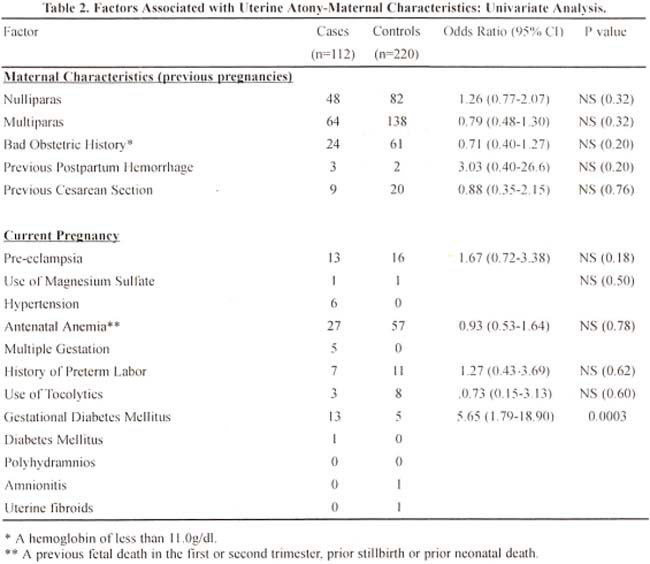
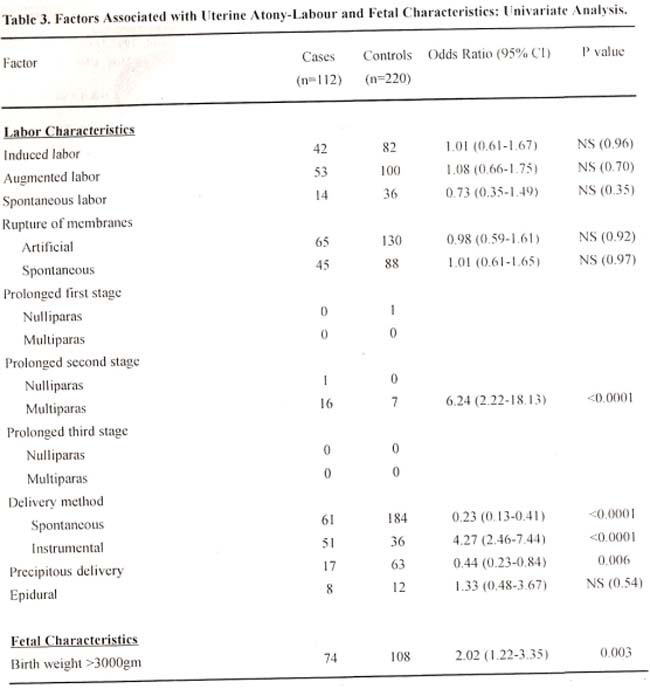
Chi-square analysis between risk factors showed covariance between a prolonged second stage of labor in multiparas. instrumental deliveries and a birth weight greater than 3000 grams. Similarly gestational diabetes mellitus and a birth weight greater than 3000 grams were found to be covariants. We used gestational diabetes mellitus and a prolonged second stage of labour in multiparas as predictors/covariates in a model for multiple logistic regression. On analysis, both gestational diabetes mellitus and a prolonged second stage of labour iii multiparas proved to he strong predictors for uterine atonv (Table 4).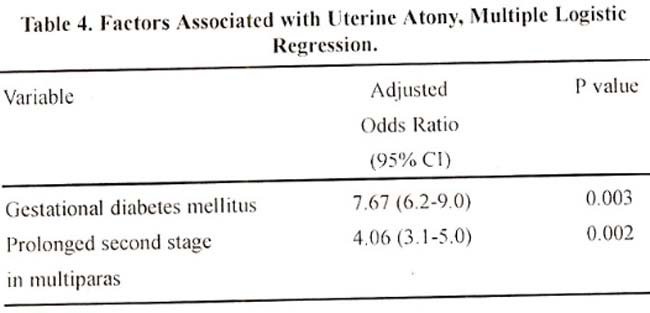
Other variables that were significant on univariate analysis did not have significant associations in the logistic regression model. Variables that were not significant but biologically important were also included, but failed to improve the model.
Discussion
It has been generally accepted that grand multiparity is an important risk factor PPH due to uterine atonv. Many of the studies that have shown such an association have not controlled for the effect of maternal age4. Our sample did not contaiii enough women with grand multiparity for a meaningful analysis. However, we did not find any association between various levels of parity and uterine atony on stratified un ivariatc analysis.
High maternal age has been considered as a risk factor for postpartum hemorrhage due to uterine atony1.
One of the explanations for this observation is based on age related changes in connective tissue that diminish the ability of cervial, vaginal and perineal muscles to stretch as needed during delivery resulting in greater trauma to tissues, prolonged labour and diminished uterine contractility after delivery4. However, this study did not find any significant difference between the cases and controls in terms of age.
Pre-eclampsia has been seen as an important predictor variable in other studies2,3 Its association with uterine atony is purported to stem from the use of magnesium sulphate to prevent seizures. We found no association between pre-eclanipsia and uterine atony. This may result from the fact that only one case and one control had been given magnesium sulfate.
Multiple gestation has been cited by some studies as a risk factor for uterine atony due to over-distension of the uterus and impaired contractility3,14 Again because of the lack of women with multiple gestation in our study, we were not able evaluate this risk factor.
Gestational diabetes mellitus (GDM). has not been evaluated as being a risk factor thr uterine atony in other studies. In our study GDM has been found to be a significant predictor variable. This may be postulated to result from the increased incidence of polyhydramnios and increased birth weight in pregnancies complicated by GDM. In our study, none of the women had polyhydramnios. The association of macrosomia with post partuni uterine atony is well known. Our observation that macrosomia loses statistical significance when used iii the model with gestational diabetes mellitus may be reflective of one of the problems inherent to this mode of analysis. Very often, when two deeplu entangled variables such as gestational diabetes mellitus and macrosomia are used in such a model, one variable does not emerge as a significant predictor of the outcome. This is because a relatively small sample size prevents the expression of an independent effect, by the variable on the outcome of interest.
Augmented labour has also been linked to post partum hemorrhage due to uterine atony7-10. It is understandable that a uterus that requires augmentation would also be at a higher risk of postpartum atonv. In our study augmentation of labour was not found to predispose to uterine atony. This may be explained by the routine augmentation of labour in a large majority of women for reasons other than non-progress of labour.
A second stage longer than 20 minutes has been associated with PPH due to retained placenta and uterine atony2-4. in one of the few studies to control for mode of delivery when looking at prolonged labour it was found that there was a threefold increased risk of PPH with a second stage of greater than one hour in spontaneous deliveries8. in concordance with these studies, we found that in multiparous women, a prolonged second stage. i.e. greater than 30 minutes, was significantly associated with uterine atony. This analysis could not be done for nulliparas because a prolonged second stage was not seen in any such subjects.
In our study. instrumental delivery was found to have a significant association with uterine atony on univariate analysis. However, this was conlounded by a prolonged second stage and was excluded from the model.
It has been SCCfl ill a study that women with precipitate labour are at a decreased risk for postpartum hemorrhage probably because of decreased uterine atony5. Another article has described precipitate labour as a risk factor predisposing to uterine atony. In our univanate analysis, precipitate labour was lounci to have a significant protective effect. We attempted to insert this variable in tile logistic model at several points and were unable to find a significant association.
One of the major limitations to the interpretation of these results sterns from the sample size. A number of variables may have failed in emerging as statistically significant because the sample size may not have been adequate for the detection of a significant difference in the frequency of the variable between cases and controls.
Conclusion
Among previously documented risk factors for uterine atony, only a prolonged second stage of labour in multiparas was found to be significant in this study. Gestational diabetes mellitus, a previously undocumented factor, has also been identified as an independent risk factor. The study calls into question the importance of multiparity and age. Replication of these investigations and operational research into the value of these findings would be required for better prevention or management of uterine atony.
Reference
1. Jafarey Sadiqua Maternal mortality in Pakistan: hospital based data. Maternal and infant mortality. policy and interventions, report of’ an international workshop at the Aga Khan University Febi uary 7—9. 1994.
2.Combs CA, Murphy EL. Laros RK Jr. Factors associated with Postpartum hemorrhage with vaginal birth. Obstet (i naccol . 1991 :77:69-76.
3.t)ruelinger L. Postpartum cmergencies Emerg. Med Clin North Am 1994.12:219-37.
4.Viv en DT. Postpartum hemorrhage in Zimbabwe a risk factor analysis Br. J. Obstet. Gvnaeeol., April 1993:100:327-33.
5.Non is TC. Management of Postpartum hemorrhage Am. Earn. Phvs. 1997;55:635-40.
6.Kuclis K. et al The “Grand Multipara"-I s it a problem> A review of’ 5 785 eases. Int. J. Obstet. Gynaecol., 1985:94:67-71.
7.Brinsden PRS, Clark AD. Postpartum hemorrhage after induced and spontaneous labor. Br. Med J.
8.Gilbert L, Porter W. Brown VA. Postpartum hemorrhage: a comtinuig problem. Br. J. Obstet. G naccol.. 1987:94:67-71.
9.Hall Mll. Halliwell R. Carr-Hill R. Concomitant and repeated happenings of’ complications of the third stage of labor Br. J. Obstet. Gvmmaecol 1985:92:732-38.
10.Klapholz It. flood transfusion in contemporary obstetric practice Obstet. Gynaeeol., 990:75:940-43.
11 .H arrison K A et al The influence of maternal ige on clii ld bearing. health aiid social priorities a surv cy of 22,77-1 consecutive hospital births in Zaria Northern Nigeria Br J. Obstet. Gynaecol.. (suppl), 1985:5,23-31.
12.Duignan NM, Studd JWW. Hughes AO: Characteristies of normal labour in different racial groups. Br. J Obstet Gynaceol.,, 82:593.
13.Gabbe SG, Niebyl JR. Simpson JI.. Obstetrics, Normal and Abnormal Pregnancies, 3rd ed Churchill Livingstoue, 1996, Pt, 371 -9-1.
14.Gahres EE. Albert SN. Dodek SM. Intra-partum blood loss measurements with Cr5 I-tagged erythroevies Obstet. Gynaecol., 1962:19:455-62.
Journal of the Pakistan Medical Association has agreed to receive and publish manuscripts in accordance with the principles of the following committees:


