

May 2011, Volume 61, Issue 5
Student's Corner

Madam, unfortunately we live in an era where the amount of wounds inflicted in humans is very high and with the current situation of violent outbreaks as well as natural calamities there exist a dire need for the medical students, doctors and all health care professionals to understand the basics of rapidly evolving and constantly changing guidelines for wound management.
Wound care through the ages have ranged from good to bad and there is extensive evidence and guidelines for the management of different types of wounds. Majority of civilian traumatic wounds fall in the category of contaminated wounds which are open (avulsive), fresh, accidental wounds or wounds from surgical operations involving major breaks in sterile technique or gross spillage from the gastrointestinal tract.1 Acute inflammation without pus is encountered.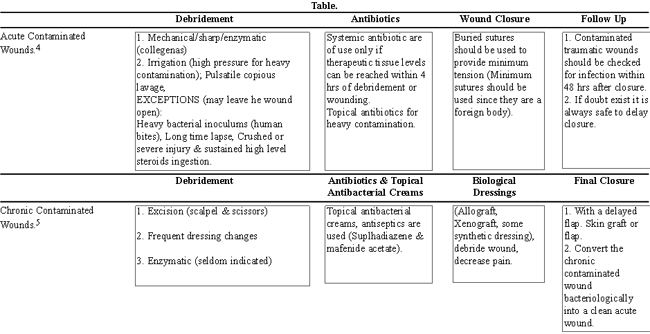
Contaminated wounds after dirty wounds are the most commonly encountered wounds in surgical health care. Before the use of prophylactic antibiotics the rate of infection of contaminated wounds were 13%-20%.2 Wound healing and management have been affected by diabetes and smoking, co morbidities that are very much prevalent in today\\\'s world.3
With advancement in clinical research and with a significant meta-analysis available, the dimensions of wound management have widened and there is a constant change and update in the management of wounds. Following are the most recent guidelines for the management of both acute and chronic contaminated wounds.
Muhammad Haseeb Zubair,1 Muhammad Habib Zubair,2 Wajiha Jazil Faruqi3
Final Year MBBS, Karachi Medical and Dental College,1,2 Graduate Dow Medical College, DUHS.3
References
1.Devaney L, Rowell KS. Improved surgical wound classification--why it matters. AORN J 2004; 80: 208-9.
2.Gottrup F, Melling A, Hollander DA. An overview of surgical site infections: aetiology, incidence and risk factors. (Online) Available from URL: http://www.worldwidewounds.com/2005/september/Gottrup/Surgical-Site-Infections-Overview.html.
3.Lewis F, Fry DE. Surgical Infection. Selected readings in General Surgery (SRGS) 2009; 35: 7.
4.Singer AJ, Dagum AB. Current management of acute cutaneous wounds. N Engl J Med 2008; 359: 1037-46.
5.Fonder MA, Lazarus GS, Cowan DA, Aronson-Cook B, Kohli AR, Mamelak AJ. Treating the chronic wound: A practical approach to the care of nonhealing wounds and wound care dressings. J Am Acad Dermatol 2008; 58: 185-206.
Journal of the Pakistan Medical Association has agreed to receive and publish manuscripts in accordance with the principles of the following committees:


