

Shirin Djalalinia ( Research & Technology, Ministry of Health & Education, Iran. )
Hossein Malekafzali ( Research & Technology, Ministry of Health & Education, Iran. )
Fahimeh Ramezani Tehrani ( Research Institute For Endocrine Sciences, Shahid Beheshty Medical Science University, Iran. )
Marzieh Rostami Dovvom ( Research & Technology, Ministry of Health & Education, Iran. )
Rosemary Neot ( Research & Technology, Ministry of Health & Education, Iran. )
Niloofar Peykari ( Research & Technology, Ministry of Health & Education, Iran. )
May 2011, Volume 61, Issue 5
Original Article

Abstract
Objectives: To study general practitioners\\\' knowledge regarding smoking and their formal educational training on quitting smoking and associated readiness for providing associated services.
Methods: This cross sectional study was carried out using an anonymous WHO based questionnaire. According to sample size estimated based on general practitioners\\\' population ratio, review literatures and response rate probability; it was given to the 5140 general practitioners selected by random quota sampling method from a total of 25,600 practitioners all over the country at the time of the study.
Results: There were 3804 (74%) males with 16% being smokers and 4.6% having a history of smoking. Thirty percent of the subjects felt that they were ready for smoking cessation counseling, but only 9% had received formal training for it during medical school or post graduate training, while more than 80% perceived such training as necessary. Smoking cessation intervention during physician visits was associated with increased patient satisfaction especially among those who smoked.
Conclusion: Formal training for smoking cessation among the study subject was inadequate. They were of the opinion that more courses should be included in medical school as better trained doctors could make good counselors.
Keywords: General practitioners, Smoking cessation, Formal training (JPMA 61:449; 2011).
Introduction
More than 1/6 of the total population worldwide are smokers and each day approximately 400 persons are added to this number. Latest study has shown that 25 causes of deaths were attributed to cigarette smoking and research has confirmed that 50% smokers have lost their lives due to the harmful effects of smoking.1,2
Authorities believed that families, friends and doctors play a great role in decreasing cigarette consumption and smoking cessation. Health care providers (especially doctors) attitudes towards smoking should be considered as role models in the community, as their behaviour can have positive or negative effect on smoking cessation. A study on this effect showed that when doctors posted a "No Smoking" sign in their place of work it had more positive effect on their patients\\\' smoking habits.3,4 In another study conducted by WHO, it was observed that general practitioners have the ability to motivate their patients in quitting smoking by using effective techniques. One study showed that after counseling, smoking cessation increased from 61% to 81%.5
Results of studies from different parts of the world have clearly shown that there is a reverse relationship between knowledge and smoking, Less knowledge of practitioners regarding the harmful effects of smoking as well as its harmful effects to the public, economy and on how to counsel properly has a detrimental effect on smoking cessation. Researchers have commented that GP\\\'s, during their college training have not acquired enough training on the factors mentioned above.5-7
Researchers have attributed this increase to lack of education and lack of motivation among medical students.8 Another study conducted by Crafton on 42 countries worldwide showed that number of smokers among medical students in different countries have a wide range (2-48% males and 5-22%females) and what is surprising is the fact that, these students did not know that smoking causes CHD, thromboembolism, emphysema and bladder cancer. Absence of educational training in the medical curriculum plays an important role for the lack of readiness of doctors to council regarding smoking cessation.9,10
This study was designed and conducted on the general practitioners to assess their knowledge on the side effects of smoking and their formal educational training on quitting smoking and associated readiness for providing associated services.
Methods
This cross-sectional study was conducted at a national level in Iran, from 2002 to 2003. All the 25 provinces with a total of 25,600 General Practitioners were included in the study.11 Multi-stage quota sampling technique was used to choose 5140 GPs, first taking into consideration the general practitioners provincial allotment, sample size of each province was determined. In next stage gender allotment was estimated for each province samples based on general practitioners list in Medical Council office of same province. Following that, random selection was conducted via general practitioners list in Medical Council office of each province. This sample size was calculated keeping an alpha of 0.05, power of 80% And CI of 95% an approximate prevalence of 20% was used for these calculations.
Standard anonymous questionnaires provided by WHO were used for data collection. (Global Health Professional Surveys). Although the validity of the instrument has been established by WHO, its validity had been confirmed through the peer-reviewed literature by national scientific committee of the project. For establishing reliability, the test - retest technique was used. Subjects of the study were all Iranian nationals.
The questionnaire was translated in-country by a professional translator. For each participant both original and translated version of questionnaires were provided by trained experts and they filled out the original one. After collecting the filled out questionnaires, data analyses was conducted and after that the original versions of questionnaires were returned to the WHO office. The response rate was approximately 83%.
This project was approved by the National Ethics committee of Ministry of Health and Education. Anonymous Self-administered questionnaires were filled up at home or in the offices with the presence of trained researchers. The nature and purpose of the study were explained to every participant before his/her consent was taken.
Data analysis was done by descriptive and presumptive statistics. To study the demographic data and descriptive studies, prevalence, mean and standard deviation was used. Analysis and comparison of data were conducted by using: Chi square (c2) test, Variance Analysis and Fisher test. Two-sided tests of significance were based on the 0.05 level. Final results were calculated with the use of SPSS software, windows 11 version (Chicago IL USA).
Results
There were (74%) male and 26% females with a mean age of 35 ± 8.1 years. Most of the physicians (95.4%) were employed by the government, 81.4% were working in the urban areas, 13% in the rural areas and 5.6% in the outskirts of the city. Only about 80% of them were aware of the side effects of smoking, 86.6% agreed that smoking has harmful effects on health, while 70% absolutely disagreed. Regarding the harmful effects of smoking during pregnancy, 44.2% strongly agreed that neonatal death was a result of the adverse effect of smoking while 5% stated that there was no relationship between mother\\\'s smoking and neonatal death. Considering Sudden Infant Death Syndrome as another consequence of smoking during pregnancy, 63.4% of the subjects strongly agreed while 2% strongly disagreed. Harmful effects of cigarette smoke on the immediate environment is one factor that has to be given special attention, considering that 74.3% of the subjects agreed that many lung diseases had a direct relation with smoking while 23.4% relatively agreed. It was encouraging to note that 92.7% of the practitioners agreed that cardiovascular diseases were the leading side effects of smoking. The knowledge that parents smoking can have an adverse influence on the children is a hopeful insight in this study as 66.9% of the subjects strongly agreed and 27.8%were more or less agreeable.
There is a need for special educational training in the field of smoking cessation. This deficiency was expressed by 87.4% of the physicians. Present study also showed that 91% of medical graduates had never received any formal education on the technique of quitting smoking, which is the main reason for these doctors not making good counselors. Post graduate training has not been satisfactory either, with only 11.9% of the subjects having received informal training through seminars and conferences and 7% received training during their college education. Another important aspect to be considered is that only 28.3% expressed preparedness to counsel whereas 10% were not willing. This was observed in the study when 80.7% doctors above 40 years age who had deficient training in techniques of smoking cessation, declined to counsel. The younger practitioners who were better exposed, were agreeable.
Of the different types of interventions used in order to quit smoking, counseling proved to be the most successful (55%) followed by self- learning materials (30.5%), use of drugs (25.4%) and the use of traditional treatment (12.6%) (Table-2). 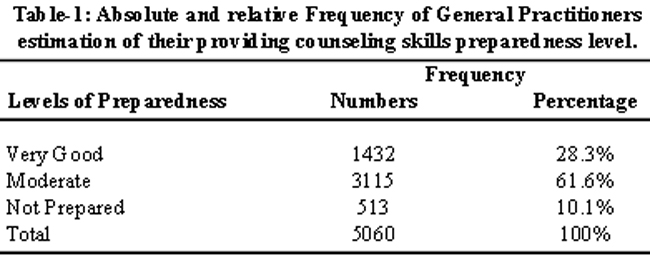
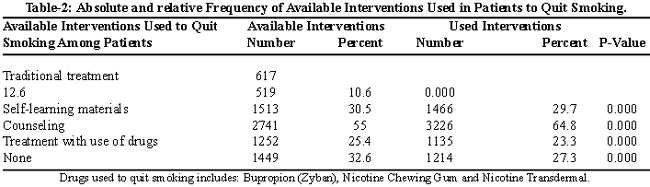
Failure to make use of the services of 45% of practitioners is a factor that has to be taken seriously, considering that counseling has the highest success rate in smoking cessation.
Practitioners level of preparedness to counsel were measured with the use of Analysis Variance Test and was rated as (very good, moderate and lack of preparedness). 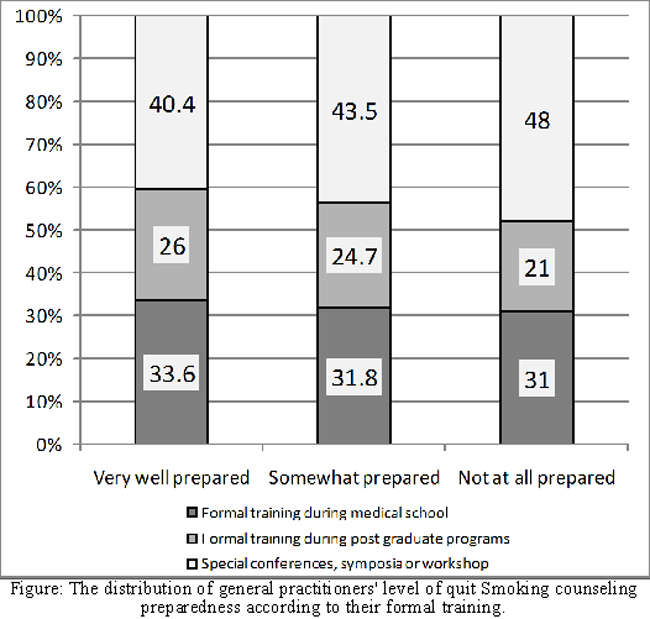
Comparison of average results on these 3 items resulted in (P< 0.001). There was a significant relationship between the result of those subjects who are well prepared to counsel compared to those who are moderately prepared and those who lacked preparedness (23.5± 2.47 vs 22.5 ±1.8 and 22.3±1.6).
Discussion
A study on the practitioners\\\' knowledge regarding the side effects of smoking and their attitude towards it, has a direct impact on encouraging the patients to quit smoking habits. Furthermore, providing effective counseling has direct relationships with educational training of the practitioner.12,13
Results of surveys done in Europe have shown that, even if the level of Medical Students\\\' knowledge on smoking has increased in the last year of college, still this lack of training on counseling can be observed. As an example, less than 30% of these students believed that smoking plays at least a minor role in causing advanced cardiovascular diseases, and they also believed that Public Health plays a lesser role in controlling smoking.14,15
Surveys have also emphasized on general practitioners role in decreasing cigarette consumption together with an effective programme.16 This reflects on attitude and knowledge on its harmful effects. It has been observed that 61% patients who never received counseling were interested to quit smoking, while the number of patients who quit smoking after being counselled increased to 81%.Many other new researches found similar relations.17,18
These results have a direct relation with factors such as, physicians\\\' knowledge and patterns of cigarettes used; (P<0.001) lack of available anti smoking training programmes, and appropriate training on counseling. The situation will remain this way as long as doctors are considered the most important members of the Health and Medical Services.
Results of this study revealed that, practitioners\\\' knowledge on the harmful effects of smoking was insufficient and they lacked expertise in counseling patients.
Improvement of doctors education will not only enhance the level of public health but will also have positive effects on smoking cessation. It is noteworthy that knowledge promotion in health care providers as well as use of modern and more effective techniques for quitting smoking are proposed in other similar studies.19
Implementation of educational training programmes in their graduate curriculum and students\\\' participation in several training programmes will provide a very meaningful effect.
Conclusion
Study concluded that most of the participants lacked formal training on smoking cessation. They found this to be a handicap for counseling patients in their practice.
Implementation of educational training programs in the practitioners\\\' graduate curriculum and their participation in several training programmes will provide a very meaningful effect especially on practitioners\\\' smoking cessation counseling.
Acknowledgment
We would like to express our thanks to the representatives of each university throughout the country and to all participants who have given their assistance in conducting this study. Also special thanks to WHO who funded this project.
References
1.McGinnis JM, Foege WH. Actual causes of death in the United States. JAMA 1993; 270: 2207-12.
2.Perrin PC, Merrill RM, Lindsay GB. Patterns of smoking behavior among physicians in Yerevan, Armenia. BMC Public Health 2006; 6: 139.
3.Dawley HH Jr. Carroels SF, Morrison JE. The discouragement of smoking in a hospital setting: the importance of modeled behavior. Int J Addict 1981; 16: 905-10.
4.Neergard L. It takes more than the path to Quit Smoking. Dallas chronicle, 1995; 24: B4. (Online) (Cited 2010 Feb 5). Available from URL: http://www.thedalleschronicle.com.
5.Djamalian R. The epidemiologic criteria of smoker physicians in Tehran. J Med Council IR Iran 1987; 6: 397-402.
6.Abdulmohsen MF. Abdulrahman IS, Al-Khadra AH, Bahnassy AA, Taha SA, Kamal BA, et al. Physicians\\\' knowledge, attitude and practice towards erectile dysfunction in Saudi Arabia. Easet Mediterr Health J 2004; 10: 648-54.
7.Solbery LI, Boyle RG, Davidson G, Magnan SJ, Carlson CL. Patient Satisfaction and Discussion of Smoking Cessation During Clinical Visits. Mayo Clin Proc 2001; 76: 138-43.
8.Champan S. Doctors who smoke. BMJ 1995; 311: 142-3.
9.Crofton JW, Freour PP, Tessier JF. Medical education on tobacco: implications of a word wide survey. Tobacco and health committee of the International Union Against Tuberculosis and lang Disease (I,UATLD) . Med Educ 1994; 28: 187-96.
10.Josseran L, King G, Guilbert P, Davis J, Brücker G. Smoking by French general practitioners: behaviour, attitudes and practice. Eur J Public Health 2005; 15: 33-8.
11.Medical Council Organization, IR Iran. General Practitioners Information. (Online) (Cited 2000 Aug 20). Available from URL: http://www.irimc.org/News/Default.aspx.
12.Johnston JM, Chan SS, Chan SK, Lam TH, Chi I, Leung GM. Training nurses and social workers in smoking cessation counseling: a population needs assessment in Hong Kong. Prev Med 2005; 40: 389-406.
13.Darves B. ACP-ASIM: physicians play major role in helping patient change un healthy behaviours. American college of physicians - American Society of Internal Medical Annual session. April 27; 2004.
14.Underner M, Ingrand P, Allouch A, Laforgue AV, Migeot V, Defossez G, et al. [Influence of smoking among family physicians on their practice of giving minimal smoking cessation advice]. Rev Mal Respir 2006; 23: 426-9.
15.Frank E, Elon L, Spencer E. Personal and clinical tobacco-related practices and attitudes of U.S. medical students. Prev Med 2009; 49: 233-9.
16.Maciejewski J, Bednarek M, Korzybski D, Zieli?ski J. [Smoking habits in a family physician\\\'s practice]. Pneumonol Alergol Pol 2009; 77: 248-55.
17.Pipe A, Sorensen M, Reid R. Physician smoking status, attitudes toward smoking, and cessation advice to patients: an international survey. Patient Educ Couns 2009; 74: 118-23.
18.Sotiropoulos A, Gikas A, Spanou E, Dimitrelos D, Karakostas F, Skliros E, et al. Smoking habits and associated factors among Greek physicians. Public Health 2007; 121: 333-40.
19.Malik AK, Chaudhry A, Karamat A, Arif N, Cheema MA, Rauf A, et al.Cigarette smoking and health care professionals at Mayo Hospital, Lahore, Pakistan. J Pak Med Assoc 1990; 40: 6-10.
Related Articles
Journal of the Pakistan Medical Association has agreed to receive and publish manuscripts in accordance with the principles of the following committees:


