

Ferha Saeed ( Department of Obstetrics & Gynecology, Aga Khan University Hospital, Karachi, Pakistan. )
Ahmed Jawad ( Final Year Medical Student, Aga Khan University Hospital, Karachi, Pakistan. )
Asma Azmat ( Final Year Medical Student, Aga Khan University Hospital, Karachi, Pakistan. )
Iqbal Azam ( Department of Community Health Sciences, Aga Khan University Hospital, Karachi, Pakistan. )
Safdar Kagazwala ( Department of Obstetrics & Gynecology, Aga Khan University Hospital, Karachi, Pakistan. )
January 2011, Volume 61, Issue 1
Original Article

Abstract
Objective: To determine the relationship between pregnancy induced hypertensive diseases and obesity.
Methods: A retrospective case controlled study was performed at Aga Khan University Hospital including records from July 2000 to June 2005. All women developing hypertension with or without proteinuria after 20 weeks of pregnancy (n=218) were included. Categories of pregnancy induced hypertensive diseases (PIHD) were defined according to National high blood pressure working group and ACOG committee bulletin. Controls were selected randomly with a ratio of 1:1.7 between cases and controls.
Results: The estimated prevalence of pre-eclampsia in our institution is 1.9%. Earlier reports suggested mostly non-Asian women primigravida were more likely to develop gestational hypertension when compared with multigravidae (p-value=0.004). Mean BMI of cases was significantly higher than controls (p=<0.001). The risks of both non-protienuric hypertension (Mean BMI= 27.16±5.46) and preeclampsia (Mean BMI= 27.39±6.15) increased consistently with increasing BMI. This rise was significantly associated with severity of pre-eclampsia and early development of PIH, but not associated with complications like eclampsia. No significant association of height and hypertension was found as most women of both cases and control were 150-165 cm tall.
Conclusions: High BMI in pregnant women serves as a significant risk factor for developing hypertension in pregnancy but failed to establish this association with height is the main findings of our study.
Keywords: Anthrometric measurement, hypertion in pregnancy (JPMA 61:58; 2011).
Introduction
Pregnancy induced hypertension affects 10% of pregnancies, and pre-eclampsia complicates 2-8% of pregnancies.1 Although obstetricians now distinguish \'transient hypertension\' (without proteinuria) from \'pre-eclampsia\' (with proteinuria) and from \'superimposed pre-eclampsia\' (with pre-existing hypertension);2 risk factors for these often overlap.3 Aside from an immediate threat to the mother\'s life (worldwide, it results in an estimated 75000 maternal deaths annually),4 there is also a growing realization that pre-eclampsia predicts an excess mortality of mothers in later life, particularly from cardiovascular disease.5,6 However, no clear guidelines are available to identify women at risk. A history of pre-eclampsia should be considered when assessing the risk of cardiovascular disease in women.7
Pregnancy induced hypertensive diseases (PIHD) and especially its ominous entity pre-eclampsia share a number of risk factors (Atherosclerosis, obesity, endothelial disease and pre existing hypertension) with cardiovascular diseases. Women with recurrent pre-eclampsia or pre-eclampsia in early pregnancy reportedly have an increased long term risk of cardiovascular disease (CVD).6,8 A recent study has shown women with pre-eclampsia who had preterm deliveries had an eight fold risk of dying from cardiovascular disease compared to those women who had given birth at term.6 Women with recurrent pre-eclampsia or pre-eclampsia early in pregnancy reportedly have an increased long-term risk of CVD.
Height and weight are two of the most easily obtained anthropometric measurements. In combination, they have been used to demonstrate the health risks associated with being overweight as well as underweight and are used extensively in screening and monitoring programmes.9
Short stature and increased BMI are known markers for CVD.10,11 Obesity has been reported to be associated with pre eclampsia and other hypertensive disorders of pregnancy and later on in life with cardiovascular disease.12 Compared with European women, South Asian women have high levels of abdominal obesity even when they fall within normal range of BMI13,14 and the risk associated with cardiovascular disease occurs at lower BMI as compared with white population.12 This is attributed to their body fat distribution with more visceral fat and consequently more dyslipidaemia which may account for increased prevalence of cardiovascular diseases.
Height, since it is used to calculate the BMI, is not commonly reported among the results for reasons that either no association was found or not measured. However, we were able to identify a few articles where information on pregnancy related hypertension in relation to categories of maternal height was presented. Only a few studies have explored the association between height and pre-eclampsia. Short stature is a risk factor for CVD but has rarely been examined in relation to gestational hypertension. It might as well be an additional risk marker for pregnancy induced hypertensive diseases which may help to provide biological clues to the etiology. A recent study has shown that short height is associated with pre-eclampsia.15 Considering the female Southeast Asian population where average height might be slightly shorter with higher mean body mass index than the Caucasian population,16 we performed this retrospective study in 218 mothers who had PIHD over 5 year\'s period to determine its relationship with anthropometric measurements.
Patients and Methods
Hospital Management Information Systems (HMIS) of the Aga Khan University Hospital kept the information of the patients who were either admitted or who came in for a consultation at the out-patient clinics of the hospital using ICD-9-CM, in a computerized database system. In this study, we included all women who developed hypertension with or without proteinuria after 20 weeks of pregnancy as cases (n=218) during July 2000 and June 2005. Pregnancies complicated with chronic hypertension, a pre-pregnancy diagnosis of hypertension or, pregnancies where diagnosis of hypertension was made before the 20th week of gestation, were excluded from the study.
All categories of pregnancy induced hypertensive diseases (PIHD) were defined according to the report of the National high blood pressure working group and ACOG committee bulletin.17,18 If a woman was delivered more than once in the study period, the earliest delivery was included in the analysis. If in any of the multiple deliveries, a woman was found to be hypertensive, she was regarded as a case throughout. Controls were randomly selected from the same time period with a ratio of 1:1.7 between cases and controls. Women in control group were selected with the exception of those who fulfilled the predefined criteria of Pregnancy induced Hypertension, Preeclampsia, Eclampsia or Chronic Hypertension. All other women with pregnancy induced complications not a result of Hypertensive disorders were included in the study. All cases with incomplete records were excluded from the study. The resultant sample size for 586 subjects achieves a power of 80 percent with an anticipated odds ratio of 2, level of significance of 5 percent and the exposure among controls ranged from 11.2 percent to 78.5 percent.
Data was double entered by two different data entry operators using data entry software Epidata (version 3.0) in order to minimize data entry errors and analyzed using SPSS for Windows, Release 14.0 (Statistical Package for Social Sciences Inc., Chicago, IL, USA). Student\'s t-test was used to compare cases and controls for continuous variables like age of women at the time of booking, height of mother (in cm), body mass index at the time of booking, gestational weeks at the time of booking, gestational weeks at the time of delivery, birth weight of baby and duration of surgical ICU stay (in days).2 and Fisher\'s exact tests were used to compare the association between cases and controls in categorical variables like women age (in groups) at the time of booking, parity (primi or multi gravida), height (in groups) of women, body mass index (in groups) at the time of booking, patient\'s mother’s history of hypertension, family history of hypertension, delivery status, IUGR, Abruptio Placenta, CPD, Foetal Distress and surgical ICU stay. Simple and Multiple logistic regressions were used to evaluate the association between pre-eclampsia and the various risk factors and reported as crude and adjusted odds ratios 95% confidence intervals for uni-variate and multi-variable analysis.
We examined the effect of mother\'s height by dividing height into three categories (<150 cm, 150-165 cm and 165 cm). BMI at the time of antenatal booking was used for the analysis and the subjects were divided into groups according to maternal BMI the cut offs recommended by WHO.19
Results
Out of a total of 15,000 women who gave birth in our hospital in the last five years 281(1.9%; 95% C.I.: 1.7%, 2.1%) women developed pregnancy induced hypertension. Sixty-eight cases had an incomplete record and hence were excluded from the study. Out of the remaining 218 cases, 135 had established Pre-eclampsia and 83 had pregnancy induced hypertension only. Primigravida were more likely to develop gestational hypertension when compared with Multigravidae (p<0.004). Mean BMI of cases was significantly higher than controls (p<0.001). The risk of both non protienuric hypertension (Mean BMI= 27.16±5.46) and pre-eclampsia (Mean BMI= 27.39±6.15) increased consistently with increasing booking body mass index, with a higher booking mean gestational age for cases as compared to controls (Table-1).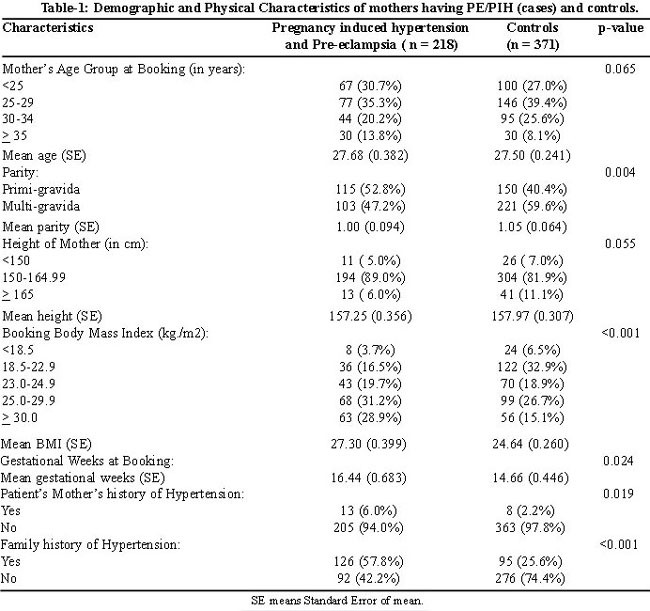
Subjects with higher BMI (Obese) and lower BMI (underweight) were more likely to develop pre-eclampsia and pregnancy induced hypertension. Increasing BMI was significantly associated with severity of pre-eclampsia and early development of pregnancy induced hypertension but not associated with complications like eclampsia. It also had no relationship with an early development of pre-eclampsia. Similar findings for height and BMI were obtained when pregnancy induced hypertension and pre-eclampsia separately compared with controls. No significant association of height and hypertension was found as most women of both cases and control were 150-165 cm tall.
The cases (PE and PIH) however were associated with nulliparity, a higher rate of IUGR (p<0.001), and a family history of hypertension (p<0.001) The cases ended up having increased surgical ICU stay (p<0.001) and as expected a significantly higher rate of, smaller babies and a much higher frequency of preterm deliveries compared with the women without hypertension. The frequency of operative deliveries and caesarian-sections (p<0.001), was much higher among cases. No significant difference was found for maternal age, abortion, duration of marriage foetal distress between cases and control. In the stratified analysis based on parity status (primigravida and multigravida) no association between cases and controls were obtained. Pregnancy hypertension was a significant predictor of low birth weight (Table-2).
In the univariate analysis, mother’s age group at booking, parity, height of mother, body mass index, gestational weeks at booking, mother’s history of hypertension, family history of hypertension, delivery status and surgical ICU stay were found significant (Table-2).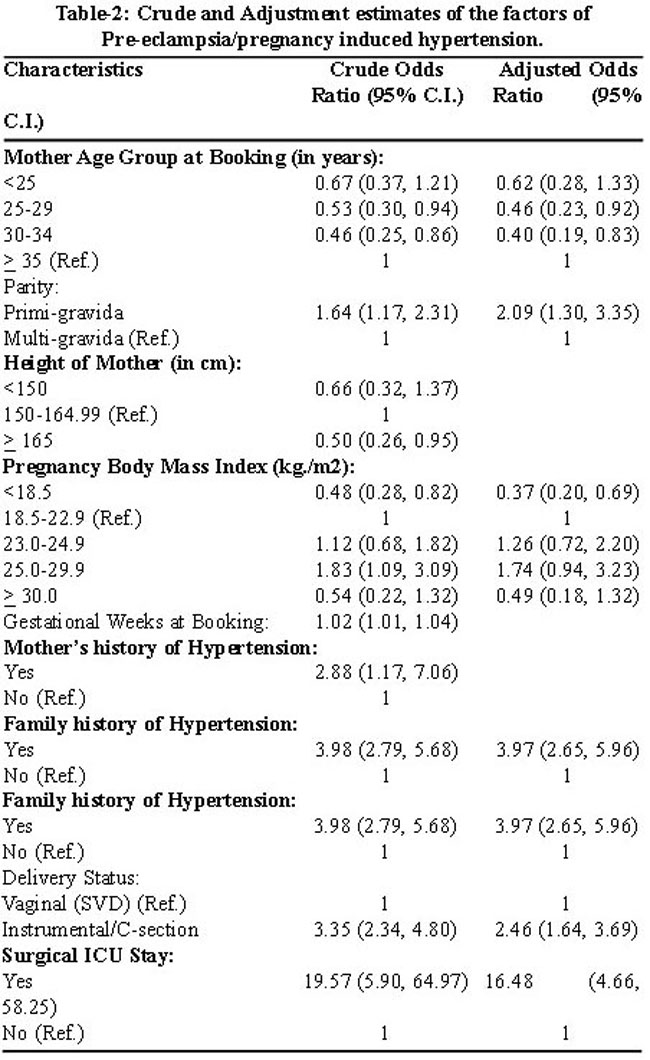
In multi variate analysis, the variables included in the model were mother’s age group at booking, parity, body mass index, family history of hypertension, delivery status and surgical ICU stay (Table-2).
Two way ANOV A of height (em.) were found to be insignificant for PE/PIH status (F(1,579)=3.471, p-value=O.063), interaction between body mass index and PE/PIH status (F(4,579)=1.504, p-value=O.200) and BMI status (F(4,579)=1.627, p-value=O.166) (Figure-1a).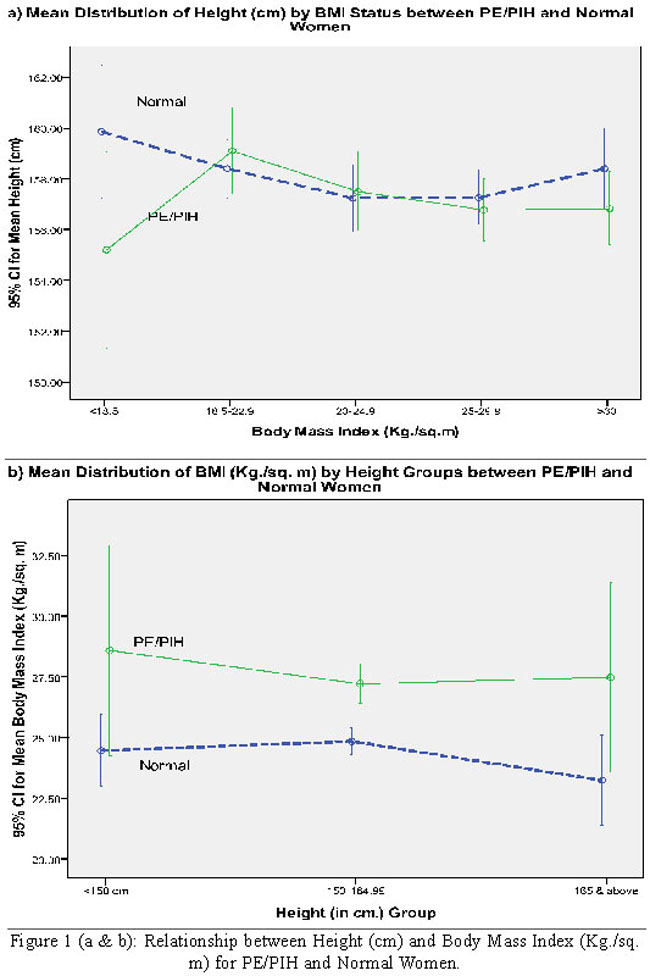
Similarly, Two way ANOV A of BMI (Kg./sq. m) was found to be significant for PE/PIH status (F(1,583)=16.802, p-value
Discussion
The estimated prevalence of pre-eclampsia in our institution is 1.9%, which is lower than that of previous reports from mostly non-Asian women, despite being a tertiary care referral centre, where we tend to receive higher number of high risk cases.20 The association of hypertension and BMI at booking was observed and showed relationship of obesity and hypertension. Eskenazi et al. had demonstrated a similar result.21 Obesity and hypertension are linked in pregnancy as in the non-pregnant state.15 Obesity and hypertension in overall population is very high in Pakistan, which increases risk of developing hypertension in pregnancy.22 In a systematic review of 13 cohort studies of approximately 1 million women, O\'Brien et al.23 found that the risk of pre-eclampsia doubled for each 5-7 unit increase in prepregnancy body mass index (BMI). Although we could not find the pre pregnancy weight of our study population due to its retrospective record review nature, but major fraction of our patients (56% and 28% respectively) were booked in first and second trimester.
Our findings show that short stature and risk of pre-eclampsia are not related. Short stature has been reported to be related to increased risk pre-eclampsia, and these are the women who are an elevated risk of developing CVD. No association was also observed for height and risk of pre-eclampsia when studied separately for primi and Multigravidae, which is contrary to the observation made by a Danish study.15 In their study they have shown a positive association of pre eclampsia with short stature in Multigravidae where, to a large extent, it might reflect pre-existing sub-clinical maternal disease and this might explain the stronger association between short stature and severe pre-eclampsia seen in multiparas, if short stature is in fact a marker of CVD.8
Such an association may be related to the progressive vascular endothelial damage that occurs with aging. Obstruction of the maternal spiral arteriolar Lumina by atherosis have been frequently observed in pregnancies complicated by pre-eclampsia. Therefore, we believe women at an advanced age should be followed carefully for the possible development of pre-eclampsia. A significant association was observed between parity and pre-eclampsia, where nulliparous women had higher incidence of pre-eclampsia as compared to multigravida, which is consistent with other investigations that are population-based,12,16,17 hospital-based,18,19 or other types of studies18,21,22 in which the incidence of pre eclampsia has been found to be greater in first births than in later ones. In clinical practice, the extent to which pre-eclampsia would occur as mainly a disease of primigravida would depend on the fraction of patient\'s seen in their first pregnancies. In our study, we could not demonstrate that having a previous history of abortion protected against pre-eclampsia. A limitation of the present study is the inability to differentiate between spontaneous and induced abortion because of the lack of information on this variable. Some workers suggested previously that a history of spontaneous abortion, which usually occurs later in gestation, provided a protection against pre eclampsia.6,13
Although high BMI was seen as a significant risk factor for developing hypertension in pregnancy in our series but we were not able to establish the association of height with pre-eclampsia. Our study revealed that the prevalence of pre-eclampsia in our institution is 1.9%, which is lower than that of previous reports from mostly non-Asian women. As one of the tertiary care referral centre, where we tend to receive higher number of high risk cases, we expected an increased prevalence. Therefore we can derive the conclusion that frequency of pre-eclampsia in our general population should be even lower. The reason for this disparity remains unknown; however, we believe that a difference in the prevalence of environmental or genetic risk factors may partially contribute to this discrepancy and merits further research to be conducted on the topic.
References
1.Lain KY; Roberts JM Contemporary concepts of the pathogenesis and management of preeclampsia. JAMA 2002; 287: 3183-6.
2.Gifford R. Working Group Report on High Blood Pressure and Pregnancy. NIH publication No. 00-3029. Washington, DC: National Institutes of Health, 2000.
3.Thadhani R, Stampfer MJ, Hunter DJ, Manson JE, Solomon CG, Curhan GC. High body mass index and hypercholesterolemia: risk of hypertensive disorders of pregnancy. Obstet and Gynecol 1999; 94: 543-550.
4.Senior K, A possible molecular explanation for pre-eclampsia. Lancet 2001; 357: 1857
5.Jonsdottir LS, Arngrimsson R, Geirsson RT, Sigvaldason H, Sigfusson N. Death rates from ischemic heart disease in women with a history of hypertension in pregnancy. Acta Obstetricia et Gynecologica Scandinavica 1995; 74: 772-6.
6.Irgens HU, Reisaeter L, Irgens LM, Lie RT. Long term mortality of mothers and fathers after pre-eclampsia: population based cohort study. BMJ 2001; 323: 1213-7.
7.Bellamy L, Casas JP, Hingorani AD, Williams DJ. Pre-eclampsia and risk of cardiovascular disease and cancer in later life: systematic review and meta-analysis. BMJ 2007; 10: 335-46.
8.Chesley LC. Recognition of the long-term sequelae of eclampsia. Am J Obstet Gynecol 2000; 182: 249-50.
9.Mason JB, Habicht JP, Tabatabai H, Valverde V. Nutritional surveillance. Geneva: WHO, 1984.
10.Marmot MG, Shipley MJ ,Rose G, Inequalities in death — specific explanations of a general pattern. Lancet 1984; 1: 1003-6.
11.McCarran P, Okasha M, McEwen J, Davey, Smith G. Height in young adulthood and risk of death from cerebrorespiratory disease: a prospective study of male former students of Glasgow University, Scotland. Am J Epidemiol 2002; 155: 683-7.
12.Benarji M, Faridi N, Atluri R, Chaiken RL, Leboviz HE. Body composition, visceral fat, leptin and insulin resistance in Asian Indian men: J Clin Endocrinol Metabol 1999; 84: 137-44.
13.Pomerleau J, McKeigue PM, Chaturvedi N. Factors associated with obesity in South Asian, Afro-Caribbean and European women. Int J Obesity Relat Metab Disord 1999; 23: 25-33.
14.The Asia Pacific Perspective: Redefining Obesity and its Treatment. Health Communication Australia Pty Ltd. February 2000, Section 2, page 20.
15.Basso O, Wilcox AJ, Weinberg CR, Baud DD, Olsen J. Height and risk of severe pre-eclampsia. A study within the Danish National Birth Cohort Int J of Epidemiol 2004; 33: 858-63.
16.William R, Bhopal RK, Hunt K. Coronary Risk in a British Punjabi Population: Comparative Profile of Non-Biochemical Factors. Int J Epidemiol 1994; 23: 28-37.
17.ACOG committee on obstetric practice Bulletins-Obstetrics. ACOG practice bulletin. Diagnosis and management of preeclampsia and eclampsia. Number 33, January 2002. American College of Obstetricians and Gynecologist. Obstet Gynecol 2002; 99: 159-67.
18.Report of the National High Blood Pressure Education Program Working Group on High Blood Pressure in Pregnancy. Am J Obstet Gynecol 2001; 183: S1-22.
19.Obesity: Preventing and Managing the Global Epidemic: Report of a WHO Consultation on Obesity. Geneva: WHO 1998; 9.
20.Lee CJ, Hsieh TT, Chiu TH, Chen KL, Lo LM, Hung TH. Risk factors for pre-eclampsia in an Asian population. Intl J of Gynecol Obstet 2000; 70: 327-33.
21.Eskenazi B, Fenster L, Sidney S. A multivariate analysis of risk factors for pre-eclampsia. JAMA 1991; 226: 237-41.
22.Basit A, Shera AS. Prevalence of metabolic syndrome in Pakistan. Metab Syndr Relat Disord. 2008; 6: 171-5.
23.O\'Brien TE, Ray JG, Chan WS. Maternal body mass index and the risk of preeclampsia: a systematic overview. Epidemiology. 2003; 14: 368-74.
Related Articles
Journal of the Pakistan Medical Association has agreed to receive and publish manuscripts in accordance with the principles of the following committees:


