

Naveed Akhtar ( Department of Cardiology, Shifa International Hospital, Islamabad. )
Malik Muhammad Adil ( Department of Medicine, Shifa International Hospital, Islamabad. )
Waqas Ahmed ( Department of Cardiology, Shifa International Hospital, Islamabad. )
Habib-ur-Rehman ( Department of Cardiology, Shifa International Hospital, Islamabad. )
Mumtaz Ali Shah ( Department of Cardiology, Shifa International Hospital, Islamabad. )
January 2011, Volume 61, Issue 1
Original Article

Abstract
Objective: To study the role of leukocyte count in patients with unstable angina pectoris or myocardial infarction (Acute Coronary Syndrome) its prognostic significance and correlation with plasma brain natriuretic peptide (BNP) levels.
Methods: A total of 143 Patients with unstable angina pectoris, non-ST segment elevation MI and ST segment elevation MI were considered for entry into the study. Plasma BNP levels were measured using a commercial BNP kit (AxSym System BNP Reagent Pack, Abbott Laboratories, Abbott Park, IL, USA). Leukocyte count was measured on CELL DYNE counter of Abbott Laboratories.
Results: Mean age of the patients were 58.67±12.48 years. Mean leukocyte count was 9772±3006 /cumm. In all 43 (30 %) patients had high leukocyte count, and 82 (57%) patients had elevated BNP level. Out of 61 patients with normal BNP level, 49 (80%) had normal leukocyte count and 12 (20%) had elevated leukocyte count. Out of 82 patients with elevated BNP level, 51 (62%) had normal leukocyte count and 31 (38%) had elevated leukocyte count (P = 0.01).
Conclusion: No statistically significant association was found between Leukocyte count and ACS. Although there is a trend of increased Leukocyte count noted in patients with increase BNP level. This finding necessitates further studies to elucidate its accurate significance.
Keywords: Coronary artery Disease, Leukocyte count, BNP (JPMA 61:51; 2011).
Introduction
A high leukocyte count has been implicated as an important risk factor for incidental ischaemic heart disease (IHD) as well as being a prognostic indicator for ischaemic events and myocardial infarction in various patient populations and clinical studies.1-3 Although leukocyte count is quite inexpensive, reliable and ordered routinely in patients, very few research studies have actually mentioned the importance of leukocyte count as an independent predictor of cardiovascular events.4 Elevated Leukocyte count also serves as indicator of IHD mortality independent of the conventional risk factors for IHD including smoking thus signifying a role of inflammation in the pathogenesis of CHD.5
We conducted a prospective observational study to assess the risk of new heart failure, recurrent myocardial infarction (MI) or ischaemia and all cause mortality one month after an index episode of unstable angina pectoris (UA), non-ST segment elevation MI (NSTEMI) or ST segment elevation MI (STEMI) in patients with normal and elevated plasma BNP levels and determine the effect of myocardial revascularization on such patients.6 We sought to determine the correlation of Leukocyte count with BNP levels and the prognostic value of Leukocyte Count in patients presenting with ACS.
Patients and Methods
A detail of the study protocol has already been published.6 Briefly, patients with UA, NSTEMI and STEMI were considered for entry into the study. The diagnosis of these disorders was made in accordance with established criteria.7,8 Patients with heart failure on presentation, a serum creatinine level > 1.5 mg/dl, the presence of other acute illnesses and chronic co-morbidities that might result in early death were excluded from the study.9
At presentation, a focused medical history, physical examination, a 12 lead Electrocardiogram and chest x-ray were performed. Venous blood was drawn for blood and serum studies. Aspirin, heparin (unfractionated or low molecular weight), clopidogrel, beta-blockers and angiotensin converting enzyme inhibitors were initiated in accordance with current guidelines for patients with UA, NSTEMI and STEMI.7,8 Plasma BNP levels were measured using a commercial BNP kit (AxSym System BNP Reagent Pack, Abbott Laboratories, Abbott Park, IL, USA). Leukocyte count was measured on CELL DYNE counter of Abbott Laboratories.
Informed consent was obtained from all patients in accordance with the principles of the Declaration of Helsinki.
Statistical analysis was conducted using SPSS 10 software. The chi square test was used to determine if significant differences existed between proportions for categorical variables. A p value <0.05 was required for statistical significance.
Results
One hundred and fifty consecutive eligible patients were entered into the study. Seven patients were lost to follow-up.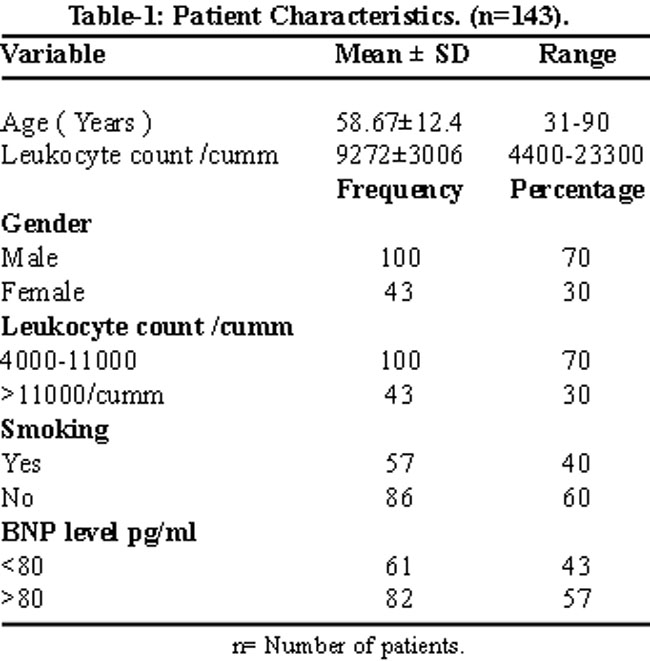
Table-1 shows the baseline characteristics of the patients. Mean age of the patients was 58.67±12.48 years. Seventy percent were males and 30 percent were females. Mean leukocyte count was 9772±3006 /cumm. Out of 143 patients, 43 (30 %) had high leukocyte count (> 11000 /cumm). Eighty two (57 %) had elevated BNP level (> 80 pg/ml).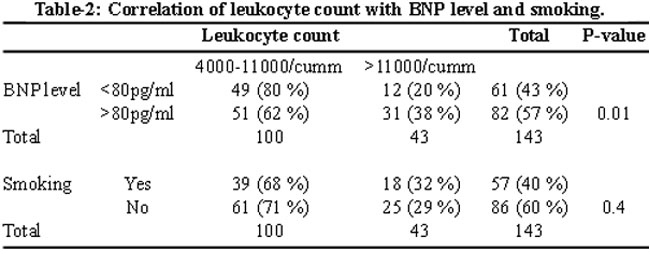
Table-2 Shows the correlation of leukocyte count with BNP level and smoking.
Out of 143 patients, 61(43%) had normal BNP level and 82(57%) had elevated BNP level. Out of 61 patients with normal BNP level, 49 (80%) had normal leukocyte count and 12 (20%) had elevated leukocyte count. Out of 82 patients with elevated BNP level, 51 (62%) had normal leukocyte count and 31 (38%) had elevated leukocyte count (P = 0.01)
Out of 143 patients, 57(40%) were smokers and 86(60%) were nonsmokers. Out of 57 smokers, 39 (68%) had normal leukocyte count and 18 (32%) had elevated leukocyte count. Out of 86 nonsmokers, 61 (71%) had normal leukocyte count and 25 (29%) had elevated leukocyte count.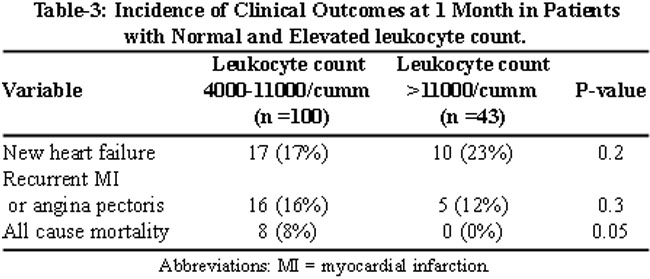
Table-3 shows the incidence of new heart failure, recurrent MI or ischaemia and all cause mortality 1 month after the index event in patients with normal and elevated leukocyte count. The incidence rates of all cause mortality was borderline significant in patients with elevated leukocyte count. No correlation was seen between the incidence rates of new heart failure and recurrent MI or ischaemia and leukocyte counts.
Discussion
Leukocyte count is routinely measured by clinicians and is readily available, therefore many studies have investigated the role of Leukocyte count as a risk factor for IHD and as a prognostic indicator for future outcome. Several prospective studies have shown a positive and independent association between Leukocyte count and IHD incidence or mortality.7,10,11 Contrary to these, our major finding was that there is no statistically significant relationship between the baseline leukocyte count and the incidence of IHD in the population studied. Thus elevated leukocyte count does not appear to be a risk factor for IHD in our population. NHANES I Epidemiologic Follow-up Study also failed to clearly establish an increase in Leukocyte count as a risk factor for IHD in white men who had never smoked, although leukocytosis was associated with an increased risk of IHD in white women.12
We also investigated the association between elevated Leukocyte count and plasma BNP levels. To our knowledge, this was probably the first study to investigate the association of Leukocyte count with BNP levels. We found a significant correlation between elevated BNP levels and elevated leukocyte counts.
Several studies have shown the association between smoking and leukocytosis.13-15 However we did not find a significant association between elevated Leukocyte count and smoking in our study.
In this study the association between leukocyte count and mortality at one month was borderline significant (P = 0.05). This is consistent with a study carried out in the elderly population. This study strongly correlated Leukocyte count, an indicator of inflammation, with severe later fatal IHD, attributed to plaque rupture and thrombus formation.16
Limitations:
The limitations of our study are a relatively small sample size and short duration of follow-up.
Conclusion
Our study showed no statistically significant association between Leukocyte count and ACS. Although there is a trend of increase Leukocyte count noted in patients with increase BNP level. This finding necessitates further studies to elucidate its accurate significance.
References
1.Danesh J, Collins R, Appleby P, Peto R. Association of fibrinogen, C-reactive protein, albumin, or leukocyte count with coronary heart disease: meta analysis of prospective studies. JAMA 1998; 279: 1477-82.
2.Grimm RH Jr, Neaton JD, Ludwig W. Prognostic importance of the white blood cell count for coronary, cancer, and all-cause mortality. JAMA 1985; 254: 1932-7.
3.Zalokar JB, Richard JL, Claude JR. Leukocyte count, smoking, and myocardial infarction. N Engl J Med 1981; 304: 465-8.
4.Madjid M, Awan I, Willerson JT, Casscells SW. Leukocyte count and coronary heart disease: implications for risk assessment. J Am Coll Cardiol 2004; 16: 44: 1945-56.
5.Brown DW, Giles WH, Croft JB.White blood cell count: an independent predictor of coronary heart disease mortality among a national cohort. J Clin Epidemiol 2001; 54: 316-22.
6.Ahmed W, Zafar S, Yawar AY, Akhtar N, Shah MA, Alpert MA. Plasma levels of B-type natriuretic Peptide in patients with unstable angina pectoris or acute myocardial infarction: prognostic significance and therapeutic implications. Angiology 2007; 58: 269-74.
7.Antman EM, Anbe DT, Armstrong PW, Bates ER, Green LA, Hand M, et al. ACC/AHA Guidelines for the management of patients with ST elevation myocardial infarction. A report of the American College of Cardiology/American Heart Association Task Force on Practice Guidelines (Writing Committee to revise the 1999 guidelines for the management of patients with acute myocardial infarction). J Am Coll Cardiol 2004; 44: 671-719.
8.Braunwald E, Antman EM, Beasley JW, Califf RM, Cheitlin MD, Hochman JS, et al. ACC/AHA 2002 guideline update for the management of patients with unstable angina and non-ST segment myocardial infarction. Summary article: a report of the Amerian College of Cardiology/American Heart Association task force on practice guideline (Committee on the Management of Patients with Unstable Angina). J Am Coll Cardiol 2002; 40: 1366-74.
9.McKee PA, Castelli WP, McNamara PM, Kannel WB. The natural history of congestive heart failure: the Framingham Study. New Engl J Med 1971; 285: 1441-46.
10.Lee CD, Folsom AR, Nieto FJ, Chambless LE, Shahar E, Wolfe DA. White Blood Cell Count and Incidence of Coronary Heart Disease and Ischaemic Stroke and Mortality from Cardiovascular Disease in African-American and White Men and Women: Atherosclerosis Risk in Communities Study. Am J Epidemiol 2001; 154: 758-64.
11.Jee SH, Park JY, Kim HS, Lee TY, Samet JM. White blood cell count and risk for all-cause, cardiovascular, and cancer mortality in a cohort of koreans. Am J Epidemiol 2005; 162: 1062-9.
12.Gillum RF, Ingram DD, Makuc DM. White blood cell count, coronary heart disease, and death: the NHANES I Epidemiologic Follow-up Study. Am Heart J 1993; 125: 855-63.
13.Hansen LK, Grimm RH, Neaton JD. The relationship of white blood cell count to other cardiovascular risk factors. Int J Epidemiol 1990; 19: 881-8.
14.Nieto FJ, Szklo M, Folsom AR, Rock R, Mercuri M. Leukocyte count correlates in middle-aged adults: the Atherosclerosis Risk in Communities (ARIC) Study. Am J Epidemiol 1992; 136: 525-37.
15.Friedman GD, Tekawa I, Grimm RH, et al. The leukocyte count: correlates and relationship to coronary risk factors. The CARDIA Study. Int J Epidemiol 1990; 19: 889-93.
16.Weijenberg MP, Feskens EJ, Kromhout D. White blood cell count and the risk of coronary heart disease and all-cause mortality in elderly men. Arterioscles Thromb Vax Biol 1996; 16: 499-503.
Related Articles
Journal of the Pakistan Medical Association has agreed to receive and publish manuscripts in accordance with the principles of the following committees:


