

Syed Shahabuddin ( Cardiothoracic Surgery Section, Department of Surgery, The Aga Khan University, Karachi, Pakistan. )
Junaid Alam Ansari ( Cardiothoracic Surgery Section, Department of Surgery, The Aga Khan University, Karachi, Pakistan. )
Fahad Jawaid Siddiqui ( Cardiothoracic Surgery Section, Department of Surgery, The Aga Khan University, Karachi, Pakistan. )
Muneer Amanullah ( Cardiothoracic Surgery Section, Department of Surgery, The Aga Khan University, Karachi, Pakistan. )
Shahid Ahmed Sami ( Cardiothoracic Surgery Section, Department of Surgery, The Aga Khan University, Karachi, Pakistan. )
January 2011, Volume 61, Issue 1
Original Article

Abstract
Objective: To evaluate outcomes of re-operative coronary artery surgery in a tertiary care hospital in a developing country.
Method: Preoperative, intra-operative and postoperative variables were analyzed in 82 consecutive patients who underwent re-operative coronary surgery on cardiopulmonary bypass.
Results: The mean age was 63.3 ± 7.7 years, 91.2% were male and 9.8% female. Coronary artery disease risk factors were present in more than 50% of the patients. History of preoperative myocardial infarction was positive in 56% patients. There was strong clinical and angiographic indication for surgery with unstable angina in 50% patients and >80% had multivessel disease. Only 5% patients were in functional class I. The risk stratification showed a mean Euro score of 8. The IABP was used in 20% patients. A mean of 3.1 grafts per patient were applied. The median cardiopulmonary bypass (CPB) and aortic cross clamp time was 144 minutes respectively. Postoperative mortality was 7.3%. Short term follow up revealed 74% of the patients in NYHA functional class I.
Conclusion: Reoperative coronary artery bypass grafting is challenging but with expertise, team effort can be performed with good functional outcome.
Keywors: Redo CABG, Developing country, outcomes (JPMA 61:31; 2011).
Introduction
It has been estimated that 10-20% of all patients who have had aorto-coronary bypass will require a second bypass procedure within 10 years.1 Coronary re-operations are demanding procedures especially with an increased risk profile of these patients.2 Coronary artery disease (CAD) progresses with time involving native vessels, both grafted and non-grafted, and the vein grafts.3 These patients may require management of their symptoms from recurrence of CAD. These patients may require surgical intervention. Redo CABG is a major surgical procedure with a high mortality of up to 11.4%.4 Despite alternative strategies in the management of recurrent angina following coronary artery bypass grafting (CABG) the conventional re-operative coronary surgery on cardiopulmonary bypass (CPB) remains the standard surgical technique for complete revascularization in multi-vessel disease. Redo CABG with re-sternotomy carries a potential risk of catastrophic bleeding5 damage to previous patent grafts and thromoboembolism from diseased grafts leading to peri-operative myocardial infarction (MI) and CVA. These are the commonest factors contributing to postoperative mortality.6 In view of the above issues, we looked at the 30 day and late mortality along with their functional class at follow up in patients undergoing redo CABG.
Patients and Methods
Using the computerized database, all patients who underwent redo CABG from 1997 to 2007 were selected for the study at the Aga Khan University Hospital. All off pump redo CABG, or those operated using left thoracotomy with beating heart on CPB were excluded to ensure that the study group remains homogenous. The medical records were retrieved, reviewed and the pre-operative, intra-operative and post-operative variables were entered into a specifically developed dataset. Variables considered were indication for surgery, severity of disease, comorbidities, Euro SCORE, priority of admission, and type of surgery. Renal failure was defined as serum creatinine >1.5 mg/dl. Prolonged ventilation was defined as mechanical ventilation for >24 hours. Left ventricular (LV) dysfunction was categorized on the basis of ejection fraction and considered severe, moderate, mild, or normal if ejection fraction was < 35%, 35 to < 45%, 45 to < 55%, or 55% and above, respectively. Perioperative variables included the use of an intra-aortic balloon pump, type of previous graft, and duration of surgery. The operative aspects recorded were number of grafts, the use of internal mammary artery (IMA), and duration of cardiopulmonary bypass and cross clamp time. The indications for intra-aortic balloon pumping (IABP) were unstable angina, cardiogenic shock, low cardiac output and inability to wean patient from CPB. Postoperative characteristics were focused on outcomes including length of stay, complications, 30 day mortality, assessment of New York Heart Association (NYHA) functional class on follow up and late death. Functional class improvement was assessed at follow-up and by telephone questionnaire.
Frequencies were reported for categorical variables. Skewed data was likely due to nature of the variables recorded on continuous scale. Hence median and inter quartile ranges were reported unless otherwise indicated. Kaplan Meier survival curve was plotted for survival data.
The standard operating strategies for redo CABG was to have blood and cell saver device with cutaneous pads for defibrillation/pacing attached. Femoral artery was either marked or exposed once the patient was induced. A redo median sternotomy was performed using an oscillating saw. Sharp dissection was done to mobilize the heart away from the sternum. The right atrium and aorta were exposed to facilitate aorto caval cannulation after systemic heparinisation (300units/kg). Cardiopulmonary bypass was commenced urgently in the presence of ischaemic ECG changes, injury to patent grafts, haemodynamic instability and also to ease technically difficult dissection. Most of the patients were put on cardiopulmonary bypass through central cannulation. However in few cases CPB was established using femoral vascular access. Myocardial protection was achieved by administration of blood cardioplegia by antegrade and retrograde routes. Moderate hypothermia (28ºC to 32ºC) with topical cooling was used to enhance myocardial protection. Previous vein grafts were interrupted by ligation and wherever internal mammary graft was patent, efforts were made to preserve the graft and careful isolation was done for temporary occlusion of IMA during cross clamp period. Distal anastomoses were constructed on an arrested heart. During the rewarming phase the proximal ends of the vein grafts were anastomosed to the aorta using either a single clamp technique or partial occlusion of ascending aorta depending upon the condition of the aortic wall. After the heart had reperfused CPB was weaning usually with inotropic support, and the sternum was closed.
Result
From January, 1997 to December 2007, 91 patients were identified to have undergone redo CABG at Aga Khan University Hospital. Out of these 8 were off pump cases and 1 patient was operated through an anterolateral thoracotomy, hence 9 patients were excluded.
The preoperative characteristics of 82 eligible patients are shown in Table-1. All the patients were symptomatic and more than 87% of them were in NYHA class II or III. Angiography revealed multivessel CAD in 90% cases, while 60% had some degree of impaired left ventricular function.
The mean age was 63.3 ± 7.7 years with 8 (9.8%) patients being female. Coronary artery disease risk factors including tobacco use status (current, previous or non-user), dyslipidaemia and family history were present in more than 50% patients (Table-1).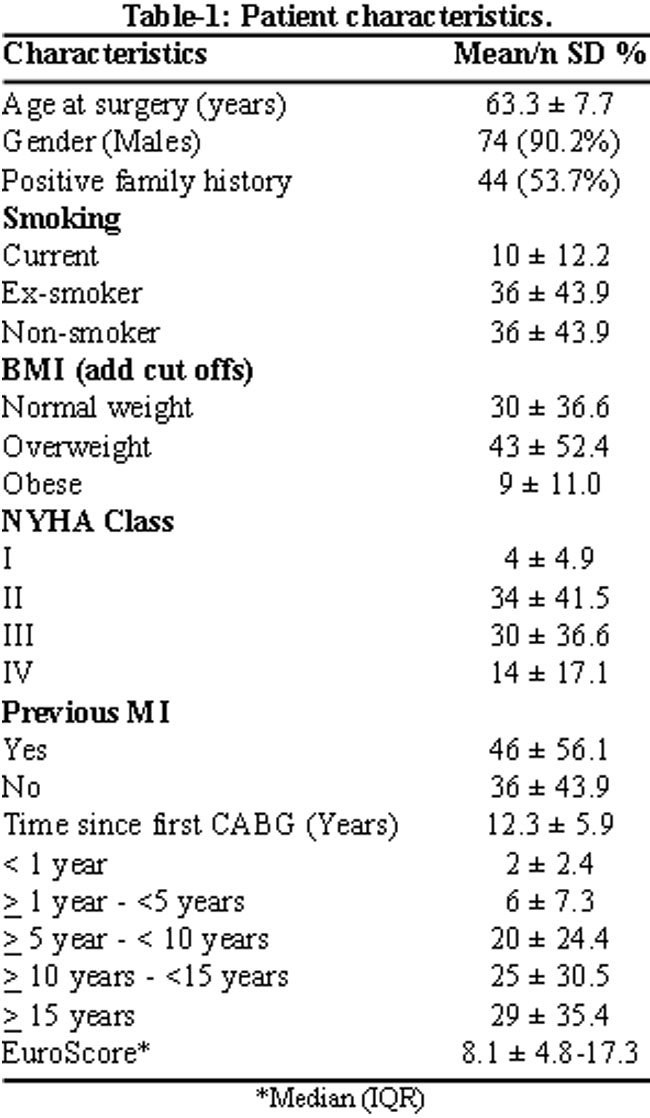
Previous myocardial infarction was experienced by 46 (56%) patients. Clinical and angiographic indication for surgery were; unstable angina in 42 (50%) patients and >80% had multivessel disease. These patients were operated after few months to more than ten years of primary CABG. Only 4 (5%) patients were in functional class I preoperatively. The risk stratification using Euro SCORE was a mean of 8. IABP was used in 20% patients. A mean of 3.1 grafts per patient were applied. The median CPB and aortic cross clamp times were 144 minutes and 82 minutes, respectively. Most frequently observed complication was prolonged ventilation, 15 (30%) followed by renal failure, atrial fibrillation and bleeding in 2 (3.2%) patients. Postoperative mortality was 7.3%. The surviving patients were followed up for a median period of 3.5 years. A further 5 (6.1%) patients died on follow up (late mortality). On late follow up 74% of the patients were in functional class I. A further analysis of surviving patients revealed 5 year survival of more than 80% (Figure-1).
Discussion
Coronary artery disease is known to progress in both grafted and non grafted vessels and often necessitates reoperation. The annual incidence of reoperation, which increases with the length of follow-up, is 1.1% at 5 years and 3.2% at 10 years.1 It has been estimated that 10-20% of all patients who have had CABG will require a second bypass procedure within 10 years. Coronary re-operations are demanding procedures especially with an increased risk profile of these patients. They have advanced disease and are poor surgical candidates in view of old age, more co morbid factors, decreased left ventricle Ejection Fraction and more extensive arteriopathy.2 It is also important to select patients with impaired left ventricular function to achieve objective of redo CABG7 Coronary artery disease (CAD) progresses with time involving native vessels, (both grafted and non-grafted), and the grafted veins.3 This study highlights the very important aspect of progression of coronary artery disease subsequent to surgical repair. In the developing world redo CABG is considered a high risk operation with only a few centers offering treatment to such patients. Our series is among the few experiences being reported from developing countries.8,9 Such challenging operations should be undertaken in experienced tertiary care centers to have internationally comparable results.
The technical challenges associated with redo CABG are multiple. Sternal re-entry can result in damage to the right ventricle (RV), aorta or previous grafts. The use of an oscillating saw and a preoperative chest X-ray to judge the distance between the posterior sternal surface and the anterior surface of the right ventricle helps to minimize these risk.10 Secondly there is an issue of availability of conduits, more so with second time redo. Thirdly, the handling of patent but diseased grafts can result in embolisation of debri and perioperative MI.6 Fourth and the most important aspect was myocardial protection. It might be difficult in these cases to obtain desirable myocardial protection via antegrade route alone. Retrograde cardioplegia is reported to decrease hospital mortality.11 Hence we used a combination of antegrade and retrograde route along with direct graft cardioplegia to enhance myocardial protection.
This study is a descriptive case series. Therefore, a multivariate analysis could not be performed to determine risk factors for redo CABG. Nevertheless, on reviewing the data, certain possible predictors for reoperation can be identified. These include left ventricular function and non-harvesting of the IMA.
Only eighty two patients who underwent redo CABG on CPB over a decade were included which may be the result of the referral pattern for redo CABG. This is because of the awareness about the increased mortality associated with redo CABG and the cost of surgery. Literature search has revealed limited reports of redo CABG on CPB from developing countries. The annual incidence of reoperation, which increases with the length of follow-up, is 1.1% at 5 years and 3.2% at 10 years.1 Majority of patients undergoing reoperation was more than 10 years of the primary surgery reinforcing the fact that atherosclerosis is an ongoing process.
We looked into the impact of surgery on improving their functional status and survival on follow up and early postoperative mortality. Six patients died in the hospital postoperatively. Redo CABG is a major surgical procedure and carries a higher mortality than primary CABG.4 The best results have been reported from the Cleveland Clinic with an operative mortality for reoperative CABG of 3.4%.12 Even in patients undergoing redo CABG before 45 years of age the mortality is 4.4%.9 However those who survived have shown a remarkable improvement in their functional status and majority of the patients were in functional class I, satisfying one of the important objective of redo CABG. The hospital survivors were followed for a median period of 3.5 years after hospital discharge. It was satisfying to see the five year survival is comparable to international literature.13 It was also noticed that six percent of the patients died during their follow up period supporting literature that patients requiring redo CABG tend to have different disease severity as compared to patients requiring primary CABG during their subsequent years.14
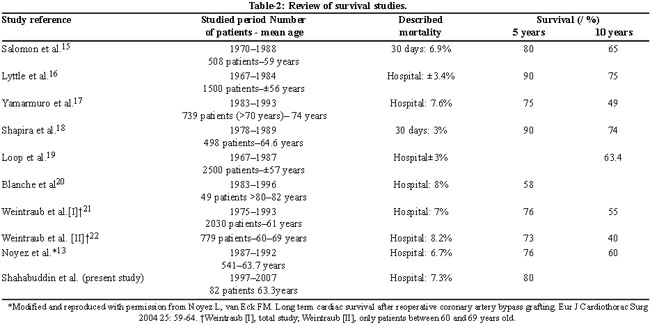
There are certain limitations of this study like retrospective nature with its inherent issues, however after careful search it was found to be the first study from our country looking at the redo CABG with their outcomes in terms of survival and functional class. The mortality appears to be on the higher side of the range as it is crude mortality and people in this part of the world seek medical attention late which translates into adverse outcome. If we look at the review of survival and mortality by Noyez et al from various groups it is evident that we have comparable results in terms of mortality and 5 year survival (Table-2).13,15-21
The other limitation with our study was that a small subset of patients were lost to follow up.
Conclusion
In conclusion, redo CABG is technically a challenging procedure requiring experience to manage these patients. The aim should be to achieve desired level of revascularization without damaging the myocardium. A high level of surgical expertise and supporting services are required to safely perform Redo CABG with acceptable morbidity and mortality and achieve good functional outcome.
Acknowledgement
We gratefully acknowledge support from Shumaila Furnaz in organizing the data.
Footnote:
Presented at 16th Annual Congress of the Asian Society for Cardiovascular and Throacic Surgery, Singapore 14-16 March 2008.
References
1.Cosgrove DM, Loop FD, Lytle BW, Gill CC, Golding LA, Gibson C, et al. Predictors of reoperation after myocardial revascularization. J Thorac Cardiovasc Surg 1986; 92: 811-21.
2.van Eck FM, Noyez L, Verheugt FW, Brouwer RM. Changing profile of patients undergoing redo-coronary artery surgery. Eur J Cardiothorac Surg 2002; 21: 205-11.
3.FitzGibbon GM, Leach AJ, Kafka HP, Keon WJ. Coronary bypass graft fate: long-term angiographic study. J Am Coll Cardiol 1991; 17: 1075-80.
4.He GW, Acuff TE, Ryan WH, He YH, Mack MJ. Determinants of operative mortality in reoperative coronary artery bypass grafting. J Thoracic Cardiovasc Surg 1995; 110: 971-8.
5.Follis FM, Pett SB Jr, Miller KB, Wong RS, Temes RT, Wernly JA. Catastrophic hemorrhage on sternal reentry: still a dreaded complication? Ann Thorac Surg 1999; 68: 2215-9.
6.Keon WJ, Heggtveit HA, Leduc J. Perioperative myocardial infarction caused by atheroembolism. J Thorac Cardiovasc Surg 1982; 84: 849-55.
7.Jones EL, Weintraub WS. The importance of completeness of revascularization during long-term follow-up after coronary artery operations. J Thorac Cardiovasc Surg 1996; 112: 227-37.
8.Jodati AR, Yousefnia MA. Reoperative Coronary Artery Bypass Grafting: analysis of early and late outcomes. Rawal Med J 2008; 33: 36-9.
9.Sajja LR, Mannam GC, Pantula NR, Sompalli S, Raju ARG, Raju BS. Reoperation for coronary artery disease in young: early and mid term results. Ind J Thorac Cardiovasc Surg 2005; 21: 199-203.
10.Sabik JF 3rd, Blackstone EH, Houghtaling PL, Walts PA, Lytle BW. Is reoperation still a risk factor in coronary artery bypass surgery? Ann Thorac Surg 2005; 80: 1719-27.
11.Borger MA, Rao V, Weisel RD, Floh AA, Cohen G, Feindel CM, et al. Reoperative coronarybypass surgery: effect of patent grafts and retrograde cardioplegia. J Thorac Cardiovasc Surg 2001; 121: 83-90.
12.Lytle BW, McElroy D, McCarthy P, Loop FD, Taylor PC, Goormastic M, Stewart RW, Cosgrove DM. Influence of arterial coronary bypass grafts on mortality in coronary reoperations. J Thorac Cardiovasc Surg 1994; 107: 675-83.
13.Noyez L, van Eck FM. Long term cardiac survival after reoperative coronary artery bypass grafting. Eur J Cardiothorac Surg 2004; 25: 59-64.
14.Di Mauro M, Iacò AL, Contini M, Teodori G, Vitolla G, Pano M, et al. Reoperative coronary artery bypass grafting: analysis of early and late outcomes. Ann Thorac Surg 2005; 79: 81-7.
15.Salomon NW, Page US, Bigelow JC, Krause AH, Okies JE, Metzdorff MT. Reoperative coronary surgery. Comparative analysis of 6591 patients undergoing primary bypass and 508 patients undergoing reoperative coronary bypass. J Thorac Cardiovasc Surg 1990; 100: 250-60.
16.Lytle BW, Loop FD, Cosgrove DM, Taylor PC, Goormastic M, Peper W, et al. Fifteen hundred coronary reoperations. Results and determinants of early and late survival. J Thorac Cardiovasc Surg 1987; 93: 847-59.
17.Yamamuro M, Lytle BW, Sapp SK, Cosgrove DM 3rd, Loop FD, McCarthy PM. Risk factors and outcomes after coronary reoperation in 739 elderly patients. Ann Thorac Surg 2000; 69: 464-74.
18.Shapira I, Isakov A, Heller I, Topilsky M, Pines A. Long-term follow-up after coronary artery bypass grafting reoperation. Chest 1999; 115: 1593-7.
19.Loop FD, Lytle BW, Cosgrove DM, Woods EL, Stewart RW, Golding LA, et al. Reoperation for coronary atherosclerosis. Changing practice in 2509 consecutive patients. Ann Surg 1990; 212: 378-86.
20.Blanche C, Khan SS, Chaux A, Denton TA, Sandhu M, Tsai TP, et al. Cardiac reoperations in octogenarians: analysis of outcomes. Ann Thorac Surg 1999; 67: 93-8.
21.Weintraub WS, Jones EL, Craver JM, Grosswald R, Guyton RA. In-hospital and long-term outcome after reoperative coronary artery bypass surgery. Circulation 1995; 92: 1150-7.
Related Articles
Journal of the Pakistan Medical Association has agreed to receive and publish manuscripts in accordance with the principles of the following committees:


