

Ali Mohammad Mir ( Population Council, House 7, Street 62, F-6/3, Islamabad, Pakistan. )
Abdul Wajid ( Population Council, House 7, Street 62, F-6/3, Islamabad, Pakistan. )
Laura Reichenbach ( Population Council, House 7, Street 62, F-6/3, Islamabad, Pakistan. )
Mumraiz Khan ( Population Council, House 7, Street 62, F-6/3, Islamabad, Pakistan. )
Irfan Masood ( Population Council, House 7, Street 62, F-6/3, Islamabad, Pakistan. )
November 2010, Volume 60, Issue 11
Original Article

Abstract
Objective: To describe the prevalence of Herpes Simplex Virus-2 (HSV-2) infection among males in six major cities of Pakistan.
Methods: A cross sectional behavioural and biological survey of urban male population aged 16-45 years was conducted in Rawalpindi, Lahore, Karachi, Faisalabad, Peshawar and Quetta to measure the prevalence of five sexually transmitted infections and assess sexual behaviours. Respondents were selected through a multistage sampling technique. In each city 10 blocks demarcated by the Population Census Organization were selected based on probability proportional to socio-economic status. In each block 40 men were selected through systematic sampling with a random start. In total 2400 men were administered a behavioural questionnaire and 2396 provided biological specimens for laboratory testing.
Results: This paper discusses the overall and city wise prevalence of HSV-2 infection. The overall prevalence of HSV-2 infection in the six cities was 3.4 percent (95% CI 2.8-4.3). City wise the highest prevalence was reported in Karachi 6 percent (95% CI 4.1-8.8), followed by Lahore and Quetta at 4.3 percent (95% CI 2.7-6.7), and Faisalabad at 2.5 percent (95% CI 1.4-4.5). The lowest prevalence was in Rawalpindi at 1.8 percent (95% CI 0.9-3.6).
Conclusion: Empirical evidence from this study suggests that there is city wise variation in the prevalence of HSV-2 infection across the major cities in Pakistan. Based on possible link between HSV-2 and HIV, future HIV control strategies must also focus on the better management of HSV-2 infections in Pakistan (JPMA 60:918; 2010).
Introduction
Globally Herpes Simplex Virus Type-2 (HSV-2) is amongst the most common sexually transmitted infections.1 HSV-2 seroprevalence studies show variation in infection by geographic location. The highest prevalence levels of the virus have been found in Africa and the Americas. Although there have been few studies, the lowest prevalence has been seen in Asia.2
Herpes Simplex Virus has been characterized into 2 distinct serotypes; HSV-1 and HSV-2. HSV-2 is primarily associated with genital and neonatal infections. Global research evidence has shown that there is a link between the HIV epidemic and the herpes simplex virus (HSV-2) infection.3 Amongst all sexually transmitted infections there appears to be a true epidemiologic synergy between these two viruses.4 Recent evidence accumulated from Africa, Asia and the Americas shows that the impact of genital HSV infection has increased the risk of HIV acquisition.5
HSV-2 prevalence has been found to vary by individual-level characteristics with the risk of acquisition being influenced by factors such as gender, age, sexual activity level, marital status, socioeconomic status (SES), education, race and ethnicity.6
Till recently, we did not have either national or city wise prevalence estimates for HSV infection in Pakistan. In 2007 the Ministry of Health and the National Aids Control Program (NACP) commissioned a behavioural and biological study of urban male population that was implemented by the Population Council. The two main objectives of this DFID-funded study were to estimate the prevalence of five commonly occurring STIs, including HIV, in six major cities of the country and to document sexual behaviours amongst urban male population. This paper discusses results related to the prevalence of HSV-2 infection amongst males in the six major cities of Pakistan.
Materials and Methods
The main component of the study was a cross-sectional behavioural and biological survey of 2400 men carried out in six major cities of Pakistan from June to August 2007. Only male population were selected as they constitute the bridging population that is a conduit for the spread of sexually transmitted infections from high to low risk general population.
City selection was based on inclusion of the four provincial capitals of the country, Lahore, Peshawar, Quetta and Karachi as well as two other larger cities, Rawalpindi and Faisalabad. A multistage sampling design was employed to select a total of 400 men aged 16-45 years in each city. In the first stage 10 blocks demarcated by the Population Census Organization (that comprise 200-250 households) were selected in each city based on probability proportionate to socio-economic status using male and female literacy as a proxy indicator for economic status. Within each block 40 individuals were selected from each household through systematic sampling with a random start. Informed consent was obtained for both the interview and the sampling of biological specimens. In order to meet the sample size 5,995 households were visited. The overall refusal rate was 37 percent well within the range of other surveys comprising male population.7,8 The sample size calculations were based on a conservative expected 7 percent prevalence of any tested STI (chlamydia, gonorrhea, or syphilis). Expected compliance for the biological data collection was 70 percent, based on the pretest results. The design effect (which takes into account the increase in standard errors due to clustering) was set at 2.0. The proposed sample size of 2,400 was considered to have the power to detect a decrease in STI prevalence from 7.0 percent to 4.4 percent if the study was repeated in five years, for instance. For an estimate of 3 percent (e.g., for a specific STI), the confidence interval would be 2.1 percent - 3.9 percent. The proposed sample size was also justified in terms of its power to detect behavioural change with statistical confidence.
The structured survey questionnaire was developed taking into consideration existing questionnaires developed on this topic by previous studies such as Behavioural Surveillance Survey.8 Separate informed consent was obtained from the participants for conducting both the behavioural questionnaire and obtaining biological specimens. Two data collection teams, each comprising a doctor, phlebotomist, lab technician and two social interviewers remained in the field for 45 days in each city. Eight ml of blood was obtained for biological testing. All specimens were transported to the laboratory of the Sindh Institute of Urology and Transplantation at Karachi. Specimens were airlifted to Karachi taking special precautions during transportation that included maintaining the cold chain and avoidance of spillage and contamination of the specimens. Special containers were provided by Sind Institute of Urology and Transplantation for this purpose. Laboratory results for 2383 specimens were received. HSV-2 testing was carried out by focus diagnostics herpes select 2 ELISA lgG test. This test qualitatively detects the presence or absence of human lgG class antibodies to HSV-2 in human sera. The focus diagnostics ELISA uses purified recombinant type specific IgG-2 antigen immobilized on polystyrene microwells. The sensitivity relative to western blot was determined to be 96.1% and specificity was 97.0%.9
The entire study was approved by the Ethical Review Boards of the Population Council in New York, the London School of Hygiene and Tropical Medicine and HOPE (Health Oriented Preventive Education), a Pakistani research NGO which has its own ethical clearance board.
Data Analysis: The data was double entered using the software CSPro3. Data analysis was carried out using SPSS version 14. Data analysis included descriptive statistics measuring frequencies, bi and multivariate analysis based on logistic regression models. In this paper the multivariate analysis has looked at the association of the independent factors age, education, marital status, sex in the last three months and number of partners with the presence of HSV-2 infection. Significance was assessed by confidence intervals and Wald statistic.
Results
The mean age of the respondents of the survey was 29 ± 8.6 years and median was 27 years. Proportion of unmarried respondents was 47 percent of which 80 percent were employed and 14 percent were illiterate. In total 106 individual respondents were diagnosed with one of the five STIs, out of which 83 cases were diagnosed with HSV-2 infection. The results related to the prevalence of Genital Herpes (HSV-2) in the six major urban centres of the country are presented in Figure.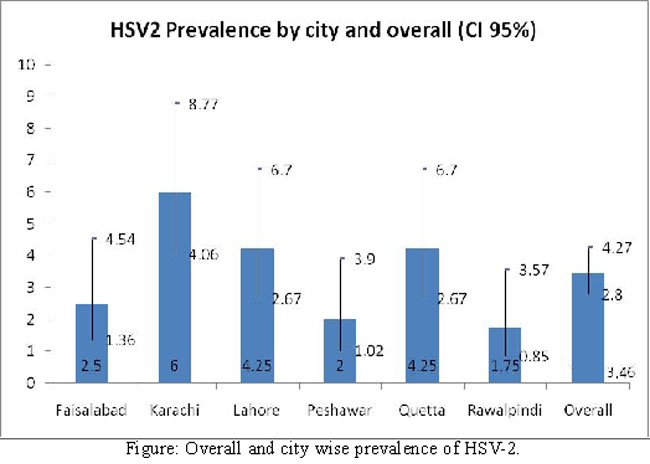
The overall prevalence of HSV-2 infection in all six cities was 3.5 percent (95% CI 2.8-4.3). City wise the highest prevalence was reported in Karachi 6 percent (95% CI 4.1-8.8), followed by Lahore and Quetta at 4.3 percent (95% CI 2.7-6.7), and Faisalabad at 2.5 percent (95% CI 1.4-4.5). The lowest prevalence was in Rawalpindi at 1.8 percent (95% CI 0.9-3.6).
Of a total of 83 respondents, 12 were positive for HSV-2 infection and were also diagnosed with syphilis. Nine respondents who tested positive for HSV-2 reported as never having had sexual intercourse in their life times.
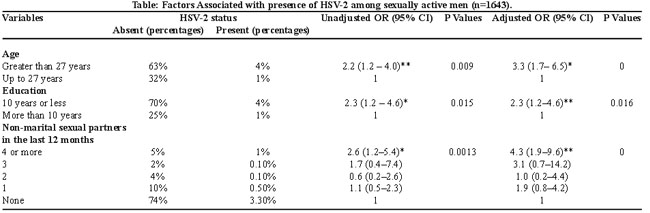
In Table, the multivariate analysis shows that HSV-2 infection was significantly associated with age greater than 27 years (27 years was selected as the cut off since it was the median age of the respondents in the overall sample). Having less than ten years of education had an adjusted O.R of 2.3 (95% CI 1.2-4.6). Association was also observed between presence of HSV-2 infection and respondents having four or more non-marital sexual partners (either male or female) in the last 12 months [adjusted O.R. 4.3 (95% CI 1.9-9.6)]. On the other hand, occupation, income and marital status were not found to be significantly associated.
Discussion
HSV is now considered as the major cause of Genital Ulcer Disease (GUD) in both developed10 and developing countries.5,11 HSV-2 is almost always sexually transmitted and has been shown to be a good marker of sexual risk behaviour in populations.12 HSV-2 seroprevalence among sexually transmitted diseases clinic attendees in studies from India ranged from 43 percent to 83 percent. In population based cross-sectional studies, a lower prevalence ranging from 7.9 percent to 14.6 percent was reported.13
According to Corey et al,14 more than 30 epidemiologic studies have demonstrated that prevalent HSV-2 is associated with a two to four fold increased risk of HIV-1 acquisition. A study in Rakai, Uganda, indicated that HSV-2-seropositive persons had a five fold greater risk of acquiring HIV-1 compared with HSV-2-negative persons.14
The clear linkage between HSV-2 infection and HIV acquisition points to the need for the prompt diagnosis and early management of HSV-2 infections as an important strategy for combating the spread of the HIV infection.
According to UNAIDS estimates, there are approximately 70,000 to 80,000 HIV positive cases in Pakistan, which is about 0.1 percent of the total adult population.15 The number of reported HIV cases is 2622, with 321 individuals suffering from AIDS.16 Our previous study has also found an HIV prevalence of 0.1 percent.17 Although in Pakistan HIV prevalence is low, recent evidence shows that the country is already experiencing a concentrated epidemic in the high-risk groups such as intravenous drug users, commercial sex workers, transvestites and long distance truck drivers.18 Therefore, the infection has the potential to spread from these groups to the general population. The presence of a concentrated epidemic in the high risk groups suggests the need for more targeted interventions at mitigating high risk behaviours including the acquisition of sexually transmitted infections.
An important aspect of HSV infection that raises a major public health challenge is the high proportion of infections that are unrecognized by both patients and clinicians. Up to 70 percent of genital HSV infections are unrecognized.3 Asymptomatic infection plays a major role in maintaining viral circulation in society.
Many cases of genital herpes are transmitted by persons who are unaware that they are infected. This study clearly demonstrates the link between sexual behaviours and HSV-2 prevalence. Having multiple partners is statistically significantly associated with disease occurrence. With a concentrated HIV epidemic already manifest in the high risk groups, genital herpes may serve as a conduit for the spread of subsequent HIV infections into the general low risk population of women. One of the most serious consequences of genital herpes in women is neonatal herpes. Without treatment 70 percent of neonates with disseminated infections are unable to survive19 and half of the survivors develop neurological conditions.
Based on the growing international evidence policy makers and programme managers should consider the prevalence of HSV-2 infection as a "canary in the mine" in predicting the emergence of a future HIV epidemic and the need to invest in HSV-2 surveillance programmes.
Our study results have demonstrated an association between HSV-2 prevalence and higher age, a finding similar to the results obtained from a multi country study conducted in Brazil, Estonia, India, Morocco and Sri Lanka where HSV-2 seroprevalence increased significantly with age.20
Future prevention intervention must therefore keep in mind targeting this specific group of older men, through focused IEC (Information, Education and Communication) and behaviour change strategies that reduce individual vulnerability by modifying sexual behaviours. Results from this study also show the relationship between educational level and infection prevalence to be city specific. For instance, Rawalpindi with a high male literacy rate (82 percent) had the lowest prevalence of HSV-2. On the other hand Karachi which is a metropolitan city with a large migrant population of unskilled workers and a lower male literacy level (72 percent) had the highest prevalence of all six cities. Future prevention programmes must, therefore, be cognizant of and adapt as needed, to city differentials. The empirical evidence from the literature has shown a higher seroprevalence of HSV-2 among females as compared to males.21-23 This argues for the inclusion of women in the overall STI prevention strategy.
To further enhance the effectiveness of prevention programmes, primary care providers should be trained to recognize, counsel and adequately manage STIs. Counseling will play an important role in preventing transmission to the partner and subsequent neonatal mortality. To ensure adequate treatment, antibody specific tests for HSV-2 detection should be made available on an incremental basis at all tertiary level care facilities, at least at the district headquarter hospitals where functional laboratories are already present. Furthermore health educational campaigns launched through health facilities should educate men about risk factors and the need for periodic testing in order to avoid complications that can occur in case they remain asymptomatic for long. Encouraging a healthy lifestyle by providing youth with life skills education within schools can be an effective approach in reaching out to young men. The information must include messages that conform to our religious and societal norms and emphasize behaviours such as abstinence and marital fidelity along with explanations of the modes of transmission and associated morbidities of sexually transmitted infections.
Currently, due to paucity of specific STI clinics in the public sector facilities, most men resort to traditional or private practitioners to manage their sexual health problems. These practitioners mostly prescribe antibiotics which may cover bacterial infections, but they do not treat viral infections. Mass awareness must be created in the general population to access services from trained providers who have the facilities to provide information, counseling, testing, and appropriate treatment.
Conclusion
While HSV-2 Prevalence in Pakistan is low, there is however, no room for complacency. Appropriate strategies for preventing acquisition and management of Sexually Transmitted Infections should be amongst the priorities for curtailing the future spread of an HIV epidemic in Pakistan.
Acknowledgment
The study of Sexually Transmitted Infections among urban male population in Pakistan: Identifying the Bridging Population was commissioned by the National AIDS Control Program, Government of Pakistan, with funding from the Department for International Development (DFID), United Kingdom. We are grateful to Dr. Rana Muzaffar, Head of Molecular Biology at Sindh Institute of Urology and Transplantation (SIUT), and her team, Dr. Salma Batool and Mr. Sabz Ali,for their assistance in carrying out all the laboratory tests.
References
1.Brugha R, Keersmaekers K, Renton A, Meheus A. Genital herpes infection: a review. Int J Epidemiol 1997; 26: 698-709.
2.Smith JS, Robinson NJ. Age-specific prevalence of infection with herpes simplex virus types 2 and 1: a global review. J Infect Dis 2002; 186: S3-28.
3.Corey L, Handsfield HH. Genital herpes and public health: addressing a global problem. JAMA 2000; 283: 791-4.
4.Chen CY, Ballard RC, Beck-Sague CM, Dangor Y, Radebe F, Schmid S, et al. Human immunodeficiency virus infection and genital ulcer disease in South Africa: the herpetic connection. Sex Transm Dis 2000; 27: 21-9.
5.Mbizvo MT, Mashu A, Chipato T, Makura E, Bopoto R, Fottrell PF. Trends in HIV-1 and HIV-2 prevalence and risk factors in pregnant women in Harare, Zimbabwe. Cent Afr J Med 1996; 42: 14-21.
6.Xu F, Sternberg MR, Kottiri BJ, McQuillan GM, Lee FK, Nahmias AJ, et al. Trends in herpes simplex virus type 1 and type 2 seroprevalence in the United States. JAMA 2006; 296: 964-73.
7.Mishra V, Vaessen M, Boerma JT, Arnold F, Way A, Barrere B, et al. HIV testing in national population-based surveys: experience from the Demographic and Health Surveys. Bull World Health Organ 2006; 84: 537-45.
8.National Institute of Population Studies and IRD/Macro International Inc. Pakistan Demographic and Health Survey 1990/1991. Columbia, Maryland, USA: National Institute of Population Studies and IRD/Macro International Inc., 1992.
9.Enzyme-linked immunosorbent assay (ELISA) for the qualitative detection of human IgG class antibodies to HSV-2. (Online) 2009 (Cited 2009 October 13). Available from URL: www.focusdx.com.
10.Mertz KJ, Trees D, Levine WC, Lewis JS, Litchfield B, Pettus KS, et al. Etiology of genital ulcers and prevalence of human immunodeficiency virus coinfection in 10 US cities. The Genital Ulcer Disease Surveillance Group. J Infect Dis 1998; 178: 1795-8.
11.Morse SA. Etiology of genital ulcer disease and its relationship to HIV infection. Sex Transm Dis 1999; 26: 63-5.
12.Nahmias AJ, Lee FK, Beckman-Nahmias S. Sero-epidemiological and sociological patterns of herpes simplex virus infection in the world. Scand J Infect Dis Suppl 1990; 69: 19-36.
13.Madhivanan P, Krupp K, Chandrasekaran V, Karat C, Arun A, Klausner JD, et al. The epidemiology of herpes simplex virus type-2 infection among married women in Mysore, India. Sex Transm Dis 2007; 34: 935-7.
14.Corey L, Wald A, Celum CL, Quinn TC. The effects of herpes simplex virus-2 on HIV-1 acquisition and transmission: a review of two overlapping epidemics. J Acquir Immune Defic Syndr 2004; 35: 435-45.
15.World Bank. Report on Preventing HIV/AIDS in Pakistan: Islamabad, 2005. (Online) 2009 (Cited 2009 January 30). Available from URL: http://go.worldbank.org/ZPV0G29CD0.
16.Family Health International. National Study of RTI and STI: Survey of high-risk groups in Lahore and Karachi: Islamabad, 2005. (Online) 2009 (Cited 2009 January 30). Available from URL: http://www.fhi.org/en/ CountryProfiles/Pakistan/res_stistudy.htm.
17.Mir AM, Wajid A, Reichenbach L, Khan M. STI prevalence and associated factors among urban men in Pakistan. Sex Transm Infect 2009; 85: 199-200.
18.Family Health International. Implementing Aids Prevention and Care Project: 2007. (Online) 2009 (Cited 2009 January 30). Available from URL: http://www.fhi.org/en/HIVAIDS/pub/res_IMPACT_Final_Report.htm.
19.Arvin, A, C Prober. Herpes Simplex Viruses. 876-883. In Murray, P, E Baron, M Pfaller, F Tenover, and R Yolken (eds.). Manual of Clinical Microbiology. 6th Ed. ASM, Washington, D.C. (1995).
20.Cowan FM, French RS, Mayaud P, Gopal R, Robinson NJ, de Oliveira SA, et al. Seroepidemiological study of herpes simplex virus types 1 and 2 in Brazil, Estonia, India, Morocco, and Sri Lanka. Sex Transm Infect 2003; 79: 286-90.
21.Fleming DT, McQuillan GM, Johnson RE, Nahmias AJ, Aral SO, Lee FK, et al. Herpes simplex virus type 2 in the United States, 1976 to 1994. N Engl J Med 1997; 337: 1105-11.
22.Obasi A, Mosha F, Quigley M, Sekirassa Z, Gibbs T, Munguti K, et al. Antibody to herpes simplex virus type 2 as a marker of sexual risk behavior in rural Tanzania. J Infect Dis 1999; 179: 16-24.
23.Shivaswamy KN, Thappa DM, Jaisankar TJ, Sujatha S. High seroprevalence of HSV-1 and HSV-2 in STD clinic attendees and non-high risk controls: A case control study at a referral hospital in South India. IJDVL 2005; 71: 26-30.
Journal of the Pakistan Medical Association has agreed to receive and publish manuscripts in accordance with the principles of the following committees:


