

Safoorah Khalid ( Laboratory Department, Dr. Sulaiman Al Habib Medical Group, King Fahad Road, Olaya Riyadh, Kingdom of Saudi Arabia. )
Mohammad Usman ( Laboratory Department, Dr. Sulaiman Al Habib Medical Group, King Fahad Road, Olaya Riyadh, Kingdom of Saudi Arabia. )
Mohammad Khurshid ( Laboratory Department, Dr. Sulaiman Al Habib Medical Group, King Fahad Road, Olaya Riyadh, Kingdom of Saudi Arabia. )
October 2010, Volume 60, Issue 10
Original Article

Abstract
Objective: To determine the frequency and type of Acute Transfusion Reactions (ATRs) occurring in inpatients, reported to the transfusion service at Aga Khan University Hospital, Karachi, Pakistan.
Methods: This was a three years and seven months (from January 2005 till July 2008) retrospective review of all the transfusion reactions that were reported to the transfusion service at Aga Khan University Hospital, Karachi, Pakistan. All the reactions were clinically evaluated by the blood bank physician. Transfusion reactions occurring during or within four hours after transfusion were evaluated and classified by standard and recognized definitions defined by American Association of Blood Banks.
Results: The acute transfusion reactions (ATRs) reported during the study period were 212. However, out of these 212 ATRs, 182 ATRs were confirmed by blood bank physician, and included febrile non haemolytic reactions [89 (41.9%)], allergic reaction [73 (34.4%)], isolated hypotension [3 (1.4%)], haemolytic reaction [4 (1.8%)] and bacterial contamination [2 (0.9%)]. Eleven (5.1%) ATRs were unclassifiable and were thus labeled as non specific reaction.
Conclusion: The frequency of transfusion reactions in our patients was found to be 0.082%. Febrile non haemolytic reaction was the most frequent transfusion reaction followed by allergic reaction. This may be an under reported figure. There is a need for establishing a haemovigilance system for critical analysis of blood transfusion events (JPMA 60:832; 2010).
Introduction
Transfusion of blood products is often required with the aim of improving the blood counts and clinical condition of the patients. However, transfusion can lead to serious adverse effects including infectious and non-infectious complications. With the improvements in donor screening and infectious diseases testing, the risk of infectious complications has declined in the past few decades. But the risks of non- infectious complications have become more apparent. These non- infectious complications can occur rapidly after transfusion (acute) or many days and/ or weeks after transfusion (delayed).1 Acute transfusion reactions (ATRs) occur within 24 hours of administration of transfusion and most of them occurs within the first four hours. Commonly encountered ATRs include acute haemolytic reaction, febrile non-haemolytic reaction, allergic reaction, volume overload, bacterial contamination and isolated hypotension.2 These ATRs have different etiology, clinical presentation and severity. However, most of these reactions are usually mild and transient.
The frequency of ATRs is estimated to be 0.2% to 10%2-4 and are responsible for death in approximately 1 per 250,000.3
Haemovigilance consists of reporting of all the complications related to transfusion so that these can be avoided in the future. Various haemovigilance programmmes have been developed and implemented in several countries including Canada, United Kingdom and France; and they publish their annual reports of adverse events associated with blood transfusion.4-6 The aim of these programmmes is to have a system of surveillance and thus lower the risks associated with transfusion. Unfortunately, there is no such programmme in Pakistan and the reporting of transfusion hazards is not mandatory. Also there is under reporting by the medical staff and thus most of the minor adverse events do not come to attention and therefore the exact incidence of various types of transfusion reactions is not known.
Keeping this in mind, the primary objective of the study was to determine the frequency and type of ATRs occurring in hospitalized patients who required transfusion at a tertiary care center in Pakistan.
Patients and Methods
This was a three years and seven months (from January 2005 till July 2008) retrospective review of all the transfusion reactions that were reported to the transfusion service at Aga Khan University Hospital, Karachi, Pakistan. All the reactions were clinically evaluated by the blood bank physician.
An algorithm was already provided to the medical staff in the ward on how to proceed with clinical and laboratory investigations whenever any transfusion reaction occurred. All the details were noted on a transfusion reaction form. In case of any transfusion reaction, pre-transfusion data that was collected included patient\'s identification number, ABO and Rh group of the patient, type of blood product transfused, donor number and blood group, date and time of starting transfusion and patient\'s vital signs. Post-transfusion data included date and time of stopping transfusion, approximate volume transfused, type of reaction noted and patient\'s vital signs.
As part of the routine transfusion reaction evaluation, the patient\'s blood sample and blood component(s) were checked for clerical errors; the serum or plasma in a post reaction blood sample was inspected for any evidence of haemolysis and compared with a pre reaction sample, if available. The tests performed after the occurrence of transfusion reaction were patient\'s ABO and Rh group on pre and post reaction samples, donor\'s ABO and Rh group, patient and donor re-cross matching on pre and post reaction samples, direct antiglobulin test (DAT) on patient\'s pre and post reaction samples, complete blood picture and peripheral blood film on post reaction sample, patient\'s urine detailed report and blood bag culture.
Transfusion reactions occurring during or within four hours after transfusion were evaluated. Based on the clinical features experienced by the recipient and laboratory parameters, these reactions were classified by standards and recognized definitions defined by American Association of Blood Banks.7 Febrile non haemolytic reaction was defined as a temperature increase of more than 1°C and/or chills associated with transfusion without any other explanation. Allergic reactions were associated with cutaneous or systemic manifestations that responded to antihistamine therapy. Immune haemolytic reactions were diagnosed based on the clinical and/or laboratory evidence of haemolysis and positive DAT. Non immune hemolysis due to mechanical destruction of red cells was suspected when the patient had hemolysis and negative DAT. Bacterial contamination was defined as the contamination of the blood product detected by a positive culture of the blood product resulting in infection of the recipient. Volume overload was manifested by respiratory distress leading to pulmonary oedema on chest X-ray. Isolated hypotension was marked by sudden hypotension after starting transfusion. Transfusion related acute lung injury (TRALI) was characterized by hypoxaemia, respiratory failure, hypotension and fever in the absence of cardiac failure, angioedema or bronchospasm. The signs and symptoms, for which no direct relationship to the transfusion could be demonstrated, were classified as non specific reactions.
All statistical analyses were performed using SPSS Version 16.0 (SPSS Inc. Chicago, IL, USA). Descriptive statistics were calculated for each of the variables. The incidence rate of ATRs was calculated as total number of a particular ATR (numerator) per total number of transfusions (denominator).
Results
The total number of transfusion reactions reported to our transfusion service during the study period was 212. There were 115 (54.3%) females and 97 (45.7%) males who had experienced a transfusion reaction. Mean age was 45 ± 20 years (range 0.2-88 years). The signs and symptoms encountered included fever [n= 90 (42.4%)], chills [n= 89 (41.9%)], urticaria [n= 76 (35.8%)], dyspnoea/ tachypnoea [n= 27 (12.7%)], hypotension [n= 4 (1.8%)], headache/ body aches [n= 3 (1.4%)], anxiety and/ or agitation [n= 2 (0.94%)], sweating [n= 2 (0.94%)], numbness of the extremities [n= 1 (0.47%)] and redness around the injection site [n= 1 (0.47%)]. All the signs and symptoms were reported within four hours of starting the transfusion.
All ATRs occurred with packed cells (87.7%), platelets (7.0%) and FFP (5.1 %); none of the transfusion reactions were observed with cryoprecipitate or granulocyte concentrates. Overall 0.18% of packed cells, 0.02% of platelets and 0.02% of FFP were involved in causing ATRs.
Of the 212 transfusion reactions reported, 30 (14.1%) were not concluded because of either missing data or failure to obtain the blood and urine samples for further investigation. Among the 182 ATRs that were confirmed by blood bank physician, there were febrile non haemolytic reactions [89 (41.9%)], allergic reaction [73 (34.4%)], isolated hypotension [3 (1.4%)], haemolytic reaction [4 (1.8%)] and bacterial contamination [2 (0.9%)]. Eleven ATRs (5.1%) were unclassifiable and were thus labeled as non specific reaction. Not a single case of TRALI was observed in our study.
In case of febrile non haemolytic reactions, cultures were performed on all the units and were found to be negative.
Anaphylactic shock manifested by systemic symptoms was observed in only one patient; who responded to symptomatic therapy.
The two reactions that were reported as bacterial contamination were due to gram negative rods which were identified in patient\'s blood culture as well as blood bag culture.
Haemolytic reaction was observed in four patients. Two of which were due to ABO incompatibility which was a result of errors at all stages in the transfusion chain. Two other haemolytic reactions occurred in patients who were transfused least incompatible blood due to a history of immune mediated haemolysis. In one of them, alloantibodies as anti C and anti K were detected after transfusion. However, no mortality or morbidity was encountered in all four patients.
The total number of transfusions recorded during the study period were 255662 and the total transfusion reactions were 212, giving a frequency of 0.082%. The characteristics of these transfusions are shown in Table-1.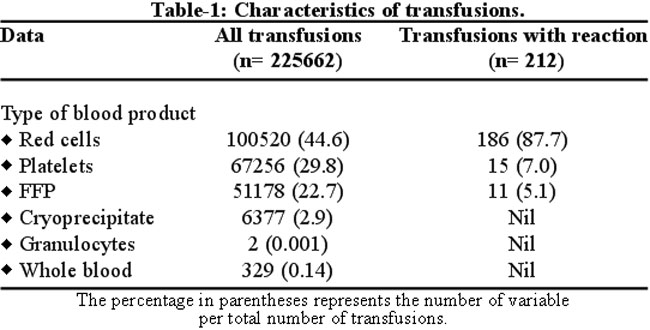
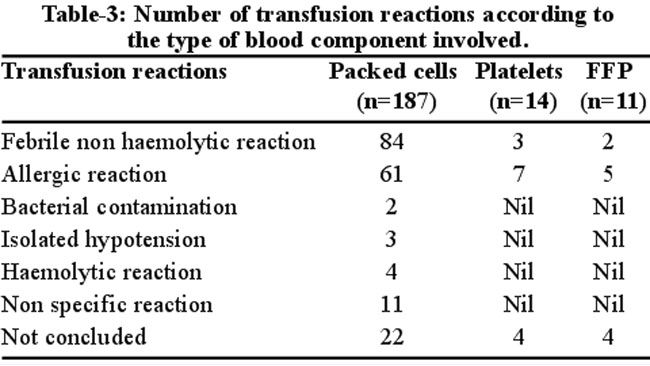
The distribution of different types of transfusion reactions is presented in Table-2 and the blood products that were involved in different types of reactions are summarized in Table-3.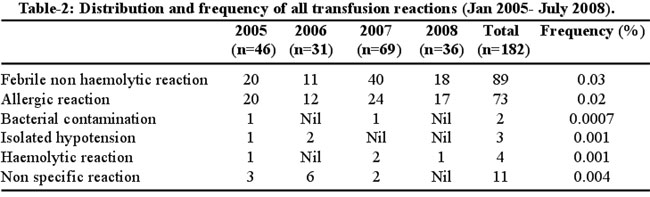
Discussion
To the best of our knowledge, this is the first study that provides a detailed analysis of transfusion reactions occurring at a single institution in Pakistan. Our results showed that febrile non-haemolytic reaction was the most frequent transfusion hazard followed by allergic reactions. This is similar to other studies as well.4,8,9
Incidence rates of transfusion reactions are also reported by various haemovigilance systems. In a report from the transfusion service of Puerto Rico Medical services administration,10 ATR was found to be in 0.2% of labile blood product transfusion. The haemovigilance network in France reported a rate of 0.25 incidents per 100 blood components between 1994 and 1998.6 According to 2001 report of haemovigilance system of the Canadian province of Quebec, the incidence of ATR was 0.35% for labile blood components.4 A university hospital in Switzerland documented a global incidence of 4.2 incidents for 1000 blood products distributed.11
The incidence of ATRs reported in our study (0.082%) is different from what is reported by these haemovigilance systems. This could be due to under reporting because a critical analysis has revealed that only the most obvious transfusion events are reported to our transfusion service and others are totally ignored.
Literature search has revealed many published case reports12-15 and haemovigilance reports16 of TRALI, however, only a single case of TRALI has been reported so far from Pakistan.17 We did not encounter any case of TRALI during the study period. This could be due to the rarity of this complication among the transfusion recipients and most importantly this may be due to the lack of clear definition and awareness of this potentially lethal complication among the healthcare personnel and also due to confusion with other conditions leading to similar clinical picture. Moreover, specific diagnostic tests to confirm TRALI are not available that further complicates the recognition of this reaction.
Another complication associated with transfusion i.e. volume overload was also not encountered in our study and this may also be due to the uncertainty about the diagnosis.
Transfusion reaction due to ABO incompatibility was observed in two patients. Such incidents of incorrect blood component transfusion have also been reported in the literature18-20 with errors occurring at all stages.
The blood products that were involved in transfusion reactions were packed cells, platelets and FFP with the majority of transfusion reactions being due to packed cells. This finding was also observed in a study conducted in a paediatric intensive care unit;1 however they only reported 48% of transfusion reactions due to packed cells with platelets accounting for 40% and FFP for 12%. The reason for this difference could be because of the use of universal leucoreduced packed cells used in this study in contrast to our study where leucoreduction was only employed if the patient experienced repeated febrile reactions.
The retrospective nature of our study has left many questions unanswered. First, we did not identify the risk factors that were present in patients who developed an ATR. Secondly, we only reported the transfusion events that occurred during the first four hours after transfusion since most significant ATRs are encountered during or soon after transfusion.1 Finally, under reporting by medical staff could have underestimated the number of ATRs in our study. Under reporting of minor transfusion reactions has also been reported by Narvios AB et al.21
To avoid any of the transfusion complications, there is a need to improve the knowledge of healthcare professionals for prompt recognition. The medical staff should understand the importance of reporting all major and minor transfusion events to the transfusion service. Improved and strict surveillance programmmes are required to estimate the risk- benefit ratio of blood transfusion and to identify the problems in the transfusion chain and take measures to assure compatibility between the donor and the recipient at all stages. Establishing a haemovigilance system can also be a better option to gain a better understanding of transfusion related events. The ultimate goal of all the efforts should be to make transfusion of blood as safe as possible for the patient.
Conclusion
The frequency of transfusion reactions in our patients was found to be 0.082% and there is surely an element of under reporting in our system. We strongly feel that there is a need for establishing a haemovigilance system in our country that can be helpful in the detection of transfusion reactions, as well as in the decision to take appropriate preventive measures.
References
1.Gauvin F, Lacroix J, Robillard P, Lapointe H, Hume H. Acute transfusion reactions in the pediatric intensive care unit. Transfusion 2006; 46: 1899-908.
2.Kleinman S, Chan P, Robillard P. Risks associated with transfusion of cellular blood components in Canada. Transfus Med Rev 2003; 17: 120-62.
3.Callum JL, Pinkerton PH. Transfusion reactions. In: Callum JL, Pinkerton PH. Bloody easy: blood transfusions, blood alternatives and transfusion reactions, a guide to transfusion medicine. Toronto (Ontario): Sunnybrook & Women\'s College Health Sciences Centre, 2005; pp 34-65.
4.Robillard P, Nawej KI, Jochem K. The Quebec haemovigilance system: description and results from the first two years. Transfus Apher Sci 2004; 31: 111-22.
5.Stainsby D, Jones H, Asher D, Atterbury C, Boncinelli A, Brant L, et al. Serious hazards of transfusion: a decade of haemovigilance in the UK. Transfus Med Rev 2006; 20: 273-82.
6.Andreu G, Morel P, Forestier F, Debeir J, Rebibo D, Janvier G, et al. Haemovigilance network in France: organization and analysis of immediate transfusion incident reports from 1994 to 1998. Transfusion 2002; 42: 1356-64.
7.Brecher ME. Non infectious complications of blood transfusion. In: Brecher ME, ed. Technical manual 14th ed. Bethesda: American Association of Blood Banks, 2002; pp 585-612.
8.Siegenthaler MA, Schneider P, Vu DH, Tissot JD. Haemovigilance in a general university hospital: need for a more comprehensive classification and a codification of transfusion related events. Vox Sang 2005; 88: 22-30.
9.Mbanya D, Binam F, Kaptue L. Transfusion outcome in a resource limited setting of Cameroon: a five year evaluation. Int J Infect Dis 2001; 5: 70-3.
10.Climent- Peris C, Velez-Rosario R. Immediate transfusion reactions. P R Health Sci J 2001; 20: 229-35.
11.Michlig C, Vu DH, Wasserfallen JB, Spahn DR, Schneider P, Tissot JD. Three years of haemovigilance in a general university hospital. Transfus Med 2003; 13: 63-72.
12.Haji AG, Sharma S, Vijaykumar DK, Paul J. Transfusion related acute lung injury presenting with acute dyspnoea: a case report. J Med Case Reports 2008; 2: 336.
13.Cruz J, Skipworth E, Blue D, Waxman D, McCarthy L, Smith D. Transfusion related acute lung injury: a thrombotic thrombocytopenic purpura treatment- associated case report and concise review. J Clin Apher 2008; 23: 96-103.
14.Muniz M, Sheldon S, Schuller RM, Young NS, Klein HG, Leitman SF, et al. Platelet specific transfusion related acute lung injury. Vox Sang 2008; 94: 70-3.
15.Lin Y, Kanani N, Naughton F, Pendergrast J, Karkouti K. Case report: transfusion related acute lung injury (TRALI)- a clear and present danger. Can J Anaesth 2007; 54: 1011-6.
16.Chapman CE, Stainsby D, Jones H, Love E, Massey E, Win N, et al. Ten years of haemovigilance reports of transfusion related acute lung injury in the United Kingdom and the impact of preferential use of male donor plasma. Transfusion 2009; 49: 440-52.
17.Bawany FA, Sharif H. Fatal transfusion related acute lung injury following coronary artery by-pass surgery: a case report. Cases J 2008; 1: 372.
18.Stainsby D, Jones H, Wells AW, Gibson B, Cohen H; Shot Steering Group. Adverse outcomes of blood transfusion in children: analysis of UK reports to the serious hazards of transfusion scheme 1996-2005. Br J Haematol 2008; 141: 73-9.
19.Chiaroni J, Legrand D, Dettori I, Ferrera V. Analysis of ABO discrepancies occurring in 35 French hospitals. Transfusion 2004; 44: 860-4.
20.Newcombe RG. Two sided confidence intervals for the single proportion: comparison of seven methods. Stat Med 1998; 17: 857-72.
21.Narvios AB, Lichtiger B, Neumann JL. Underreporting of minor transfusion reactions in cancer patients. MedGenMed 2004; 6: 17.
Journal of the Pakistan Medical Association has agreed to receive and publish manuscripts in accordance with the principles of the following committees:


