

M. Rafique ( Department of Urology, Nishtar Medical College and Hospital, Multan. )
A. I. Zaidi ( Department of Urology, Nishtar Medical College and Hospital, Multan. )
July 2003, Volume 53, Issue 7
Case Reports

Introduction
Case Report
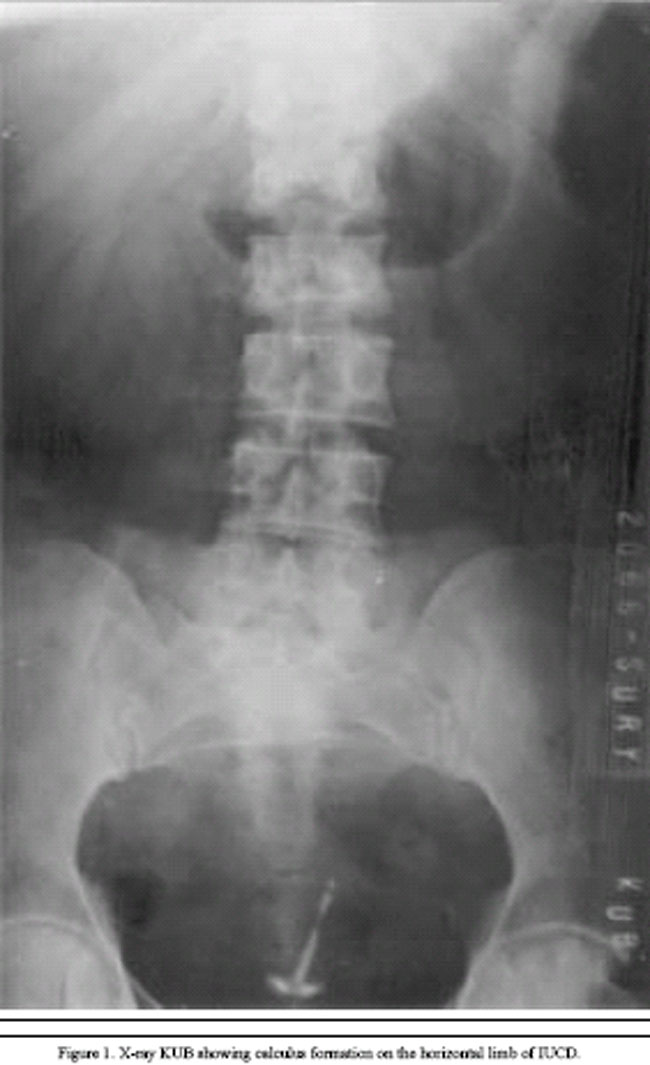
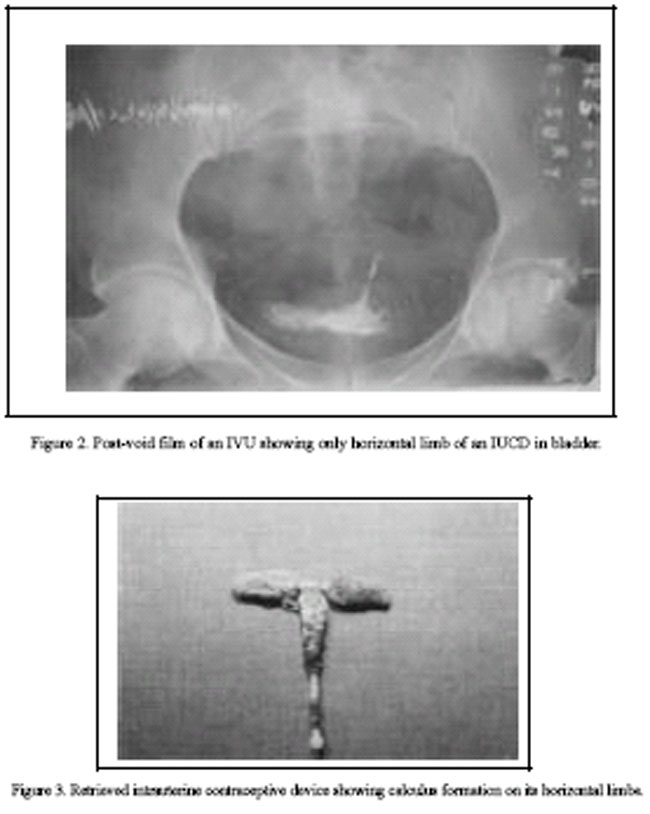
Cystoscopy was carried out. There was calulus formation on the horizontal limbs of IUCD while its vertical limb was still embedded in the uterus. The device was retrieved intact endoscopically (Figure 3). A foley catheter was retained. Her postoperative recovery was uneventful and she was discharged home after a week .
Discussion
Intra-uterine contraceptive device is considered to be an effective and reliable method of achieving contraception for family planning. However, such devices associated with complications e.g. spontaneous or septic abortion, migration into adjacent structures1, bowel perforation and vesicouterine fistula formation.2 Although erosion of IUCD into adjacent structures is an exceptionally rare event, intra-uterine devices have been found migrated into peritoneum, omentum, appendix, colon and bladder.1 How and when the migration of an IUCD in to the urinary bladder occurs, is not clear. Migration both, within months3 and years4 after its insertion has been reported.
Presence of IUCD in bladder leads to urinary symptoms and in some cases calculus formation.5-7 The degree of stone formation is variable and independent of the duration in bladder.1
Complete intra-vesical migration of IUCD and stone formation is reported in the literature. In the present case, stone formation occurred on a device that had only partially migrated in to the urinary bladder.
In a female patient with an IUCD inserted and presenting with lower urinary tract symptoms, the possibility of intra-vesical migration of the device should be considered in the differential diagnosis.
References
1. Dietrick DD, Issa MM, Kabalin JN, et al. Intravesical migration of intra-uterine device. J Urol 1992;147:132-4.
2. Thomola JV. Perforation of urinary bladder by intra-uterine device. Urology 1986;:27:260-4.
3. Maskey CP, Rehman M, Sigdar TK, et al. Vesical calculus around an intra-uterine contraceptive device.Br J Urol 1997:79:654-55.
4. Eckford SD, Persad RA, Brewster SF, Gingell JC.Intravesical foreign bodies: Five year review. Br J Urol 1992;69:41-5.
5. Lu HF, Chan JH, Chan WC, et al. Vesical calculus caused by migrant intrauterine device. Am J Roentgenol 1999;173: 504-5.
6. el-Diasty TA, Shokeir AA, al-Gharib MS, et al. Bladder stone: a complication of intravesical migration of Lippes loop. Scan J Urol Nephrol 1993:27:279-80.
7. Guvel S, Tekin MI, Kilinc F, et al. .Bladder stone around a migrated and missed intrauterine contraceptive device. Int J Urol 2001;8:78-9.
Journal of the Pakistan Medical Association has agreed to receive and publish manuscripts in accordance with the principles of the following committees:


