

Sajid Mahmood ( Department of Community Health Sciences, Aga Khan University, Karachi, Pakistan. )
Muhammad Kazim Rahim Najjad ( Department of General Surgery, K.V.S.S. Hospital, S.I.T.E, Karachi, Pakistan. )
Nasir Ali ( Dow University of Health Sciences Karachi, Pakistan. )
Naeem Yousuf ( Dow University of Health Sciences Karachi, Pakistan. )
Yasir Hamid ( Dow University of Health Sciences Karachi, Pakistan. )
September 2010, Volume 60, Issue 9
Original Article

Abstract
Objectives: To identify the predictors of obesity among post graduate trainee doctors working in a tertiary care hospital of public sector at Karachi, Pakistan.
Methods: A cross sectional analytical study was conducted at one of the tertiary care hospitals of public sector in Karachi. Information was collected from 117 post graduate trainee doctors via pre-tested self administered questionnaire and standard tools were used for height and weight measurement. Obesity was defined as body mass index (BMI) > 23 by using South Asian cut-off points. SPSS version 16 was used for data analysis, and logistic regression technique was applied to come up with predictors of obesity.
Results: Frequency of overweight and obesity among doctors was 31.6% and 28.2% respectively. Nearly, 18% were using tobacco and family history of obesity was present in 44%. Approximately 64% doctors were taking lunch outside home, 76% were taking tea at least once a day, 59% were taking snacks between meals and 50% were physically inactive. Predictors of obesity among doctors include; taking lunch outside home OR=7.11 (2.28-22.09), snacks between meals OR=5.36 (1.51-19.03), tea OR=7.85 (1.63-37.63), physical activity OR=0.18 (0.05-0.57), increase duration of training OR=1.7 (1.15-2.49), family history of obesity OR=3.35 (1.11-10.08) and male gender OR=3.83 (1.07-13.72).
Conclusion: Frequency of overweight and obesity was high among post graduate trainee doctors. Taking lunch outside home, snacks and tea intake between meals, increase duration of training, family history of obesity, male gender and lack of physical activity were found to be predictors of obesity among doctors (JPMA 60:758; 2010).
Introduction
Obesity is a condition in which there is an excess accumulation of fat in body.1 It is generally defined as body mass index (BMI) of > 30 kg/m2.2 It has been recognized as public health problem due to the fact that it increases the risk of chronic diseases such as cardiovascular diseases (CVD), stroke, diabetes, sleep apnoea, osteoarthritis, and many types of cancers.3,4 It decreases the productivity of a country by reducing life expectancy of an individual.5
Prevalence of overweight and obesity has been increasing throughout the world but the United States ranks high among other developed nations.6 It is well documented that approximately 300,000 adult deaths in the United States each year are due to unhealthy dietary habits and physical inactivity or sedentary behaviour.6 Nearly two-thirds of U.S. adults are overweight (BMI > 25), which includes those who are obese7 while in Canada its prevalence was found to be 15%.8,9 Individual national level studies from European countries have shown the prevalence of obesity in rage of 10-20% in men and 10-25% in women.10-12
Previously, obesity was considered as a problem of developed countries, but now in the last few decades its rising trend has been observed in developing countries as well.13 The prevalence of obesity was 5% and 15% in Mauritius\'s men and women respectively while in South Africa it was 8% among men and 44% in women.14,15 Data from Eastern Mediterranean Region showed that prevalence of obesity in Saudi Arabia was 16% and 24% in men and women respectively and in Kuwait its prevalence was 32% and 44% in men and women respectively.16,17
The overall prevalence of overweight and obesity were found to be 25% in general population of Pakistan.18 The highest figure, 42.8% was observed in women of age group 35-54 years. The factors associated with obesity were increasing age, female gender, urban residence, being literate, having a high economic status, high intake of meat and sedentary life style.18 Among school children, the percentage of obesity and overweight were reported to be 6% and 19% respectively.19 A study conducted in private dental college of Karachi reported that approximately 44% of male students and 61% of female students were above normal weight.20 Similarly, a study from a private medical university of Karachi showed 41.7% of the students to be overweight or obese.21
However, there is dearth of knowledge regarding obesity and its associated factors among doctors who are a role model for the general population. Due to their sedentary life style they are more prone to become overweight or obese and ultimately are at a greater risk for chronic diseases. The objective of the study was to identify the predictors of obesity among post graduate trainee doctors so as to provide an intervention programme for the professionals having a sedentary life style. We hypothesized that taking lunch from out of home is associated with obesity in doctors of a tertiary care hospital, in Karachi.
Methodology
A cross sectional analytical study was conducted in one of the tertiary care hospitals (Civil Hospital) of the public sector in Karachi, providing post graduate training. Those eligible to participate in the study were doctors enrolled for postgraduate training in any ward of the hospital. Interns and consultants were excluded. Well structured self administered questionnaires were given to doctors who were randomly selected from the list of post graduate trainees.
The respondents were asked not to put names or other identifying notation on the questionnaire to conceal their identity, and full confidentiality of information was ensured. There were no potential risks to the subjects in this study as there were no interventions involved. Data entry was done on Epi Info. Written consent was taken from each of the selected participant before filling the questionnaire. Sample size calculation was done on software Epi info, using 80% power, to detect odds ratio of 2 for obesity, at 5% level of significance, sample size of at least 117 was required to meet our objectives.
After the completion of questionnaire, weight and height measurement were carried out of each participant. Weight was measured bare footed and light clothes using a digital weighing machine and to the nearest 0.05 Kg. Height was measured to the nearest 0.5 cm by using portable height meter after removing shoes, and placing heels together.
Outcome variable was obesity defined by using South Asian cut-off of body mass index (BMI > 23).22 The independent variables used in the study were; age, duration of residency, monthly income, gender, marital status, ethnicity, tobacco use, family set up, family history of obesity, place of breakfast, place of lunch, place of dinner, snacks, tea use, and physical activity.
Software SPSS version 16 was used for statistical analysis. Mean and standard deviation was calculated for continuous variables, while proportions of categorical variables were reported. Univariate analysis was run to determine the relationship of each independent variable with the outcomes variable. Multiple logistic regression analysis technique was applied to select the group of variables independently associated with obesity. Odds ratio and 95% confidence intervals were reported to interpret our final model. Adjustment of confounders and interactions were done. Goodness of fit of model was checked by Hosmer and Lemeshow Test (A test used to assess, whether the resulted model fit the data well or not, especially when the purpose of the model is to estimate probabilities of event occurrences).23
Results
Information was gathered from 117 participants. In our sample, 37 (31.6%) postgraduate trainee doctors were overweight and 33 (28.2%) were obese. Detail of the descriptive characteristics of the participants is given in Table-1.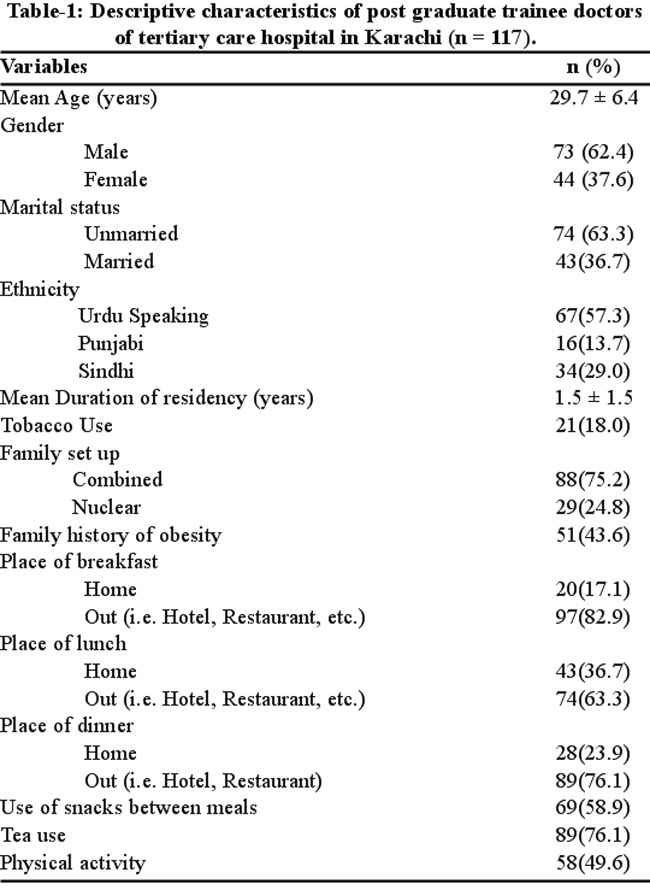
The variables found to be significant at univariate analysis level (p-value < 0.25) are summarized in Table-2.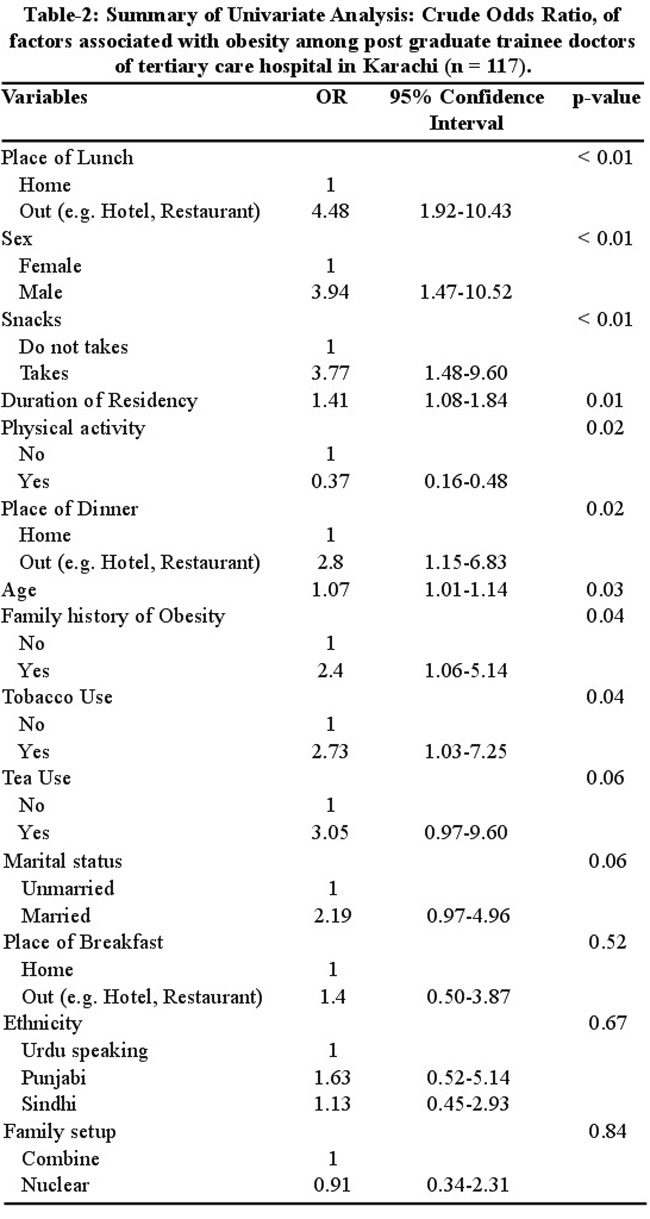
At multivariable level, place of lunch, gender, snacks, duration of residency, physical activity, family history of obesity and tea intake were found to be significant at the 5% level of significance (Table-3).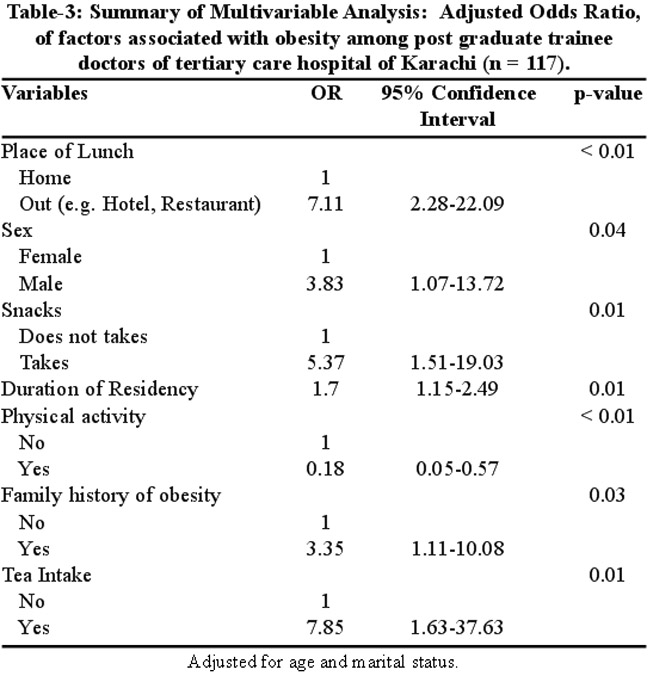
Final model has been adjusted for confounders (age and marital status). None of the biological plausible interaction was found to be significant. The summary measures of Hosmer and Lemeshow test showed that the model fits the data well.
Discussion
Approximately 28.2% of the post graduate trainees were obese and factors associated with obesity were eating lunch out of home, male gender, taking tea, snacks between meals, duration of residency, family history of obesity, and lack of physical activity. Our proportion of obesity among doctors was consistent with the prevalence of obesity in general population of Pakistan.18
Our study found significant association of having lunch from out of home that may be due to the fact that food items being cooked in commercial areas usually have more fat content as compared to homemade food. However, this is a new observation and needs verification through studies covering comprehensive dietary information.
In our study, male gender was associated with obesity which is contrary to other studies which found the female gender at greater risk for obesity.18,24 This may be due to a high proportion of male participants in our study as compared to females. We also found an association of obesity with tea and snacks between meals. This finding is not consistent with results from other studies which have shown protective effect of tea towards obesity.25,26 The contribution of tea towards obesity is due to the sugar content which varies from person to person. The usual snacks include biscuits, chips, or samosas which are rich in calories and lead to obesity.
Family history of obesity was also found to be associated with obesity in our study and this is consistent with prior studies.18 Similarly, physical activity was also found to be a protective factor against obesity and this is also in accordance with previous studies.27,28
Although, our study has identified important factors that contribute to obesity in doctors, there is a strong need to study these factors in details. The dietary components of lunch should be analyzed to identify the major difference in foods taken from out of home as compared to home-made meals. This will help to formulate healthy dietary recommendations.
Conclusion
This study identified lunch from canteens, excess tea, snacks between meals and lack of physical activity as major contributing factors towards obesity in doctors. This will help to provide guidance for the professionals to adopt a healthy life style to prevent obesity.
References
1.Garrow JS. Obesity and related diseases. London: Churchill Livingstone 1988; 1-16.
2.Physical Status: the use and interpretation of anthropometry. Report of a WHO Expert committee. Geneva, World Health Organization, 1995; 329 [Technical Report Series, No.854].
3.World Health Organization (WHO). Diet, Nutrition and the prevention of chronic diseases. Geneva: 2003. Technical report series 916.
4.World Health Organization (WHO). Obesity and overweight. Geneva: 2006.
5.Haslam DW, James WP. Obesity. Lancet 2005; 366: 1197-209.
6.Heitman B. Ten-year trends in overweight and obesity among Danish men and women aged 30-60 years. Int J Obesity 2000; 24: 1347-52.
7.U.S. Department of Health and Human Services. The Surgeon General\'s Call to Action to Prevent and Decrease Overweight and Obesity, 2001.
8.Flegal KM, Carroll MD, Ogden CL, Johnson CL. Prevalence and trends in obesity among US adults, 1999-2000. JAMA 2002; 288: 1723-7.
9.Flegal KM, Carroll MD, Kuczmarski RJ, Johnson CL. Overweight and obesity in the United States: prevalence and trends, 1960-1994. Int J Obes Relat Metab Disord 1998; 22: 39-47.
10.Reeder BA, Angel A, Ledoux M, Rabkin SW, Young TK, Sweet LE. Obesity and its relation to cardiovascular disease risk factors in Canadian adults. Canadian Heart Health Surveys Research Group. CMAJ 1992; 146: 2009-19.
11.Prescott CP, Health Survey for England 1995, London, Her Majesty\'s stationery office, 1997.
12.Seidell JC. Time trends in worldwide prevalence of obesity. In: Bray GA, eds. Handbook of obesity, New York: Marcel Dekker 1998; 79-91.
13.Seidell JC. Time trends in obesity: an epidemiological prospective. Horm Metab Res 1997; 29: 155-8.
14.Hodge AM, Dowse GK, Gareeboo H, Tuomilehto J, Alberti KG, Zimmet PZ. Incidence, increasing trends and predictors of change in obesity and fat distribution over five years in the rapidly developing population of Mauritius. Int J Obes Relat Metab Disord 1996; 20: 137-46.
15.Steyn K, Jooste PL, Bourne L, Fourie J, Badenhorst CJ, Bourne DE, et al. Risk factors for coronary heart diseases in black population of the Cape Peninsula. The BRISK Study. S Afr Med J 1991; 79: 480-5.
16.Al-Nuaim A. Prevalence of diabetes mellitus, obesity, and hypercholesterolemia in Saudi Arabia. Diet related non communicable diseases in Arab countries of the Gulf. Cairo, Food and agriculture Organization of the United Nations 1996: 73-81.
17.Al-Isa AN. Prevalence of obesity among adult Kuwaitis; a cross sectional study. Int J Obes Relat Metab Disord 1995; 19: 431-3.
18.Jafar T, Chaturvedi N, Pappas G. Prevalence of overweight and obesity and their association with hypertension and diabeties mellitus in Indo-Asian population. CMAJ 2006; 175: 1071-7.
19.Aziz S, Noorulain W, Zaidi UE, Hossain K, Siddiqui IA. Prevalence of overweight and obesity among children and adolescents of affluent schools in Karachi. J Pak Med Assoc 2009; 59: 35-8.
20.Hingorjo MR, Syed S, Qureshi MA. Overweight and obesity in students of a Dental College of Karachi: lifestyle influence and measurement by an appropriate anthropometric index. J Pak Med Assoc 2009; 59: 528-32.
21.Nisar N, Qadri MH, Fatima K, Parveen S. Dietary habits and life style among the students of a private Medical University Karachi. J Pak Med Assoc 2009; 59: 98-101.
22.Snehalatha C, Viswanathan V, Ramachandran A. Cutoff Values for Normal Anthropometric Variables in Asian Indian Adults. Diabetes Care 2003; 26: 1380-4.
23.Hosmer DW, Lameshow S. Applied Logistic Regression. 2nd Ed. USA: Lipponcott Raven Publisher; 1998.
24.Fouad M, Rastam S, Ward K, Mazlak W. Prevalence of obesity and its associated factors in Aleppo, Syria. Prev Control 2006; 2: 85-94.
25.Dulloo AG, Duret C, Rohrer D, Girardier L, Mensi N, Fathi M, et al. Efficacy of a green tea extract rich in catechin polyphenols and caffeine in increasing 24-h energy expenditure and fat oxidation in humans. Am J Clin Nutr 1999; 70: 1040-50.
26.Roberts AT, Levitan DJ, Parker L, Greenway CC, Frank L. The effect of an herbal supplement containing black tea and caffeine on metabolic parameters in humans. Alternat. Med Rev 2005, December 01.
27.Aronne LJ. Articles about Classification and Assessment of Obesity related health risk, Dept. Of Medicine, Weill Medical College of Cornel University New York 2003.
28.Dugan SA. Exercise for preventing childhood obesity. Phys Med Rehabil Clin N Am 2008; 19: 205-16.
Acknowledgment
We are thankful to Jaishri Meraj, Mehreen Fatima and Shafiq-ur-Rehman for their contribution in statistical analysis. We also appreciate the contribution of Majid Khan in data entry process.
Journal of the Pakistan Medical Association has agreed to receive and publish manuscripts in accordance with the principles of the following committees:


