

M. Alam ( Final Year Medical Students and Departments of Pathology The Aga Khan University Hospital,Karachi )
Y. N. Akhtar ( Final Year Medical Students and Departments of Pathology The Aga Khan University Hospital,Karachi )
S. S. Ali ( Final Year Medical Students and Departments of Pathology The Aga Khan University Hospital,Karachi )
M. Ahmed ( Final Year Medical Students and Departments of Pathology The Aga Khan University Hospital,Karachi )
M.Atiq ( Final Year Medical Students and Departments of Pathology The Aga Khan University Hospital,Karachi )
A. Ansari ( Final Year Medical Students and Departments of Pathology The Aga Khan University Hospital,Karachi )
F. A. Chaudhry ( Final Year Medical Students and Departments of Pathology The Aga Khan University Hospital,Karachi )
H. Bashir ( Final Year Medical Students and Departments of Pathology The Aga Khan University Hospital,Karachi )
M. A. Bangash ( Final Year Medical Students and Departments of Pathology The Aga Khan University Hospital,Karachi )
A. Awais ( Final Year Medical Students and Departments of Pathology The Aga Khan University Hospital,Karachi )
A. Safdar ( Final Year Medical Students and Departments of Pathology The Aga Khan University Hospital,Karachi )
S. F. Hasnain ( Final Year Medical Students and Departments of Community Health Sciences The Aga Khan University Hospital,Karachi )
A. Zafar ( Final Year Medical Studerts Departments of Pathology and Microbiology. Final Year Medical Studerts The Aga Khan University ilospttal. Karachi. )
March 2003, Volume 53, Issue 3
Student's Corner

Abstract
Objective: To determine the seasonal variation of the commonly isolated bacterial pathogens in stool samples.
Material and Methods: A retrospective descriptive study was undertaken of all the stool samples submitted from within Karachi to the Aga Khan University Hospital Laboratory over a period of five years (January 1997- December 2001) in order to determine the commonly isolated bacterial pathogens and to predict their seasonal variation.
Results: A total of 16379 stool samples were included in this review. Bacterial isolates were found in 6670 stool samples (culture detection rate=40.7%). The mean age at the time of culture of each sub-group was <1 year group (6.58 ± 3.1 months), 1-5 years (2.13 ± 0.94 years), 5-14 years (8.3 ± 2.6 yrs) and adults (43.2 ± 18.5 years). Male: Female ratio was 1.2:1. Vibrio cholera 01 Ogawa (32.8%), Campylobacter jejuni (17.3%), Enteropathogenic Escherichia coli (9.9%), Salmonella paratyphi b (6.6%) and Shigella flexneri (6.2%) were the most common organisms isolated. These organisms show a distinct seasonal variation with summer predilection.
Conclusion: In contrast to the previous studies from South Asia, which have identified E. coli, followed by Vibrio cholerae as the most common enteric isolates, we found Vibrio cholera 01 Ogawa followed by Campylobacter jejuni as the most common enteric pathogens isolated in an urban setting. It is important to consider seasonal variation when empirically treating diarrheal diseases in our region (JPMA 53:125:2003).
Introduction
Diarrheal diseases hold profound messages as well as opportunities that range from public health to basic science.1 Significant mortality and morbidity in the developing world is attributable to diarrheal diseases.2 The result of a multifactorial etiology, a complex interplay of social, economic and biological forces serve to keep these diseases within the population and render attempts at reduction of the disease burden ineffective. Apart from poverty, diarrhea morbidity and mortality is associated with population overgrowth.3
Seasonal cycles of infectious diseases have been variously attributed to changes in atmospheric conditions, the prevalence or virulence of the pathogen, or the behavior of the host organism.4 An understanding of the seasonal variation of enteric pathogens would contribute greatly in focusing healthcare initiatives in a climate of limited resources to a cost-effective reduction in disease morbidity and mortality which is why it has attracted considerable attention from healthcare researchers around the world with several studies having been conducted in both the developing and the developed countries.5-19
There are a limited number of papers availab!e from Pakistan that document the variety of bacterial isolates from stool samples and, although these have characterized the enteric isolates from stool samples (Aeromonas, Shigella, Campylobacter and Rota virus)20-23, they have not ventured into a study of the seasonal variations of these organisms. This study reports common isolated organisms in stool samples of patients with diarrhea and their seasonal variation.
Material and Methods
A retrospective descriptive analysis was done of all the stool samples submitted for bacterial culture at The Aga Khan University Hospital Laboratory or at its Collection Points in Karachi, Pakistan from January 1997 to December 2001.
All stool samples submitted from the city of Karachi including both the adult (defined as age >14 years) and pediatric population (defined as age <,14 years) were included in the study. For analysis purposes. all stool samples negative for bacterial culture were excluded. The data was analyzed for variables like age, sex, origin of stool samples (inpatient vs. outpatient), and enteric pathogens isolated. Data was analyzed using SPSS version Il .0 and EPI info version 6.0.
Results
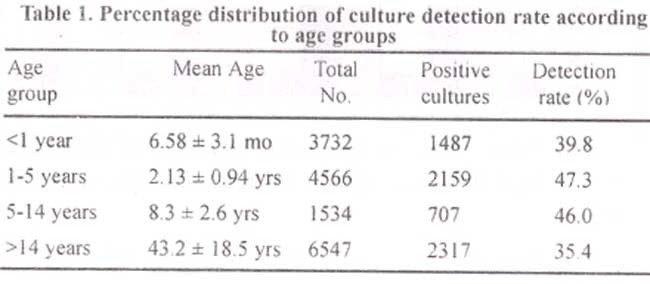
A total of 16379 stool samples collected in Karachi, Pakistan at The Aga Khan University Laboratory during the study period were studied for the various bacterial pathogens. Bacterial pathogens were isolated in 6670 samples with a detection rate of 40.7%; 9709 samples were negative on bacterial culture. Majority of stool samples were submitted from within the hospital (n5454, 81.8%) as compared to outpatient samples (n=l2l6, 18.2%). There were 3702 (55.5%) males and 2968 (44.5%) females. The mean ages of the various sub-groups of patients and culture detection rates (culture detection rate is calculated using denominator of 16379 i.e., total no. of stool samples) are given in Table 1.
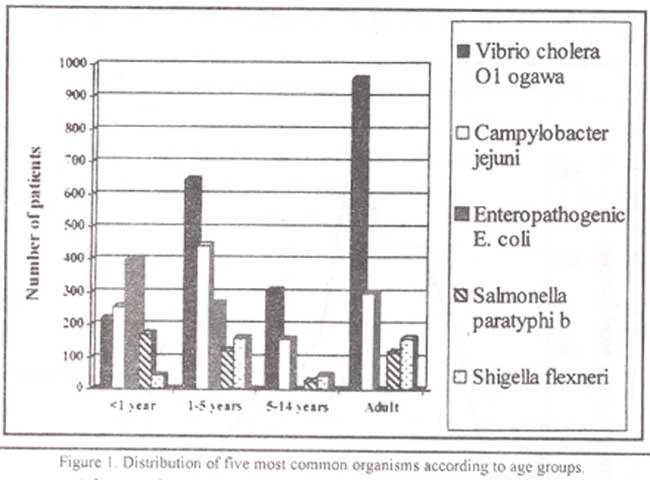
Altogether 20 species of different pathogenic bacteria were isolated from the stool samples submitted to The Aga Khan University Laboratory. The most common organisms were Vibrio cholera 01 Ogawa (33.8%), Campylobacter jejuni (17.3%), Enteropathogenic E. coli (9.9%). Salmonella paratyphi b (6.6%), and Shigella flexneri (6.2%). The other less commonly isolated pathogens include V cholera 0139, Campylobacter coli and Aerornonas hydrophila. Age-wise distribution of the five most common isolates is shown in Figure 1.
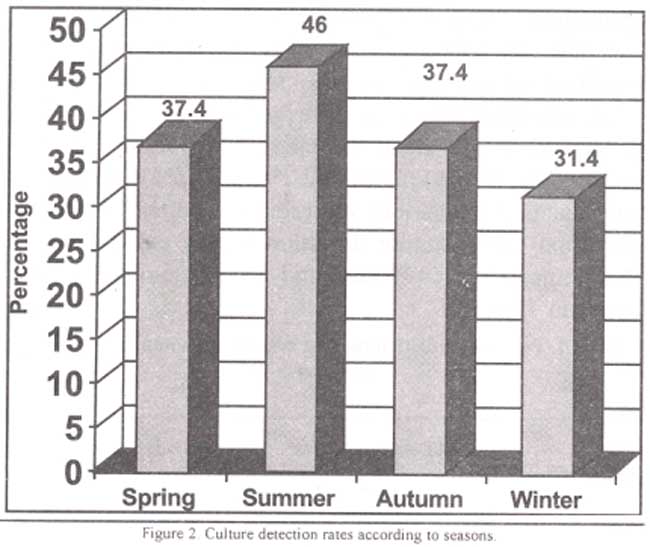
Detection rate of bacterial pathogen was high in summer as compared to other seasons (p=0.00000I). Seasonal bacterial pathogen detection rates are shown in Figure 2.
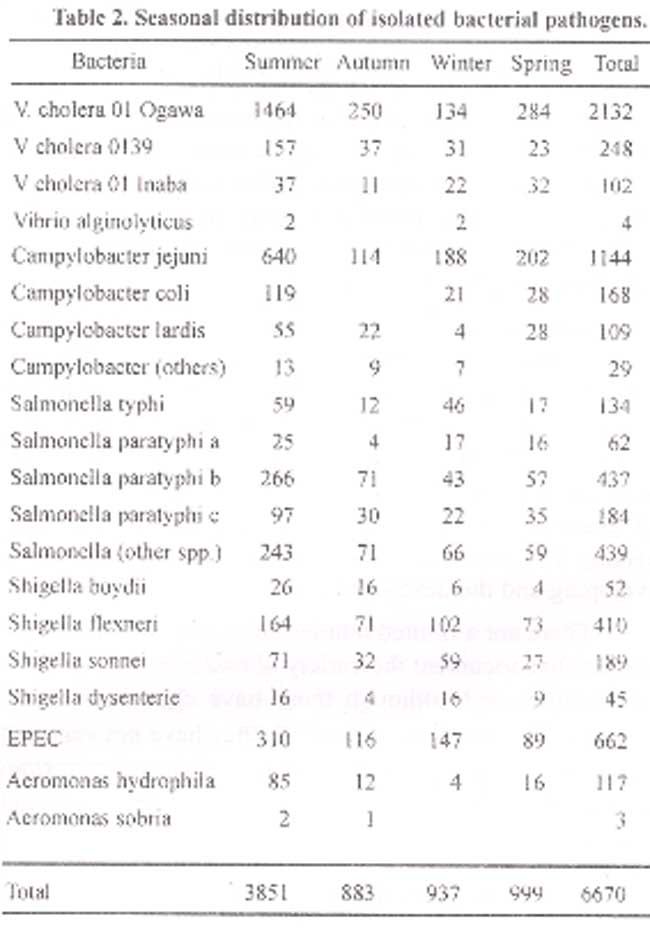
The seasonal distribution of the other organisms is shown in Table 2.
Trends in seasonal variation of three most common fecal bacterial isolates from cultures are shown in Figure 3.
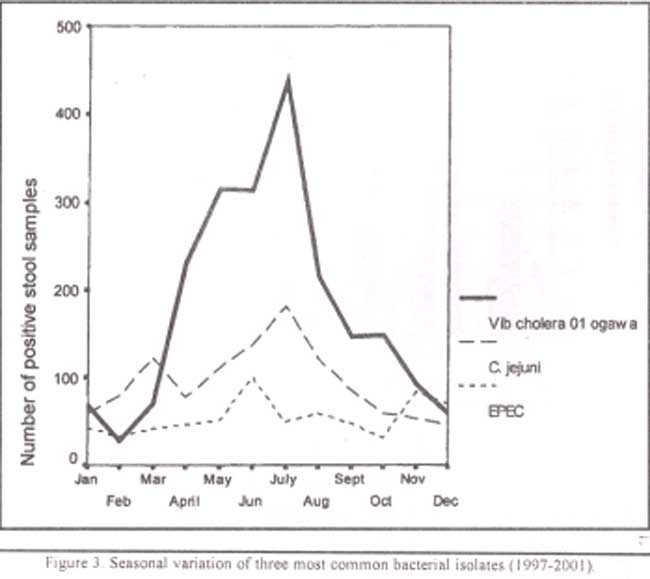
Vibrio cholera 01 ogawa was the most common single species identified in our study samples. Majority of the stool samples cultured Vibrio cholerae 01 ogawa during the summer as compared to the other seasons (p< 0.00001).
On comparison between the pediatric and adult population, over all 41.6% (958/1343) of the adult isolates were Vibrio cholerae 01 ogawa as compared to 27.1°/o (1174/4327) and this was a statistically significant difference noted (p <0,0001). A significant difference was found among different pediatric age groups in terms of Vibrio cholerae 01 ogawa culture results (p <0.05). All but 58 samples were submitted from within the hospital.
Campylobacter jejuni was the second most frequently isolated pathogen. This organism also showed a summer preponderance (p
Discussion
The isolation of pathogenic enteric bacteria from 4O.6% of the total sample size is a high rate. In comparison 33 % of fecal samples showed enteropathogens in Nepal.5 Rates were lower as compared to 73.5% in Surabaya, Indonesia24 and 58.4% in Manila Philippines.25
Since Aga Khan University Hospital is a tertiary care facility, we assume that clinical characteristics of the patients at the time of presentation must have prompted the healthcare providers to send stool culture and sensitivity testing right away. Especially in the lower socioeconomic strata, investigation are kept to a minimum and only where extremely necessary. e.g. for recurrent or resistant symptoms. The true burden of disease may be much more than can be estimated from these figures, because many patients are treated empirically without use of cultures.
Higher detection rate during the summer season may be explained due to various factors. First of all high temperature during this time of the year is thought to promote growth of these organisms in the environment. Moreover, monsoon season causes a lot of strain on already inadequate sewage disposal system in Karachi therefore resulting in a greater number of incident cases.
No differences were observed in the enteropathogen detection rate between male and female subjects. This finding was consistent with those from other regions of the world. However in China female patients were significantly more likely to be infected with Enterotoxigenic E. coli.26
V. Cholera 01 Ogawa ranked the most frequent single pathogen in this study sample. Although studies done in Indonesia, Ghana and Beijing have shown EPEC to be the most common bacterial isolate in there stool samples.24,26,27 Especially in the summers. the frequency of V. cholera towers above other pathogens. This\'organism is endemic in the region and is the major organism in the seventh pandemic of this disease. The greater burden of this disease exists in children but accounts for a higher proportion of the total disease in the adult sample. It may be because acquired immunity to this disease is incomplete and unreliable.28
Toxigenic V. cholerae is now recognized as an autochthonous member of the microflora in many aquatic environments based on its protracted survival and proliferation without losing the virulence determinants.29.30 This explains the high yield of this organism in Karachi. being a coastal city.
V. cholera exhibited a fairly uniform distribution pattern over the various years with respect to its seasonality. It was most commonly isolated in the summer season around May-July. However in 1999 and 2000, it showed a prominent bimodal distribution with a second peak during October. These findings coincide with those of Bubshait et al who found that Vibrio cholerae 01 Ogawa infections in Saudi Arabia appeared in late May. decreased in mid-July through August, increased again in September. and disappeared from December through April. Infections had a uniform geographic distribution and affected all ages.31
Comparing the adult and paediatric isolates of V.cholera, it comprises 55% of paediatric and around 45% of adult positive samples. However, of all the V cholera samples, 27.1% were from children and 44.1% from adults. This discrepancy in findings may be attributed to the fact that most common cause of childhood diarrhea being Rota virus infection had been ignored in our study and designated as negative stool cultures.
The second most commonly isolated organism is C. jejuni. It was isolated all the year around. However, it also showed summer preponderance where it usually appears around July, and in 1 998 there was a bimodal distribution with one prominent peak in March followed by a second one in August. It is difficult to explain this finding.
Chen et al have shown that Campylobacter jejuni could be detected in young children with acute diarrhea all the year round, with a higher detection rate in the spring and summer and lower in the autumn and winter.32 Investigators from Bangladesh have shown that age-specific infection rates with Campylobacter spp were greatest in infants.33 There was no age specific difference with regard to Campylobacter spp.
Looking at the various organisms. Salmonella paratyphi b species is significantly associated with the summer season, particularly in the pediatric age group. A similar trend has been seen for Shigella flexneri. However, it is more commonly a disease of the adult population. This may be explained by the erratic eating behavior of this population group. It was observed that neither Shigella nor Salmonella had significant seasonal variation although enteric fever and dysentery both are more common during the summer season.25
The main limitation of this study was the unavailability of the clinical characteristics of our sample patients. It has been documented that several enteric pathogens like V. cholera and Campy!obacterjejuni can be isolated from asymptomatic individuals.31,32 Therefore the actual burden of gastroenteritis attributable to these specific organisms cannot be documented.
Determining pathogens will treat diarrheal allow targeted variation of enteric providers to empirically understanding will g those most vulnerable, which will enable further documentation of cost effectiveness and the potential for improved human development, which is critical to reducing the widening disparity and population overgrowth, which increasingly threaten our global security. Ours is a baseline study. which will provide insight to the doctors in our community and guide further prospective studies of patients presenting with gastroenteritis.
References
1.Guerrant RL Twelve messages froni enteric infectious for science and society. Am J Trop Med live 1994:51:26-35.
2.Sazawat S, Black RE , Bhan MK. et at Zinc supplenientation reduces the incidence of persistent dianhea aiid dysentery among low socioeconomic children in India. 3 Nuir t 996:126:443-50
3.Guerrant RL. Lessons from diarrheal diseases. demography to molecular phamiacology 3 Infect Dis t 994:169:1206-18
4.DoweIl SF. Seasonal variatioii in host susceptibility and cycles of certain infectious diseases. E:aerg Infect Dis 2001.7:369-74.
5.Ono K, Rai SK, Chikahira M, ei al. Seasonal distribution of enteropathogens detected from diarrhcal stool and waler samples collected in Kattumandu. Nepal. 5oulheast Asian J Trop Med Public Health 2001:32:520-6.
6.Wasfv MO. Oyofo BA. David iC. ci al. Isolation and aiiiibiotmc susceptibility of Salmonella. Shigella. aiid Campylobacter from acute enleric infections in Egypt i Health Popw Nuts 2000:18 33-8
7.Faruque AS. Salam MA. Faruque SM. ci al. Aeliological. clinical and epidemiological characteristics of a seasonal peak of dianhoea in Dhaka, Bangladesh. Scand 3 infect Dis 1998:30:393-6.
8.Islam SS. Shahid NS. Morbidity and mortality in a diarrhoeal diseaaes hospital in Bangladeahi. Trans R Soc Trop Med Hyg 1986: 80:748-52.
9.Flori H. Akpedonu P, Armah G, et al. Enteric pathogens in severe fonna of acute gastroenleritis in Ghaiiaian children, Ada Paediatr ipn 1996:38:672-6.
10.Gennani Y, Morillon M. Begaud E, ci al Two-year study of endemic enteric pathogens associated with acute diarrhea in New Caledonia. J Clin Microbmol 1994.32:1532-6.
11.Ling 3M, Clieng AF. Infeclious diarrhoea in Hong Kong J Trop Med Hyg 1993:96:107-12.
12.Sethi SK, KhufTaah F. Bacterial and viral causes of acuie diarrhoea in children in Kuwait. 3 Diarrhoeal Dis Res 1989:7:85-8
13.Gracey NI Gasiro-enuerios in Australian children. studies on the aetiology of acute diarrhoea. Ann Trop Paediatr 1988:8:68-75.
14.Maijoribanku HC, Croxson MC, Poioi N, ci at. Infantile gastroenteritis in
I5.Casalino M, Yuauf MW, Nicoleiti M, ci al. A two-year study of entcrmc infections associated with diarrhoeal diseases in ehildreim iii umrhan Somalia. Trans R 5oc Trop Med Hyg 1988:82:637-41
16.IJhnoo I, Wadell G, Svensson L. et at. .Acuology and cpideiiiiologv of acute gastro-enteritis in Swedish children. 3 infcet 1986:13:73-89
17.Ccvcnini R. Varoti 0. Ruinpiancsi F. et al. A two—year lungitudinal siudy on (lie etiology of acute diarrhea in young children in Norihern Italy Mierobiotogica 1985’ 8:51-8
18.Georges MC. Wachsmuulm 1K. Meunier DM. et al. Parasmc. oacmerial. and v mial enueric pamhogens associated with diarrhea in (lie Central Airican Republic .1 Clin Mierohiol 984:19571-5
19.Echevcrria P, Pitarangsi C, Eanipokalap B, et at. A longitudinal study of the prevalence of bacterial cnteric pathogens among adults with diarrhea in Bangkok. rhailand. Diagn Microbiol Infect Dis I 983 1 193-204
20.Bhatti AR, Danish F. Wadood A ci al. Enuerie pathogens and their isolation at a cancer hospital in Pakiaian. Br 3 Bioined Sci (England) 1999:56 105-8.
21.Ahined A. Hafiz 5, Zafar A. ci al. Isolation of Aeromonas app. from humaii stools 3 Pak Med Assoc 1997:47.305-8
22.Khatil K. Khan SR. Mazhar K. cI at. Oectirreiice and siisceptibiliiv io antibiolies of Shigella spp in stools of hospitalized children with bloods’ diarrhea in Pakistan Am J Trop Med Hvg 998:58:800-3
23.Nishio 0, Matsui K. Oka T, cI al Rota virus infection among inlaiits us with diaiThea in Pakistan Pediatr Int 2000:42425-7
24.Wasito EG. Soepario P. Soedarino SM, eu al Isolation frequency of enieropathogens from the pediatric diaiTheal stool in Surabaya. Indonesia: a (‘lye year hospital based sludy. ipn J Trop Med Hyg 1999:27;433-6
25.Adkins Hi. Eseamitta 3, Santiago LT ci aI. Two-year survey of etiotogical agents of diarrheal disease at San Lazaro Hospital, Manila, Rebublic of Philippines. 3 Ctin Microbiology 1987:25: 1143-7
26.Koptan JP. Fineberg HV, Ferraro MJB. et al. Value of stool cultures. Lancci 1980;2:413-16.
27.Hon H. Sakatoku H. Sakumri M. ci al Smudmes on childhood drarrheal diseases in Ghana. Jpn 3 Trop Mcd Hyg 1994:22:1-4
28.Ctemaens JD, van Loon F. Sack DA. et al. Biotype as demcrnminanm of natural, immnunismng effect of cholera. Lanceu 1991:337:883-4.
29.Sanayal SC. Cholera in its present day scenario J Indian Med Assoc 2000:98:371-6.
30.Ramamnurthy T, Chakraboruy 5. Nair GB. el al, Health impairinent arising from di’inking water resources contaminated with Vibrio cholerae. Sehrmftenr ver Wasser Boden Lufthyg 2000;105:29-34.
31.BubsMhail SA, At-Turki K ci al, Seasonal, nonuoxigenuc Vibrmo cholerae 01 Ogawa umufecuions in the Easlenu Region of Saudi Arabia Int 3 Infect Dis 2000:4’ 198-202
32.Chen Z, Lu D. Wan 5. Epidemmmiologueal investigation of Campylobacter Jejum infection mn children. Zhonghua Vim Fang Yi Xue Za Zhi 995:29:144-tm
33.Glass RI, Stoll Bi, Huq MI, ci al. Epidemiologic and clinical features of endemic Camapylobacter jejuni infection in Bangladesh. 3 Infect Dis 983: t 48 :292-6.
Journal of the Pakistan Medical Association has agreed to receive and publish manuscripts in accordance with the principles of the following committees:


