

M. Azim ( The Aga Khan University Hospital. Karachi. )
A.H. Khan ( The Aga Khan University Hospital. Karachi. )
Z.L. Khilji ( The Aga Khan University Hospital. Karachi. )
J.A. Pal ( Departments of Gynecology The Aga Khan University Hospital, Karachi. )
M. Khurshid ( The Aga Khan University Hospital, Karachi. )
March 2003, Volume 53, Issue 3
Original Article

References
1.Husslin P. Huber .J. Wagenbiehler P. et a]. Chromosome abnormalities in 50 couples with multiple spontaneous abortions Feiti I Steri I 1982:37:379-83
2.Kajji T. Ohama K, Niikawa N, et al Banding analysis of normal karvotypes in spontaneous abortion. Am J Hum Genet 1973:25:539-47
3.Byrd JR. Askew DE, McDonouh PG. Cytogenetic findings in fifty five couples with recurrent fetal wastage. Fetil Steril 1977:28:246-9.
4.Ward BE, Harry GP, Robinson A. Cytogenetic studies in 100 couples with recurrent spontaneous abortions, Am .J Hum Genet 1980:32:549-54
5.Stenchener MA, Parks KJ, Dames TL, et a]. Cytogenetics of habitual abortion and other reproductive wastage. Am J Obstet Gynecol 1977:127143.50.
6.Doborah WH, Susan CE, Reuben BY. et a] Cytogentics of recurrent abortions. Fertil Steril 1978:29:414-17 7
7.Fryns JP, Buggenhout GV. Structural chromosome rearrangements in couples with recurrent fetal wastage. Eur .J Obstet Gynecol Repro Biol 1998:81 ‘1 71.6
8.Verma RS, Babu A, Human Chromosomes’ manual of basic techniques Pergamon Press. Chapter 2, ISBN.08035774-1, 4-8.
9.Sulewski JM, Dang TP, Ferguson KA. et al. Chromosomal abnonimalities associated with infertility. Obstet Gynecol 1980:55:469-75
10.Lippman HA. Veremans M. Balanced translocatmons among couples with two or more spontaneous abortions: are male and females equally likely to be carriers? Hum Genet 1983:63:252-7,
11.Lyberatou ME, Grigorti KP, Retzepopoulouz. et al Cytogenetics of recurrent abortions. Clin Genet 1983:23:294-7.
12.StolI C. Cytogenetic findings in 122 couples with recurrent abortions. Hum Genet 1981:57:101-3.
13.Diedrich U. Hansmann I, Janke D, et al. Chromosome abnormalities in 136 couples with a history of recurrent abortions. Hum Genet 1983:65:48-52.
14.Virgina VM, Carlos M, Vickie LV, et al, Chromosome translocations in couples with multiple spotitaneous abortions. Am .1 Hum Genet 1982:34:507-13.
15.Micheles VV, Medrano C, Venue VL. et al. Chromosome translocations in couples with multiple spontaneous abortions. Am J Horn Genet 1982:34:507-13.
16.Subrt 1. Reciprocal translocation with special reference to reproductive failure, Hum Genet 1980;55:303-7
17.Tsenghi C, Metaxotou SC, Stratakibeneton M, et al Chromosome studies in couples with repeated spontaneous abortion. Obstet Gynecol 976:47:463-8
18.Turleau C, Chavin CF. de Grouchv .1. Cytogenetic investigation in 413 couples with spontaneous abortions. Eur J Obstet Gynecol Repro Biol 1979:9:65.74
19.Davalos IP, Rivas F, Ramnos AL, et a]. 1nv (9) (p24q13) in three sterile brothers. Ann Genet 2000:43:51-4.
20.Teo SH, Tan M, Knight L, et a]. Pericentric inversion 9-Incidence and clinical significance. Ann Acad Med Singapore 1995:24:302-4.
Discussion
Parents who are carriers of abnormal chromosomes are at a higher risk of producing children with chromosome abnormalities. Since chromosome anomalies have been recognized as a major cause of early spontaneous abortions. the chance that a parent who has experienced repeated abortions is a carrier of abnormal chromosomes above average.9-11
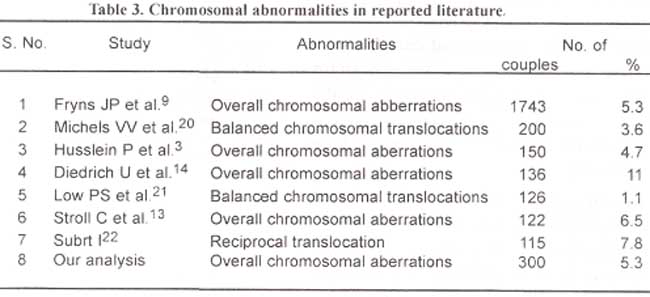
Although this study was designed to determine the frequency of chromosome changes in couples with recurrent abortions, the results are similar to those of large sample sized studies conducted by different centers (Table3).Fryns et a!7 reported 5.34% of chrornosomal abnormalities in 1743 couples with history of recurrent abortions. The frequency of cytogenetic abnormalities in other small studies varied between 0 and 4.7%9-14 probably due to difference in selection and referral of patients for cytogenetic examination. The present data hence also confirm that the chromosomal studies in couples with recurrent abortions are an important and necessary part of the etiological investigations in recurrent fetal wastage.
The overall frequency of major chromosome disorders detected was 16/300 (5.3%) of which reciprocal and Robertsonian translocations were the most frequent type. They occurred in 7/300 (2.3%), the data from other studies do not differ greatly.6.14 The findings of an autosomal reciprocal translocation are not only an important diagnostic finding, but also have an important prognostic consequence for subsequent pregnancies. Therefore genetic counseling is mandatory after the diagnosis of an autosomal reciprocal translocation and prenatal diagnosis should be offered in a subsequent pregnancy. The option to perform chorionic villi biopsy versus amniocentesis should be discussed with carrier couples.
In this study there were more carriers of autosomal aberrations as compared to males. A likely explanation for this finding is that autosomal reciprocal translocations in male carriers may have an effect on fertility, the presence of an autosornal translocation may lead to severe meiotic disturbance with spermatogenetic arrest.15,16
Pericentric inversion of chromosome 9 is such a common occurrence that some cytogeneticist would consider them as a normal variant.1-17,18 Despite being categorized as a minor chromosomal rearrangement which does not correlate with abnormal phenotypes, many reports in the literature raised conflicting views regarding the association with sterility to sub-fertility arising as a result of having pericentric inversions.19,20 In the present study on couples with recurrent abortions, five (1.6%) pericentric inversions were detected. A likely explanation for this finding is that familial inversions in carriers may have an effect on fertility and the length of inverted chromosomal segment of carrier patients seems to be a decisive factor determining the harm of a pericentric inversion in the progeny. indeed, genetically unbalanced gametes have a higher chance of arising from a large inversion meiotic loop than from a small one.
Two cases of partial deletion of chromosome 16 and 19 could be accidental or they may indicate that the fertility of a person with partial chromosomal deletions is reduced. No evidence of couples with partial deletion and recurrent abortion was found in literature. Here a cytogenetic monitoring of abortion materials from individuals with partial chromosomal deletion disorders will help to clarify the matter.
Two (0.6%) couples with gonosomal abnormalities were found in our study. Except Deborah et al8 no other investigators have reported cases of such sex chromosome disorders with multiple pregnancy loss. The occurrence of 47,XYY and 47,XXY (Klinefelter’s syndrome) in these cases could be fortuitous, on the other hand, it might be an indication that a proportion of abortuses from 47,XYY and 47,XXY individuals have chromosomal abnormalities. Chromosomal analysis should be considered as an integral part of the evaluation of couples who have had multiple abortions.
Detection of couples with chromosomal abnormalities can undoubtedly help to prevent the birth of malformed infants. Banded chromosomal studies are recommended for couples with repeated abortions.
Abstract
Objective: To analyze the chromosomal abnormalities in couples with history of recurrent abortions. Design: Retrospective study.
Setting: Cytogenetic section, Department of Pathology at the Aga Khan University Hospital. Karachi, Pakistan. Patients: Three hundred couples with history of recurrent abortions.
Main outcome measure: Structural chromosomal abnormalities in carrier couples.
Results: G-banded chromosomes were analyzed from both partners of 300 couples who had had two or more spontaneous abortions. Sixteen (5.3%) couples showed a chromosomal aberration in one of the partners. Seven translocations, 5 inversions, 2 deletions and 2 sex chromosomal abnormalities were identified. There was an increase in structural aberations, which was not significantly different from that reported worldwide.
a primary tool in the evaluation of couples with repetitive.
Conclusion:Chromosomal analysis is advocated as fetal wastage (JPMA 53:117:2003).
Introduction
Around 15 to 20% of all pregnancies in humans end up in spontaneous abortions (SABs). The incidence of chromosomal abnormalities in those abortions is as high as 50%. Although the cause is unknown in many instances, but parental chrornosomal abnormality is one of the possible causes for recurrence of miscarriages in the first three months of pregnancy.1-5 The preparation of karyotype of the parent is thus an integral part of diagnostic clarification, yet the question of the relative importance of this examination among the range of diagnostic possibilities is the subject of controversy. The reported incidence of balanced chromosomal translocations in these couples ranges from 0% to 3 l%.6,7
Several studies have been done in various countries to determine the contribution of chromosome abnormalities in parents with fetal wastage. The aim of this study was to assess the frequency and increasing the awareness of physicians about the nature of chromosomal aberrations that contribute to the occurrence of repeated abortions.
Material and Methods
Retrospective analysis of chromosomal data of 300 couples (600 individuals), referred to the laboratory as a part of work up for multiple spontaneous abortion occurring at any time of reproductive life, of the Aga Khan University Hospital from June 1996 to June 2000 was done. Cases were referred to our cytogenetic section from different cities of Pakistan. All couples had a history of two or more spontaneous abortions that were not necessarily consecutive. Couples were also included even if they also had normal and/or abnormal offspring in addition to miscarriages, but were excluded if the reason for the referral was the abnormal offspring.
Chromosome polymorphism in the form of enlarged sate!! ites. secondary constrictions, other heterochromat ic segments, or other non systematic anomalies, like a slightly increased frequency of chromosome breakage were not considered to be of importance and are therefore not reported here.
For routine cytogenetic analysis of 15-20 cells were done after standard Giemsa-Trypsin-Giemsa banding (GTG). Chromosomes were visually analyzed and abnormalities were abortions. detected during microscopy in all cases.8 Microscopic photography and karyotype were done for documentation in abnormal cases on semi automatic Applied Imaging karyotyper.
Results
A total number of 300 couples with history of recurrent abortions were investigated for chromosomal analysis during the four-year period. Among these 300 couples, 16 (5.3%) were found to be carriers of different chromosomal abnormalities. Eleven females and five male partners had chromosomal abnormalities. Data of different chromosomal aberrations found in 16 couples are summarized in Tables 1 and 2.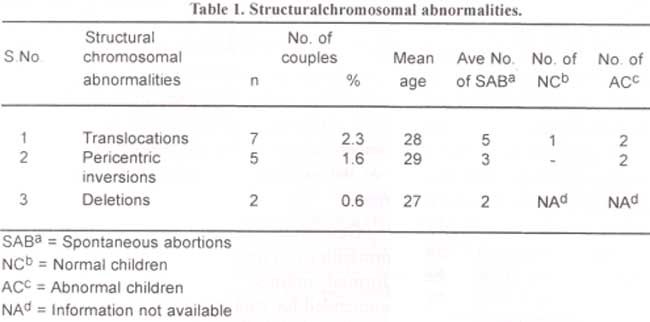
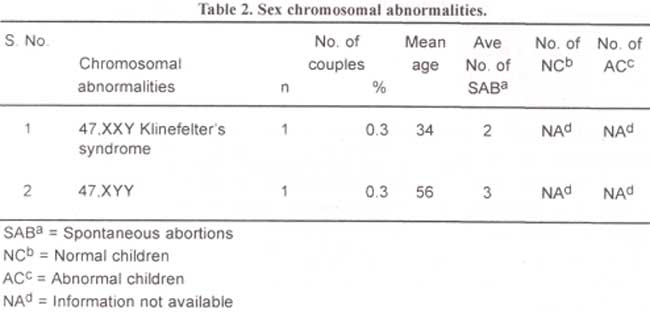
From 16 cases. 14 (4.6%) had structural chromosomal abnormalities. Of these, 7 cases of translocation abnormalities, reciprocal translocation and Robertsonian translocation were found in 5 (1.6%) and 2 (0.6%) cases respectively. In 5 cases of pericentric inversions, one (0.3%) case showed pericentric inversion of chromosome 16, while 3 females and one male partner were detected to have a pericentric inversion of chromosome 9. In 2 cases of deletion, one case (0.3%) showed deletion of short arm of chromosome 19 and one case (0.3%) showed partial deletion of long arm of chromosome 16. Gonosomal abnormalities were also detected in 2 couples.
Journal of the Pakistan Medical Association has agreed to receive and publish manuscripts in accordance with the principles of the following committees:


