

S. Hussain ( Department of Urology, King Edward Medical College/Mayo Hospital, Lahore. )
S.A. Khan ( Department of Urology, King Edward Medical College/Mayo Hospital, Lahore. )
K.A. Dodhy ( Department of Urology, King Edward Medical College/Mayo Hospital, Lahore )
F.A. Khan ( Department of Urology, King Edward Medical College/Mayo Hospital, Lahore )
March 2003, Volume 53, Issue 3
Original Article

Abstract
Objective:To determine the sonographic prevalence of Acquired Cystic Renal Disease (ACRD) in patients on maintenance haemodialysis and its relationship to the duration on dialysis.
Methods:All patients with end stage renal disease (ESRD) who were receiving maintenance haemodialysis in Urology Department of Mayo Hospital Lahore between November 1997 to February 1998 were screened by ultrasound for the prevalence of ACRD.
Results:Forty patients with ESRD on maintenance haemodialysis were evaluated. The mean age of patients was 39.9 years. The male to female ratio was 2.3:1. Four patients (10%) had documented ACRD. The proportion of patients with ACRD increased with increasing duration of dialysis; ACRD was found in 60% of patients who had dialysis for more than 3 years, 20% in those who had been dialyzed for 1-3 years, and no patient developed ACRD who was on dialysis for less than one year. All patients remained asymptomatic except one, who had intermittent macroscopic haematuria. There was no evidence of neoplasm in any of these patients on clinical grounds or on ultrasound.
Conclusion:We found a low prevalence of ACRD in the population studied compared to previously published series. This can be explained by the fact that most of our patients were on dialysis for less than one year. A further study is suggested with greater numbers in a center where patient stay on dialysis for longer period and patient turnover is low (JPMA 53:111;2003).
Introduction
Dunnill et al first described ACRD in 1977.1 ACRD refers to a specific disorder in which renal cysts develop in kidneys of both adults and children with ESRD due to a non-cystic renal disorder. It occurs in patients on long term renal replacement therapy either in the form of chronic maintenance haernodialysis or continuous ambulatory peritoneal dialysis.2,3 It has been described in patients of chronic renal failure with slow progression.4 Most of the patients with ACRD remain asymptomatic. There is an increased risk of development of neoplasm in these cysts.5-7 In this study we tried to find out the prevalence of ACRD in our dialysis population and its relationship to the duration on haemodialysis.
Patients and Methods
We evaluated a total of 40 patients (28 males, 12 females) who were receiving haemodialysis for end stage renal disease in the Haemodialysis Unit, Department of Urology, Mayo Hospital, Lahore from November 1997 to February 1998. The evaluation included detailed history including smoking status, physical examination and review of investigations. The data collected also included cause of renal failure and duration of haemodialysis. These 40 patients were selected on the basis of initial ultrasound report before they had their first dialysis. Patients having cystic lesions in either kidney on ultrasound before haemodialysis was started, were excluded from the study.
Patients were screened during the period of the study for the presence of cystic disease by ultrasound. Kidneys were visualized from parasagittal and posterior approach. ACRD was diagnosed when bilateral multiple sonolucent areas with no internal echoes were present. A minimum of five cysts of detectable size in each kidney was set as the requirement for inclusion in the study.
All patients were receiving haemodialysis twice weekly on Cobe Century System II machines with Cuprophane dialyzer and Acetate dialysate. All patients were Hepatitis B surface antigen negative.
Results
Out of 40 patients, 28 (70%) were male and 12 (30%) were female. The age ranged between 2 1-60 years with a mean age of 39.9 years. Age and sex distribution is shown in Table 1.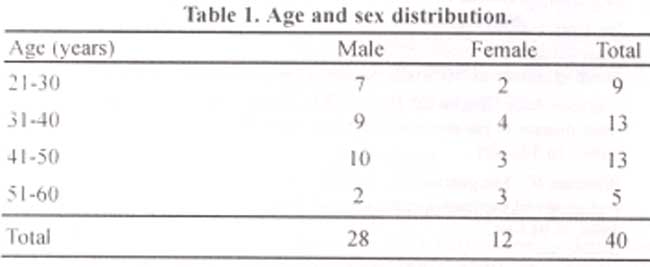
The duration of haemodialysis ranged between 1-132 months. Majority of patients (30) were on dialysis for less than one year (Table 2).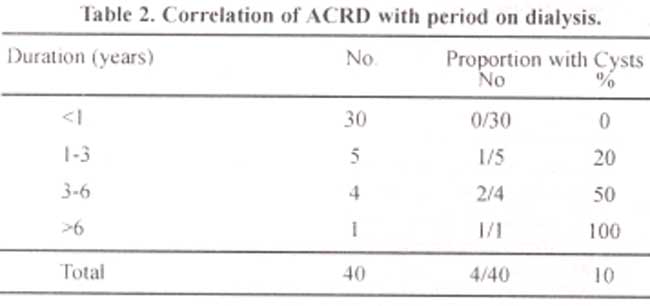
Only 8 out of 40 were smokers; the rest never smoked. Based on Clinical criteria, the probable causes of ESRD in these patients were as follows: Hypertensive nephropathy 20 (50%), nephro!ithiasis 6 (15%), chronic glomerulonephritis 5 (12.5%), diabetic nephropathy 4 (10%). chronic pyelonephritis 1 (2.5%) and others 4(10%). The relationship of ACRD to the underlying cause of ESRD is shown in Table 3.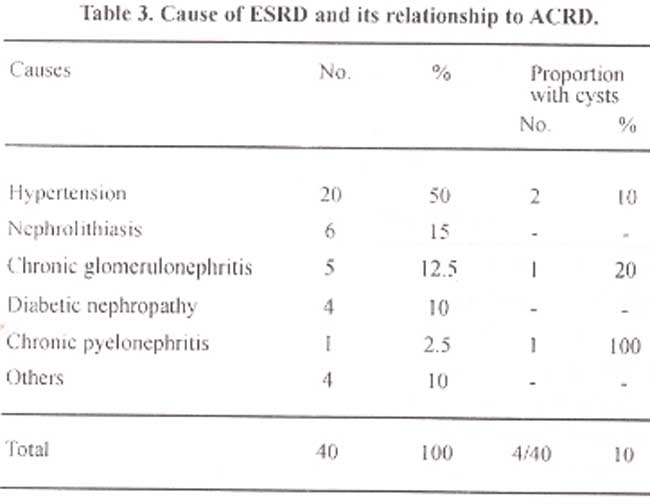
Four (10%) of the 40 patients were found to have ACRD. Ten (25%) patients were being dialyzed for more than one year. Of these 10 patients 4 (40%) had AC RD. The proportion of patients with ACRD rose with increasing duration of dialysis; 60% of patients dialyzed for more than 3 years had cysts (Table 2). The only person who was dialyzed for more than 6 years (132 months) had ACRD.
One of the four patients who had Acquired Cystic Renal Disease complained of 3-4 episodes of macroscopic haematuria without any pain. One of these episodes occurred during the period of study. Investigations included urine for culture and sensitivity and urine for cytology for malignant cells; repeat ultrasound did not show any obvious cause. None of the patients showed any features of neoplasm on ultrasonography.
Discussion
In 1977 Dunnill et al reported ACRD in 46.6% of patients who were on long term dialysis in an autopsy study. Grantham et al reported a prevalence of 43.6% in their study on 601 patients undergoing dialysis.5 Similar prevalence was reported in other studies.6-8 These studies were performed using ultrasound, CT Scan or autopsy. Prevalence of ACRD was 10% in our study. The reason for such a low prevalence is the very small number of patients who have been on long term dialysis; 75% of our patients were on dialysis for less than one year. Prolonged duration on haemodialysis has been thought to be an important risk factor for the development of ACRD.1-7 Our observation concurs with the findings of previously published series.
The underlying cause for ESRD seems to bear no relationship with the occurrence of ACRD7, but some authors have described the low prevalence of ACRD in ESRD patients due to diabetic nephropathy.4 Although in our study only 4 diabetics were included; none of them had ACRD. This is in agreement with the observation made in previous studies.
ACRD is usually asvmptomatic and is diagnosed incidentally by the radiologist on ultrasound or CT Scanning or by pathologist after nephrectomy or autopsy.5 Occasionally, it may be complicated by frank haematuria8, retroperitoneal haernorrhage9 and malignant transformation.1,10,11 Flank pain, renal colic, fever, palpable renal mass and rising haematocrit may be presenting symptoms.12 In our study one patient had frank haematuria which most probably was due to bleeding from a cyst. This was managed conservatively. None of our patients with ACRD had high haematocrit.
Renal tumors have been described in 16.4% of patients with ACRD. Most of these tumors are adenomas; some are malignant and in few distant metastasis may be present.13.14 Symptoms related with neoplasm are gross haernaturia. fever, back pain, changing haematocrit and complications of metastasis. Ultrasonography is more useful in detection of neoplasm compared to IVU due to renal failure.8.15 CT with or without contrast is a preferred diagnostic technique for ruling out neoplastic changes in these cysts)13-15 Magnetic Resonance Imaging (MRI) with or without Gadolinium enhancement may be useful.12-15,16 Malignancy has been estimated to be 50 times more frequent in dialysis patients with ACRD than in general population.5,7,10,17 In our study no tumor was detected in any patient.
The exact cause for cystic transformation is unknown but loss of functional renal mass probably stimulate production of renotropic factors which promote the development of ACRD.14.18.19 The risk factors for the development of ACRD include the duration of renal failure, years on dialysis and in some series male gender and black African origin who have a higher incidence17,20 ACRD occurs in 7-22% of patients of chronic renal failure who were not on dialysis.42. A successful renal transplant leads to regression of ACRD.22
We conclude from our study that in the population studied the prevalence of ACRD is low in patients with ESRD on haemodialysis compared to previously published series. As we know from previous studies that proportion of patients with ACRD increases with increasing duration on dialysis: the low prevalence in our study is explained by the fact that most of our patients were on dialysis for less than one year. A further study is suggested with greater numbers in a center where patient stay on dialysis for longer periods and where patient turnover is low.
References
1.Dunnill MS. Millard PR, Oliver D. Acquired cystic disease of the kidneys: a hazard of long-term intermittent maintenance haemodialysis .1 Clin Pathol.
2.Ishikawa I.Uraemic acquired cystic disease of kidney. Urology 1985:26101-8.
3.Hisario S. Hattori S, Tsuru N, et al. Acquired cystic kidney disease in children undergoing continuous ambulatory peritoneal dialysis. Am J Kidney Dis 1999:34:242-6.
4.Mickisch 0. Bommer J. Bachmann S. et al. Multicystic transformation of kidneys in chronic reital failure. Nephron 1984:38:93-9
5.Grantham J, Levine E. Acquired cystic disease: replacing one kidney disease with another. Kidney Int 1985:28:99-105.
6.Heinz-Peer-G, Schoder M, Rand T, et al. Prevalence of acquired cystic kidney disease and tumors in native kidneys of renal transplant recipients: a prospective US study. Radiology 1995:195: 667-71.
7.Sasagawa j, Terasawa Y. lmai K, et al. Acquired cystic disease of the kidney and renal carcinoma in haemodialysis patients: ultrasonographic evaluation, Br J Urol l992;70:236-9.
8.Bommer J. Waldherr R. Van Kaick G, et al. Acquired renal cysts in uremic patients - in vivo demonstration by computed tomography Clin Nephrol 1980:14:299-303.
9.Milutinovich J, Follette WC, Scribner BH. Spontaneous retroperitoneal bleeding in patients on chronic haemodialysis. Ann Intern Med 1977:86: 189-92
10.Hughson MD, Buchwald D. Fox M. Renal neoplasta and acquired cystic renal disease in patients receiving long-term dialysis. Arch Pathol Lab Med 1986:110:592-601.
11.Williams JC, Merguerian PA. Schned AR. et al. Acquired cystic renal disease and renal cell carcinoma in an allograft kidney. J Urol 1995:153:395-6.
12.Levine E. Acquired cystic kidney disease. Radiologic Clinic North Am 1996.34 947-64.
13.Schillinger F Acquired cystic renal disease in renal insufficiency a multi center study. Group of Nephrologists of the east of France. Eur J Med 1993:2:457-60.
14.Truong LD. Krishnan B, Cao JT, et al Renal neoplasia in acquired cystic kidney disease. Am 3 Kidney Dis 1995: 26:1-12.
15.Levine E, Hartrnan DS, Meilstrup 3W, et al. Current concepts and controversies in imaging of renal cystic disease. Urologic clinic North Am I 997;24:523-43.
16.Heinz-Peer 0, Maier A. Eibenberger K, et al. Role of magnetic resonance imaging in renal transplant recipients with acquired cystic kidney disease. Urology 1998:51:534-8.
17.Ishikawa I. Saito Y, Nakamura M, et al. Fifteen . year follow - tip of acquired renal cystic disease - a gender difference, Nephron 1997.75 315-20.
18.It F, Nakazawa H, Ryoji 0, et al. Cytokines Accumulated in acquired renal cysts in long - term haemodialysis patients Urol Int 2000:65:21-7.
19.Hams RH, Hise MK, Best CF Renotrophic factors in untie. kidney Int 1983:23 616-23.
20.Gulanikar AC, Daily PP. Kilambi NK, et al. Prospective pretransplant ultrasound screening in 206 patients for acquired renal cysts and renal cell carcinoma. Transplantation 1998:66:1669-72.
21.Choyke PL. Acquired cystic kidney disease. Eur Radiol 2000: 10: 1716-21.
22.lshikawa I, Yuri T, Kitada H, et al. Regression of acquired cystic disease of the kidney after successful renal transplantation. Am J Nephrol 1983:3:310-14.
Journal of the Pakistan Medical Association has agreed to receive and publish manuscripts in accordance with the principles of the following committees:


