

M. H. Ather ( Department of Surgery, Section of Urology, The Aga Khan University, Karachi. )
N. Faruqui ( Department of Surgery, Section of Urology, The Aga Khan University, Karachi. )
F. Abid ( Department of Surgery, Section of Urology, The Aga Khan University, Karachi. )
March 2003, Volume 53, Issue 3
Original Article

Abstract
Objective: To identify factors that influence peri-operative hemorrhage in view of reducing the need for transfusions in patients undergoing trans uretheral resection of prostate (TURP).
Methods: All patients undergoing TURP between January 1997 and December 1999 were identified using lCD 9CM coding and indexing system. Overall 430 patients were identified, however, 384 charts were included and reviewed for demographics, pre and intra-operative data and post-operative morbidity. Patients were divided into two groups on the basis of presence of significant hemorrhage.
Results: Overall 384 patients were analyzed. Nineteen patients had hemorrhage - group I whereas 365had no significant hemorrhage - group II. Mean age and co-morbidities in the two groups were similar. However, in group I, 58% presented with urinary retention compared to 33% in group II. In group I, factors that reached statistical significance include; operative time (p<0.05), mean resected tissue weight (p<0.02), and patient presentation (urinary retention) (p<0.032). There was no significant difference in the two groups with respect to type of anesthesia (regional versus general) and histology of the resected tissue. Patients with mean pre-operative hemoglobin of 10.6 % had a 37% transfusion rate.
Conclusion: Operative time, weight of resected prostate tissue are inter related and are only partly controllable. Low pre-operative hemoglobin is the only reversible factor in reducing transfusion following TURP (JPMA 53:1 04;2003).
Introduction
For the past 70 years, TURP has remained the gold standard in the management of bladder outlet obstruction due to prostatic enlargement. Advances in anesthesia, surgical technique video endoscopy and peri operative monitoring of fluid aiid electrolytes have considerably decreased the morbidity of the procedure.1 Peri-operative hemorrhage.infection and absorption of irrigation fluid are still important causes of morbidity. Pen-operative blood loss is a major complication and cause of great concern for both the surgeon and the patient. Many factors have been identified for their possible association with pen-operative bleeding. These include weight of the resected tissue, age of the patient, operating time, type of anesthesia, gland histology, presentation, symptomatology, presence of comorbidities, infections and use of medications.2 Urinary tract infection has also been reported in various recent reports, however, this was not considered in this paper due to lack of sufficient data.
The present study is an audit of patients undergoing TURP during the last three years, conducted to study various factors influencing peri-operative hemorrhage and to identify ways of reducing need for transfusion. Better understanding of these factors and modifications, could effectively reduce this complication and need for transfusion.
Patients and Methods
Four hundred and thirty patients had TURP at our institution for symptomatic BPH or prostate cancer between January 1997 and December 1999. Complete medical records of 384 (89.3%) patients were available, who were included in the study. In-patient and clinic records, laboratory and radiological workup, operative reports and discharge summaries were analyzed. The following parameters were documented for each patient; age, mode of presentation, co-morbidities (lschemic heart disease, hypertension. diabetes mellitus, chronic obstructive lung disease etc.) pre- and post- operative hemoglobin level, blood transfusion data, resected prostatic tissue weight, pathological diagnosis, resection time, intra-operative and post-operative complications and duration of hospital stay. The hospital stay was to ascertain the impact of procedure (TUR.P) related complications.
The criteria used for identifying patients with unacceptable hemorrhage were 1) Excessive intra-operative or post-operative blood loss necessitating volume replacement / blood transfusion; and ii) Development of clot retention and need for readmission. Patients were divided into two groups; hemorrhage group (I) and no-hemorrhage group (II). Independent samples t-test was applied to test the difference in the two groups for age, preoperative hemoglobin level, operative time, weight of resected tissue and hospital stay. Similarly chi-square test with odds ratio was used to test the association of comi orbid ity. presentation, transfusion rate, and anesthesia between the two groups. The criteria used at our institution for blood transfusion include acute drop of hemoglobin >2 gms% and a lesser drop of hemoglobin in patients with ischemic heart disease, chronic obstructive airway disease and other conditions affecting tissue perfusion.
References
1.Mebus WK, Holrgrewe HL. Cockett AT. et al. Transurethral prostatectom\\ immediate and postoperative complications. A cooperative study of 13 participating institutions evaluating 3,885 patients. J Urol 1989:14 I: 243-7.
2.Watson CJ, Deane AM, Doyle PT,et al. Identifiable lactors in post. prostatectotnv hemorrhage: the role of aspirin. Br J Urol 1990: 66:85-7.
3.Horninger W, Unterlechner H, Strasser H, et al. Transurethral prostatectomy mortality and morbidity. Prostate 1996: 28:195.200.
4.Borboroglu PG. Kane CJ. Ward JF, et al. Immediate and postoperative complications of transurethral prostatectomy in the I 990s. J Urol 1999:162:1307-10.
5.ElMalik M. Ibrahim Al, Gahli AM. et al. Risk factors in prostatectomy bleeding: preoperative urinary infection is the only reversible factor. Eur Urol 2000:37:199-204.
6.Kirollos MM, Campbell N. Factors influencing blood loss in transurethral resection of the prostate (TURP): auditing TURP. Br J Viol 1997:80: Ill-IS.
7.Abrams PH, Shah P.!, Bryning K. et al. Blood loss during transurethral resection of the prostate. Anesthesia 1982:37:71-3.
8.Madsen RE, Madsen P0. Influence of anesthesia form on blood loss in iransurethral prostatectomy. Anesth Analg 1967:46:330-2.
9.Hagerty-JA: Ginsberg-PC; Hannon-JD: Harkaway-RC Pretreatment with finasteride decreases perioperative bleeding associated with transurethral resection of the prostate. Urology 2000 May: 55: 684-9.
Discussion
Significant peri-operative hemorrhage, requiring blood transfusion is a major complication of TURP.
Avoiding transfusion reduces the overall morbidity and the attendant risks of transmissible diseases. In the present study an attempt is made to identify various factors influencing pen-operative hemorrhage to avert need for transfusion.
Blood transfusion requirements have greatly decreased in the last twenty years. In a study representative of 1 980’s practice. Mebust et at reported transfusion rate of 2.5% in over 3000 patients undergoing TURP.’ Horninger et al.3 reported the need for transfusion in 4.2%. Recently. Borboroglu et al.4 reviewed 520 consecutive patients undergoing transurethral prostatectomy at a single institution for symptomatic BPH between 1991 and 1998. The transfusion requirement in this group of patients was only 0.4%.
Identification of different factors influencing pen-operative hemorrhage has been addressed in various recent reports. Patients related factors like age, presentation, use of medications and procedure related factors like duration of surgery. type of anesthesia, histology of the gland, weight of resected tissue, have been described in literature. lbrahim et aL.5 noted that age of the patient does not influence hemorrhage in the TURP patients whereas presentation (lower urinary tract symptoms versus urinary retention) did. In our study about half the patients in group I presented with urinary retention compared to only 1/3 in the group II.
The mean pre-operative hemoglobin in the hemorrhage group was 10.6~l.6 gm/dl compared to 12.9~1.8 gm/dl in the no hemorrhage group (p <0.000). Low mean pre-operative hemoglobin level should not be regarded as a cause of bleeding but a need for earlier transfusion in case of hemorrhage. We feel that all patients, in particular with COPD and ischemic heart disease, undergoing elective TURP with a pre-operative hemoglobin under 11 gm% should be optimized before surgery. The overall transfusion rate in our study was 6.3%, which is somewhat higher than that reported from other multi center studies.1.4 Analysis of the pre and post-operative hemoglobin concentration confirmed that all transfusions of greater than 2 units were justified to avoid significant postoperative anemia (defined as a hemoglobin concentration of less than 10 gm/dl). The other factor, which was responsible for “the transfusion trigger” was the associated morbidity. Eight patients had ischemic heart disease or chronic obstructive pulmonary disease requiring approximately I Ogm% hemoglobin concentration to maintain adequate tissue perfusion.
Operative time and weight of resected tissue were found to be different in the two groups. The mean operative time for the group I in our study was 107.8±51.6 minutes compared with 90.4±38.9 minutes for group II (p<0.O9).
Similarly the mean resected tissue was 38.3+26 gm for group I and 21.4±14.3 gm for group El (p <0.02). Other investigators have also confirmed the association between resecred weight and blood loss.5.6
Observation by other investigators7,8, that regional anesthesia is associated with less blood loss than general anesthesia was not confirmed in the present study. In the hemorrhage group 68.4 % had general anesthesia compared to 51.5% in the no hemorrhage group whereas 31.6% had regional anesthesia compared to 48.5% in the no hemorrhage group. This, however, did not reach statistical significance (P 0.15). Madsen and Madsen8 showed a statistically significant advantage in blood loss of spinal over general anesthesia (P<0.001) in a study of 180 patients. They suggested that the difference was probably the result of a reduction in blood pressure. However, other investigators have found no significant statistical difference between the type of anesthesia in relation to pen-operative blood loss.8 Like other investigators, ourstudy also shows that histology of the gland does not influence hemorrhage. Ibrahim et al.5 noted that avoiding infection and use of finasteride9 significantly reduces hemorrhage related to TURP.
The present study clearly demonstrates that factors that ‘may influence the need for pen-operative transfusions and reach statistical significance includes: pre-operative hemoglobin level, operative time, and weight of resected tissue. It does not show statistical significance of presentation, co-morbidities, type of anesthesia, and histology of the resected tissue in pen-operative hemorrhage and need for transfusion. Although low preoperative hemoglobin does not influence blood loss but increases the transfusion rate. pre-operative correction of anemia would decrease the need for transfusion and the risks associated with it.
Results
Out of 384 patients studied, 19 (4.95°/o) had significant post TURP bleeding, group I, whereas there was no significant bleeding in 365 (95.05%) patients. Mean age of the patients studied was 65 ±11 .2 years (range 45-95). There was no significant difference between the two groups with respect to age, co-morbid ities and mode of anesthesia (Tables 1 and 2).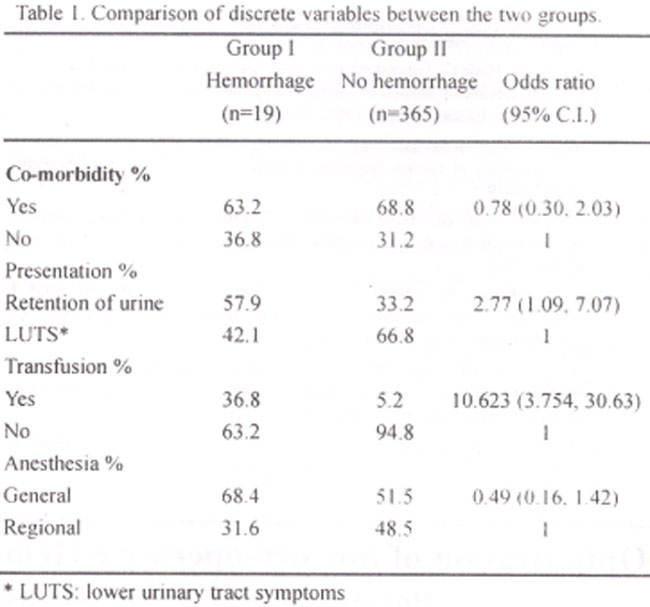
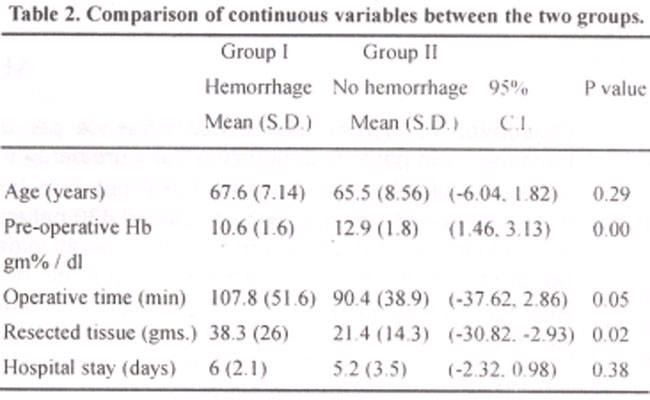
In group I. factors that reached statistical significance include; operative time (p
Journal of the Pakistan Medical Association has agreed to receive and publish manuscripts in accordance with the principles of the following committees:


