

Bikha Ram Devrajani ( Department of Medicine,Liaquat University of Medical and Health Sciences (LUMHS), Jamshoro, Hyderabad. )
Doulat Rai Bajaj ( Department of Dermatology,Liaquat University of Medical and Health Sciences (LUMHS), Jamshoro, Hyderabad. )
Syed Zulfiquar Ali Shah ( Department of Medicine,Liaquat University of Medical and Health Sciences (LUMHS), Jamshoro, Hyderabad. )
Rafi Ahmed Ghori ( Department of Medicine,Liaquat University of Medical and Health Sciences (LUMHS), Jamshoro, Hyderabad. )
January 2010, Volume 60, Issue 1
Original Article

Abstract
Objective: To determine the frequency and pattern of gonorrhoea at Liaquat University Hospital, Hyderabad.
Methods: This descriptive study of eight months was conducted at Liaquat University Hospital Hyderabad, Sindh, Pakistan from December 2007 to May 2008. All patients who were above 14 years of age and came with history of discharge from penis or vagina were evaluated and enrolled in the study. After recording demographic data these were screened for gonococcal infection by Gram's staining method. The frequency was determined by identifying the positive gonococcal infected patients while pattern was observed according to the presentation of patients. The data was analyzed by SPSS version 10.00.
Result: One hundred and eighteen patients, 92 (78%) male and 26 (22%) females were identified to have infection out of 266 patients with mean age 27.4 ± 7.77 years. Majority of the patients 92 (78%), presented in the department of dermatology. In the study group, 77 (65%) were unmarried and 41 (35%) were married, 71 (60%) belonged to Hyderabad and 47 (40%) came from periphery of Sindh province of Pakistan. Other features and presentation identified in such patients were painful micturition 98 (83%), burning micturition 94 (80%), frequent micturition 108 (92%), genital itching 85% (72%), intermenstrual bleeding 09(8%), painful sexual intercourse 87(74%) and skin lesions 24 (20%). All patients were treated by syndromic management.
Conclusion: A relatively high prevalence of gonorrhoea (46% patients) was detected in the patients seen in Liaquat University Hospital (JPMA 60:37; 2010).
Introduction
Gonorrhoea is a Greek word which means "flow of seed" and is used to describe the white milky appearance of the purulent urethral discharge. It is a sexually transmitted diseases (STD) and was discovered by Albert Ludwig Sigesmund Neisser in 1879.1 The pathogen is a gram negative diplococcus typically found inside polymorphonuclear cells and transmitted during sexual activity, has the highest frequency in the 15-29 years age group and the incubation period is usually 2-8 days.2
The World Health Organization (WHO) estimated that 62 million cases of gonorrhea occur annually worldwide and untreated infection can cause serious long-term complications. In addition, babies born to infected mothers are at risk of ocular infection, which can lead to blindness.3 In a study conducted in 1999 at the capitals of all four provinces of Pakistan, the prevalence of gonorrhoea was documented as 28%.4 The rate of prevalence differs widely among studies depending upon the type of sample. The prevalence was 2.8% for men and 1.8% for women in a study conducted in the general population of India.5 While the same was quite high among sex workers in studies conducted at India and Bangladesh, being respectively cited as 8.9% and 35.8%.6,7
There are different types of laboratory tests for diagnosing gonorrhea8 (a) Gram stain: A sample from the part of the body likely to be infected (cervix, urethra, penis, rectum, or throat) is placed on a slide and stained with the dye. It allows identifying the bacteria under a microscope. (b) Gonorrhea culture: It is done on a sample of body fluid collected from the potentially infected area, such as the cervix, urethra, eye, rectum, or throat. The sample is combined with substances that promote the growth of gonorrhea bacteria. (c) Nucleic acid amplification tests (NAAT): detect and make many copies of the genetic material (DNA) of gonorrhea bacteria. NAATs include polymerase chain reactions (PCRs) and transcription mediated amplification (TMA). These tests are very accurate and can be done either on a urine specimen or a sample of body fluid from the potentially infected area. (d) Nucleic acid hybridization test (DNA probe test, molecular probe test): detects genetic material (DNA) of gonorrhea bacteria. This test is done on the body fluid collected from the potentially infected area, most often the cervix or urethra. (e) Enzyme-linked immunosorbent assay (ELISA) and enzyme immunoassay (EIA): it is done on a sample of fluid from the penis or cervix. An EIA test detects substances that trigger the immune system to fight the gonorrhoea infection (gonorrhea antigens)
The drugs used for eradication of gonoccocal infection are Cephalosporins (cefixime and ceftriaxone), Quinolones (ciprofloxacin and ofloxacin), Azithromycin and spectinomycin.9 The complications of gonorrhoea is infertility in both male and female, pelvic inflammatory diseases, conjunctivitis complicated by perforating corneal abscess,10 disseminated gonococcal infection DGI (arthritis, dermatitis, and tenosynovitis)11 and gonococcal endocarditis (a rare complication).12
The rationale of this study was to determine the frequency and pattern of gonococcal infection in patients who attend the tertiary care teaching hospital of Hyderabad, Sindh Pakistan. Early detection and eradication of gonococcal infection can prevent and save the patient to acquire life threatening complications of gonorrhoea and prevent the spread of infection.
Patients and Method
This observational study was carried out in the department of dermatology at Liaquat University Hospital (a tertiary care 1500 bedded hospital) Hyderabad from December 2007 to May 2008. All patients above 14 years of age who came through the outdoor patient department (OPD), indoor patient and casualty outdoor department (COD) with history of yellowish white or green colour discharge from penis or vagina were evaluated and enrolled in the study. The referred suspicious patients of sexually transmitted disease (STD) from different departments were also included in our study. The data was collected through a pre-formed proforma / questionnaire. The data of 03 diagnosed gonococcal cases (identified by Gram staining and microscopic examination) in the month of January was collected from non government organizations (NGO's) working in the hospital for the awareness and cure of sexually transmitted infection (STI). The detail history of all such patients was taken; complete clinical examination and routine investigations were performed. For relevant investigation, a swab of discharge from penis / vagina was collected and put in sterilized tube to be submitted to laboratory for Gram staining and microscopic examination. Informed consent was taken from every patient or from attendant of patients after full explanation of procedure regarding the study, and all such maneuvers were under medical ethics. The data was collected, saved and analyzed in SPSS version 10.00. The frequency was determined by detecting the number of positive cases for gonococcal infection. Pattern was observed according to the presentation of patients within the hospital i.e. other associated features. By using analytical statistics the frequency, mean and standard deviation of variables were obtained. The uncooperative patients or who refused to give consent or were not interested to participate in the study were considered excluded.
Result
In this observational study one hundred eighteen patients (92 males and 26 females) were identified as gonococcal infected from different units / wards i.e. from department of casualty/dermatology/medicine out patient department (OPD) and indoor patients. Majority of patients were from dermatology department i.e. 92 (78%), 22 (19%) were initially admitted in medical department with complaints of fever, sore throat, nausea/vomiting and abdominal pain but later they developed some symptoms that were suspicious of sexually transmitted infection. After complete examination and symptomatic treatment the medical unit referred such cases to dermatology department. A final diagnosis of gonococcal infection was made by the dermatologists. Four (3%) patients of gonococcal infection were identified from gynaecology and obstetrics out patient department who came with a history of vaginal discharge. Sixty eight (58%) males and twelve females 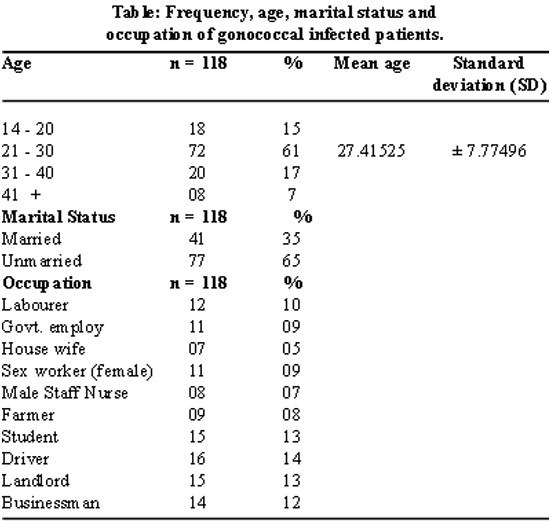
Discussion
For several decades, sexually transmitted infections (STIs) have ranked among the top five categories for which adults in developing countries seek health care services. Despite availability of cost effective treatment the burden of STIs is unacceptably high because of ineffective application of the known technical and administrative interventions. The data from epidemiological surveys show that within countries and between countries in the same region, the prevalence of STIs may vary widely even in similar population groups. These differences reflect a variety of social, cultural, and economic factors, and access to appropriate treatment.4 The present study focused on gonorrhoea, a sexually transmitted infection that affects both males and females. Despite the availability of effective antibiotic therapy and publicity about safer sexual practices gonorrhea remains a common STI.13 The high risk individuals include (a) sex workers under the age of 25 years, (b) those with previous gonorrhoea or other sexually transmitted infection, (c) those with new or multiple sex partners, (d) those who do not consistently use condoms and (e) drug users.14
In the present study the mean age of gonococcal infection was 27.4 where as it is 24.7 in the study by Bernstein et al,15 and in the study of Katz, the majority of gonococcal infected patients (35%) were between 20-24 years.16 A study regarding the age, sex, and race specific incidence rates of gonorrhoea was conducted in the United States. The gonorrhoea rates in younger age groups (ages 15-29 years) were compared to the older age groups (ages 40-54 years) for each year over the 25-year time period. It was concluded that teenagers and young adults were at high risk of acquiring gonococcal infection and the estimated annual decline in the age rate ratio for gonorrhoea in all races was 2.0%.17 This shows that younger age group are at a higher risk for acquiring gonococcal infection due to careless behaviour.
In our study the males were predominant which is similar to the study conducted in Belgrade. It was also seen that the male/female ratio increased with age and the incidence was highest in men and women of 20-29 years age.18 However a similar observation was had in the study of Wrong et al19 i.e. male predominance (42.9% males and 31.9% females). In the present study dysuria was observed in 83% patients, whereas gonococcal urethritis with discharge and dysuria (70%) was also noted in the study of Dallabetta et al and Pec et al.20,21 The current study identified other common symptoms of gonorrhoea such as lower abdominal pain, burning micturition and vaginal discharge. Similar symptoms were also identified by Christian et al.22
Regarding the marital status, our study identified 35% married people to be infected with gonococci while in unmarried it was 65%. Similar results were quoted by a study done in Chennai, India.23 Marital status is a reliable predictor of both, sexual and health care behaviour. Single individuals are engaged in more risky sexual behaviour as they do not have a moral responsibility.
A study conducted at Belgrade18 showed that male subjects i.e. service and industrial workers were more frequently affected by gonorrhoea whereas in female subjects, the infection was common among unemployed persons and among workers of the service and industrial sectors. In our study, 9% individuals were professional sex workers, whereas Thuong et al detected 10.7% prevalence of gonorrhoea among professional sex workers.24 The high carriage rate of gonococci in the throat and a low rate of condom use in oral sex were documented in professional sex workers and gonococcal anal infection was also common in such individuals.25,26
In our study, all the patients were treated by syndromic management protocol and similar to the protocol of Qianqiu et al.27 The syndromic management is relatively effective and suited clinical application and the World Health Organization (WHO) has suggested an STD syndromic approach. This is a practical method for STIs and treat patients without waiting for the results of time-consuming or costly laboratory tests, or where laboratory services are not available.27 The syndromic management approach may be suitable in basic health units, rural health centers and some tertiary care centers of rural and urban areas of our country where a large number of STIs are reported but there are limited facilities.
Conclusion
Gonorrhoea is a common sexually transmitted disease. Use of condoms during intercourse, abstaining from intercourse with people suspicious to be infected or having multiple partners (e.g. prostitutes) and meticulous treatment of infected people are essential to prevent and limit the spread of infection in population.
References
1.Ligon BL. Albert Ludwig Sigesmund Neisser: discoverer of the Cause of Gonorrhea. Semin Pediatr Infect Dis 2005; 16: 336-41.
2.McPhee SJ, Papadakis MA, Tierney LM. Infectious Diseases: Bacterial & Chlamydial. In: Chambers HF editor, Current Medical Diagnosis and treatment. 46th ed. San Francisco: Lang 2007; 1462-4.
3.Vickerman P, Peeling RW, Watts C, Mabey D. Detection of gonococcal infection: pros and cons of a rapid test. Mol Diagn 2005; 4: 175-9.
4.Rehan N. Profile of men suffering from sexually transmitted infections in Pakistan. J Ayub Med Coll Abbottabad 2003; 15: 15-9.
5.Munro HL, Pradeep BS, Jayachandran AA, Lowndes CM, Mahapatra B, Ramesh BM, et al. Prevalence and determinants of HIV and sexually transmitted infections in a general population-based sample in Mysore district, Karnataka state, southern India. AIDS 2008; 5: S117-25.
6.Shahmanesh M, Cowan F, Wayal S, Copas A, Patel V, Mabey D. The burden and determinants of HIV and sexually transmitted infections in a population-based sample of female sex workers in Goa, India. Sex Transm Infect 2009; 85: 50-9.
7.Nessa K, Waris SA, Sultan Z, Monira S, Hossain M, Nahar S, et al. Epidemiology and etiology of sexually transmitted infection among hotel-based sex workers in Dhaka, Bangladesh. J Clin Microbiol 2004; 42: 618-21.
8.Gallagher K. Sexual Conditions Health Center: Gonorrhea Test [Online]. 2007 May 09 [Cited 2008 Oct 05]; [04 screens]; Available from URL: http://www.webmd.com/sexual-conditions/gonorrhea-test.
9.Mann J, Kropp R, Wong T, Venne S, Romanowski B. Expert Working Group for the Canadian STI Guidelines. Gonorrhea treatment guidelines in Canada: 2004 update. CMAJ 2004; 171: 1345-6.
10.Gambrelle J, Ponceau B, Duquesne N, Crepet H, Fleury J, Burillon C, et al. Gonococcal conjunctivitis complicated by perforating corneal abscess in an adult. J Fr Ophtalmol 2007; 30:18.
11.LiMaye AR. Disseminated gonococcal infection in women. Primary Care Update for OB/GYNS 2003; 10: 186-e90.
12.Shetty A, Ribeiro D, Evans A, Linnane S. Gonococcal endocarditis: a rare complication of a common disease. J Clin Pathol 2004; 57: 780-1.
13.Choudhury B, Risley CL, Ghani AC, Bishop CJ, Ward H, Fenton KA, et al. Identification of individuals with gonorrhoea within sexual networks: a population-based study. Lancet 2006; 368: 139-46.
14.Worcester S. Screen High-Risk Women for Gonorrhea. Ob.Gyn.News 2005; 40: 22.
15.Bernstein1 KT, Curriero FC, Jennings JM, Olthoff G, Erbelding EJ, Zenilman J. Defining core gonorrhea transmission utilizing spatial data. Am J Epidemiol 2004; 160: 51-8.
16.Katz AR, Effler PV, Ohye RG, Lee MV. Assessing age-related risk for gonococcal and chlamydial infections among females in Hawaii, 2001: a comparison of morbidity rates with screening test positivity. Ambulatory Pediatrics 2004; 4: 188-91.
17.Chesson HW, Zaidi AA, Aral SO. Decreasing age disparities in syphilis and gonorrhea incidence rates in the United States, 1981-2005. Sex Transm Dis 2008; 35: 393-7.
18.Bjeki? M, Vlajinac H, Šipeti? S. Incidence of gonorrhea in Belgrade, 1988-1994. J Infect 1998; 37: 44-7.
19.Wong T, Singh A, Mann J, Hansen L, McMahon S. Gender Difference in STIs in Canada. BMC Womens Health 2004; 4: S26-7.
20.Dallabetta G, Behets F, Lule G, Hoffman I, Hamilton H, Wangel AM, et al. Specificity of dysuria and discharge complaints and presence of urethritis in male patients attending an STD clinic in Malawi. Sex Transm Infect 1998; 74: S34-7.21.Pé? J, Kliment J, Morav?ik P, Fetisov I, Pé?ová K. Isolation of Neisseria gonorrheae and concomitant bacterial microflora from urine obtained by suprapubic bladder puncture in women with gonococcal urethritis. Int Urol Nephrol 1990; 22: 167-71.
22.Christian P, Khatry SK, LeClerq SC, Roess AA, Wu L, Yuenger YD, et al. Prevalence and risk factors of chlamydia and gonorrhea among rural Nepali women. Sex Transm Infect 2005; 81:254-8.
23.Thappa DM. Evolution of venereology in India. Indian J Dermatol Venereol Leprol 2006; 72: 187-96.
24.Thuong NV, Nhung VT, Nghia KV, Tram LT, Fessell NO. HIV in female sex workers in five border provinces of Vietnam. Sex Trans Infect 2005; 32: 550-6.
25.Michael D, Francesca P, Ziva A, Dana G, Tamy S. Pharyngeal gonorrhea in female sex workers: Response to a single 2-g dose of azithromycin. Sex Trans Dis 2006; 33: 512-5.
26.Tanaka M, Nakayama H, Sakumoto M, Takahashi K, Nagafuji T, Akazawa K, et al. Reduced chlamydial infection and gonorrhea among commercial sex workers in Fukuoka City, Japan. Int J Urol 2007; 5: 471-5.
27.Qianqiu W, Ping Y, Mingyin Z, Guangju W. Validation of diagnostic algorithms for syndromic management of sexually transmitted diseases. Chinese Med J 2003; 116: 181-6.
Related Articles
Journal of the Pakistan Medical Association has agreed to receive and publish manuscripts in accordance with the principles of the following committees:


