

October 2009, Volume 59, Issue 10
Letter to the Editor

Madam, Diabetes is a syndrome of disordered metabolism, usually due to a combination of hereditary and environmental causes, resulting in abnormally high blood sugar levels. According to WHO, the number of diabetic patients in the year 2000 were 171,000,000 which will skyrocket to 366,000,000 by year 2030.1 There are several factors driving the growth of diabetes but changes in lifestyles, diet-leading to weight gain and genetic predisposition are chief culprits.
The prevalence of diabetes in
During the electives of one author at Manchester Royal Infirmary Hospital, UK about a month back, it was observed that doctors were prescribing a new class of drugs called Glucagon like Peptide-1(GLP-1) Receptor Agonists and Di-Peptidyl Peptidase-4 (DPP-4) Inhibitors instead of the usual glitazones and sulfonylureas as the former directly reduce insulin resistance and latter can cause hypoglycaemia, an unwanted side effect.
GLP-1 Agonist (Incretins) as Exenatide increases insulin secretion from the pancreas in a glucose dependant manner, decreases glucagon secretion from pancreas, escape inactivation from DPP-4 and binds to appetite receptor in the hypothalamus to reduce appetite and gradually reduce weight.3
DPP-4 Inhibitors as Vildagliptin, Liraglutide and Sitagliptin are enzyme inhibitors which inhibit the enzyme DPP-4. As a result the incretins escape inactivation and continue to play a role in insulin secretion and blood glucose control regulation, maintain normal amounts of HbA1C and reduce weight.4
A comparison of GLP-1 Agonists and DPP-4 Inhibitors with other conventional drugs is given in Figure.5
The information above shows that GLP-1 Agonists and DPP-4 Inhibitors are a good choice of controlling blood levels of glucose and weight gain. This group of drugs in 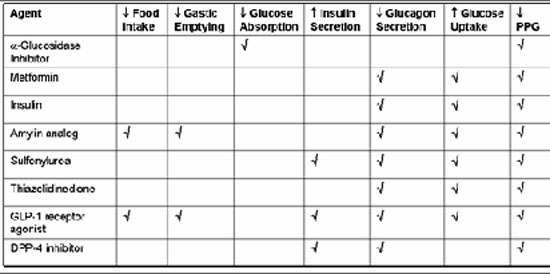
Muhammad Owais Khan, Adil Iqbal Memon,
Haris Riaz
4th Year Students,
References
1.World Health Organization Diabetes Programme. Country and regional data. (Online) 2009 (Cited 2009 May 5). Available from URL: http://www.who.int/diabetes/facts/world_figures/en/.
2.Khowaja LA,
3.Diabetes Network. Diabetes Information. (Online) (Cited 2009 May 5). Available from URL: http://www.diabetesnet.com/diabetes_treatments/glp1.php.
4.Lauster CD, McKaveney TP, Muench SV. Vildagliptin: a novel oral therapy for type 2 diabetes mellitus. Am J Health Syst Pharm 2007; 64: 1265-73.
5.(Online) (Cited 2009 May 5). Table Available from URL: http://www.ndep.nih.gov/diabetes/pubs/Drugs_tables_supplement.pdf.
Journal of the Pakistan Medical Association has agreed to receive and publish manuscripts in accordance with the principles of the following committees:


