

Muhammad Ashar Malik ( Department of Community Health Sciences, Aga Khan University, Stadium Road, Karachi, Pakistan. )
October 2009, Volume 59, Issue 10
Review Articles

Conclusion
National Health Accounts have demonstrated significant impact on better policy development and in a major shift in health policy for better healthcare. NHA has evidently provided more refined estimates, rejecting previous perception about health expenditure. As such in
Acknowledgement
I am grateful to Dr. Babar T. Shaikh, Assistant Professor, Community Health Sciences Department,
References
1.WHO. Strategy on health care financing for countries of the Western Pacific and South-East Asia Regions (2006-2010).
2.Anonymous. The Committee on the costs of medical care presents its final report, The Milbank Memorial Fund Quarterly Bulletin 1933; 11: 21-30.
3.WHO. A guide to producing National Health Accounts, with special application for low and middle income countries.
4.Berman PA. National Health Accounts in Developing Countries: appropriate methods and recent application. Health Econ 1997; 6: 11-30.
5.National Health Accounts Cell. National Health Accounts
6.WHO. National Health Accounts, Country information. (Online) (Cited 2008 July 8). Available from URL: http://www.who.int/nha/country/.
7.Tangcharoensathien V, Laixuthai A, Vasavit J, Tantigate N, Prajaubmoh-Ruffolo W, Vimolkit D, et al. National Health Accounts Development: Lessons from Thailand, Health Policy Plan 1999; 14: 342-53.
8.Cowan C A, Hartman B H. Financing Health Care: Businesses, Households, and Governments, 1987-2003.
9.Powel-Jackson T, Mills A. A review of health expenditure resource tracking in developing countries. Health Policy Plan 2007; 22: 353-62.
10.Eliya R, Ravi P. Status of National Health Accounts in Asia Pacific region: Results of APNHAN Survey.
11.Nandakumar AK, Nada K, Ibrahim A, Ezzat M, Latif MA, Sadiq A. Health Expenditure Review: Technical Report No. 35, Alexandria, Egypt.
12.British Council,
13.Data International,
14.van Doorslaer, Eddy, Wagstaffe A, Rutten F, eds. Equity in the Finance and Delivery of Health Care: An International Perspective.
15.De Susna, Dmytraczenko T, Brinkerhoff D, Tien M. Has Improved Availability of Health Expenditure Data Contributed to Evidence-Based Policymaking? Country Experience with National Health Accounts, Technical Report No. 022.
16.Schneider P, Nandakumar AK, Porignon D, Bhawalkar M, Butera D. Rwanda National Health Accounts 1998 (Technical Report No. 53). Partnerships for Health Reform (PHR), September 2000.
17.Schneider P, Schott W, Bhawalkar M, Nandakumar AK, Diop F, Butera D. Paying for HIV/AIDS services. UNAIDS Best Practice Collection,
18.Nishtar S. Health Indicators of Pakistan- Gateway Paper II.
19.Ingham L, Bennetts R, Haynes T. SHA- Based Health Accounts of 13 Countries- country studies- Australia: National Health Accounts, OECD Health Technical Papers, No.1.
20.Zifonun N. SHA- Based Health Accounts of 13 Countries- country studies- Germany: National Health Accounts, OECD Health Technical Papers, No.4.
21.Gilles F. SHA- Based Health Accounts of 13 Countries- country studies- Canada: National Health Accounts 1999, OECD Health Technical Papers, No.2.
22.Jeong H. SHA- Based Health Accounts of 13 Countries- country studies- Korea: National Health Accounts 2001, OECD Health Technical Papers, No.7.
23.Data International.
24.Prasai DP, Karki D, Sharma TM, Ganwali D, Subedi GR, Singh AB. Nepal National Health Accounts, 2001-03.
25.World Bank.
26.
Introduction
National Health accounts (NHA) is a resource tracking exercise which primarily answers some important questions regarding the healthcare financing and economics in a country. It is a financial tracking of healthcare system of a country over a specified period of time. It is a comprehensive set of data of flow of funds in to the healthcare system in the country i.e. source and use of funds. It has a well demonstrated use as a tool for decision making for optimal resource allocation for health care. Importance of financial resources in health policy and reforms is well recognized. As such the health expenditure tracking and analysis has been carried out since early 1960s in developed and developing countries. In developed countries, maintaining the expenditure data for healthcare over the last many decades is an accepted practice. More and more countries are now compiling health accounts data which includes many developing countries. Presently, there are 68 countries which have carried out national health accounts either one or many rounds.1 Pakistan's neighbouring countries such as China, India, Iran, Bangladesh, Nepal and Sri Lanka have also completed one or more rounds of national health accounts.
Use of evidence in health policy and practice in developing countries is vague due to two reasons; either available evidence is not relevant to local settings or simply there is no evidence. The case of healthcare financing in
Nature and scope of Health Accounts:
NHA provide a detailed functional (e.g. preventive vs. curative services allocation and expenditure) and object classification (e.g. salaries, medicines, equipment and building) of financial data into different sources (federal ministry, other government, state owned enterprises, private insurance plans and households) and user (rich, middle class or poor, and urban and rural etc).3
The expenditure data on healthcare is a key priority area for healthcare policy and planning at the government level as well as by other stakeholders like development partners, insurance companies, private business and even the households. Although NHA is a key resource for evidence based policy and reforms, but it can only be better utilized with other important data such as outcomes of health policy and planning. NHA dataset, along with other data on outputs and utilization of health care services, can determine the responsiveness of the health system to the population needs of healthcare. Important parameters on health system performance, efficiency of investment, beneficiary analysis and level of horizontal and vertical equity can be determined too. These analyses can provide a sound foundation for priorities setting and redirecting resources to the direly needed areas of healthcare.
Methods for carrying out National Health Accounts:
History of tracking health expenditure is traced back to early 1930s.2 Systematic efforts for compiling health expenditure, with the aim to refine health policies and for international comparison, have been started in early 1960s. Since then NHA methodology has evolved towards a standard common framework, capable for country level analysis and regional and international comparisons. Now a days, the most common methodology for establishing NHA is the System of Health Accounts (SHA) of 2000, developed by the Organization for Economic Cooperation for Development (OECD) secretariat. A recent adaptation of SHA is that developed jointly by the WHO, The World Bank (WB) and the United States Agency for International Development (USAID).3 Some of the key features of this manual are broadening the definition of health expenditure by including the health infrastructure development and the expenditure on traditional medicines. WHO NHA methodology is quite similar to the SHA methodology. However, this adaptation goes beyond OECD SHA with a more detailed breakdown of source and use; which could be critical due to pluralistic nature of healthcare systems in developing countries, and are similar to the United States, for instance.4
The real methodological challenge in the NHA creation is defining the term health expenditure. The standard definition of health expenditure is provided by the WHO manual as any expenditure whose primary purpose is to improve health. However, different countries elaborate this definition with different approaches. This grossly affects the total expenditures on health besides other detail breakup. Similarly, in the cross country comparison as well as comparison to the previous estimates of health expenditure it can lead to different analysis and conclusion. For example, in India the NHA estimates of total health expenditure as percentage of GDP in the year 2002 was 6.1%,5 compared to previous estimate of study estimated health expenditure as 4.8% of GDP during 2002.6 Similarly in Thailand, the NHA estimate of total health expenditure was 3.56% of GDP during 1994 compared to previous estimate of 5.1% of GDP.7 In case of Pakistan a specific mention would be the inter provincial variation in expenditure reporting of the public health sector. Unlike the rest of the country in Sindh province the expenditure incurred on medical education is partly reported with the Education department. If expenditure on medical education is considered as health expenditure then the expenditure specifically meant for medical colleges shall be added to the total public health expenditure in Sindh. Otherwise the expenditure incurred on medical education by the provincial health departments should be excluded from the expenditure on health.
The National Health Accounts are similar in approach and data sources of national income accounts. However, the main difference in the two is the objective achieved through them. While the NHA considers the spending on health, the national accounts take the production activities of the economy in entirety including health.3,4 In order to distinguish it from national income accounts, sometimes NHA has also been named as national health expenditure accounts8 or health resource tracking.9 Another difference between the two could be that the National accounts (in many cases) use the approach satellite accounts / T accounts (separate tabulation of source (right side) and use (left side) of the T table while the National health accounts adopts a source and use matrix framework, where source(horizontal) and use(vertical) of health resources 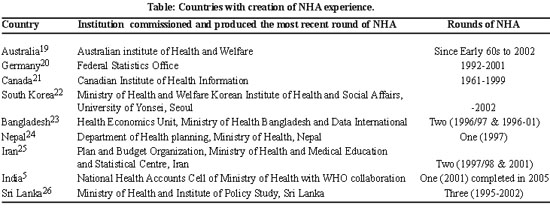
Resources required for NHA:
National health accounts mainly and ideally rely on the secondary data sources. This mainly reduces the cost and time required to produce NAH estimates. Moreover secondary data source has also long term sustainable effects. This fact to align NHA methodology with the National Accounts and household survey is more pressing in developing countries. The WHO manual recommends that an initial round of NHA should cost between US$ 50000 to US$ 75000.
The National health accounts needs diverse expertise from economics, health, accounting and statistical perspectives. As such it will require expertise in the field of national income accounting and statistics. The team of NHA should also have experts from the health sector with in-depth knowledge of healthcare system in the country. Specific to mention is the necessity to include a Health Economist in the team even if it is available on short term basis.
Regional and international experiences of NHA:
NHAs have been built upon a diverse experience as far as its commissioning and housing is concerned. However, in majority of cases, the NHA have been commissioned as well as produced by the ministry of health. A survey of 21 countries in the Asia Pacific region reveals the trend of commissioning NHA by the ministries of health is most common. Similarly, the technical production of NHA has also been characterized primarily by ministries of health followed by the public sector research agencies and national statistics agencies.10 A review of different countries (some OECD and regional countries) experience with NHA is summarized in the Table. Nonetheless, an important issue in developing countries is the sustainability of NHA. Unlike the developed countries, where NHA data is available in a time series, developing countries struggle for making this exercise consistent. In many countries, only a few rounds of NHA have been carried out no matter where they are constituted. However, even one and two rounds of NHA have demonstrated effectiveness for better policy programmes and reforms in health sector as mentioned earlier. Similarly, timeliness of producing data is a critical factor for the policy use of the findings of NHAs. A more recent example is from
Use of NHA in Health Policy and Reforms:
Sound health policy requires sound evidence on finances, utilization and output of healthcare system. Spending on healthcare is increasing across the world due to immense financial pressures on healthcare system. In developed countries, taxpayers are showing concern for this phenomenon and asking the policy makers for more efficient deployment of the scarce resources for the greater benefit of the whole society. In developing countries, resource constraints are more severe, therefore decision making needs more rigorous and robust evidence on health care financing patterns. A more recent entry to this agenda is the effectiveness of the aid provided by the donors to the developing countries. NHA data can be used to perform an analysis which will determine equity and efficiency levels of investment in healthcare in a country11,12 as well as regional13 and international comparison.14 Such analysis can help to reformulate and reorient the policy direction and carry out healthcare reforms. Findings of NHA in 1999 in
Lessons for
Demand for producing National Health Accounts in
A recent development in this regard is that the Government of Pakistan has signed a Memorandum of Understanding with a donor agency for carrying out first ever National Health Accounts of Pakistan through the Federal Bureau of Statistics. The FBS has secured a grant from a bilateral agency namely German Technical cooperation (GTZ) to conduct National Health Accounts study in
1. The Steering committee constituted by the FBS for NHA should be revisited. It should ideally be headed by the Ministry of Health with membership from FBS, NHPU, civil society and planning commission. Based on the lessons learnt from other countries, especially the regional practices, it is evident that from commissioning to production and use of NHA, ministries of health played a lead role.
2. The approved PC-1 for the NHA of the FBS needs to be revised to include the most important and ultimate goals of the NHA i.e. Data analysis and policy recommendation. Ministry of Health should be made accountable for producing timely policy recommendations based on the findings of NHA. Based on the WHO recommendation for cost of this exercise the present funds i.e.1 million Euros are more than sufficient to complete the task by funding both the arms of this study.
3. FBS should be allowed to continue the data collection and compilation. However the minute functional boundaries between preventive and curative care, private and public expenditure, direct government expenditure on healthcare would need careful and elaborated efforts. MoH can take lead on this aspect by providing technical expertise to the FBS in the field of public health.
4. Lastly it is important for sustainability and consistency in the NHA, to develop a team of local experts which can carry out this exercise even after exhausting the foreign aid. This would necessitate a human resource development at two fronts; in the FBS as well as in the MoH to carry forward the NHA data for further analysis and policy recommendation. Only then, the ultimate goal of NHA will be achieved.
Producing a comprehensive, comparable, timely, and accurate and more importantly a policy relevant data set is a big challenge for the government. Secondly, appropriate analysis of NHA data for policy and reforms usage and later on the continuation of this exercise at least with some interval would remain questionable. This requires some concrete measures and political commitment at the very outset of this exercise. The ultimate user of the NHA is MoH, for a better policy making and need based planning for the health sector. Therefore, MoH and FSB should join hands with more commitment for making first round of NHA a fruitful and policy relevant document.
Journal of the Pakistan Medical Association has agreed to receive and publish manuscripts in accordance with the principles of the following committees:


