

Nisar Ahmed Rao ( Department of Pulmonology, Ojha Institute of Chest Diseases, Dow University of Health Sciences, Karachi. )
Muhammad Irfan ( Section of Pulmonary & Critical Care Medicine, Department of Medicine, Aga Khan University, Karachi. )
Zeeshan Mahfooz ( Department of Pulmonology, Ojha Institute of Chest Diseases, Dow University of Health Sciences, Karachi. )
October 2009, Volume 59, Issue 10
Original Article

Abstract
Objective: To assess the outcomes of pulmonary multidrug-resistant tuberculosis (MDR-TB) patients treated at Ojha Institute of Chest Diseases (OICD), a reference hospital for TB in
Methods: Clinical study for the period 1996-2006, with follow-up until June 2007 was performed. All the culture and sensitivity proven cases of MDR pulmonary TB were initially admitted for 3-6 months till the sputum converted negative. Treatment regimen was decided on individual basis, and included 4-6 drugs. Supervised treatment was given to all patients during the hospitalization. After discharge from the hospital, patients were followed at monthly interval at the outpatient department of OICD for 18 months total.
Results: Five hundred and seventy nine adult patients (59.93% male) with mean age of 32.44 ± 12.63 years were studied. All patients had a history of treatment with first line anti-tuberculosis drugs. Treatment was successful in 227 (39.2%). The mortality rate was 27(4.6%) during hospitalization. During admission 83(14.3%) left treatment and 239 (41.2%) were lost to follow-up during treatment. Treatment failure was observed in three patients.
Conclusion: The treatment success rate in this study is satisfactory but high default rate is a challenge in the management of MDR tuberculosis (JPMA 59:694; 2009).
Introduction
Multi-drug resistant tuberculosis (MDR-TB) is an increasing health problem in
The treatment of MDR tuberculosis is difficult because it is expensive, prolonged and complicated which in turn result in poorer outcome.2 There is no reported data from
We are presenting our experience in treating a large series of patients with MDR pulmonary tuberculosis.
Patients & Methods
This observational study was done at Ojha Institute of Chest Diseases (OICD) from 1996 to 2006. The Ethical review committee of OICD approved the study. OICD is a 350-bedded postgraduate institute with five chest clinics in
We reviewed the records of 579 culture proven admitted cases of MDR pulmonary tuberculosis patients registered from 1996 to 2006. Susceptibility testing and drugs that had not been used in the past guided therapy. We administered minimum four drugs (range 4 to 7 drugs; median 5 drugs) during the intensive phase including one injectable aminoglycoside (mostly Kanamycin) and Quinolone (Ofloxacin in most of the patients) from the 2nd line and also included the sensitive drug if any from the first line according to the sensitivity results on individual basis. During the continuation phase we used 3 to 4 oral drugs according to the sensitivity from the first and 2nd line drugs. The dosages used are mentioned in Table-1. 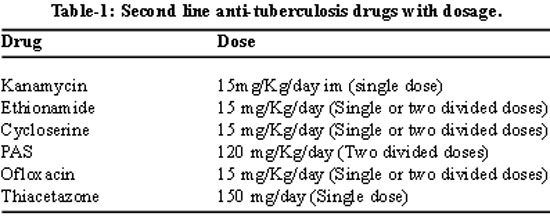
During hospitalization the sputum for AFB (Acid Fast Bacilli) smear were done monthly. AFB cultures were done every three months. Patients remained in the hospital until the sputum smear became negative. Supervised treatment was given to all patients during hospitalization. Every possible effort was made to continue therapy in patients who developed adverse drug reactions. Appropriate measures were taken to combat side effects.
After a period of initial hospitalization, patients were discharged with one month of medications and advised to report to MDR clinic within one month. They were followed in outpatient clinic monthly. Drugs for one month were pre-packed and handed over to the patient. The patients were evaluated for clinical, microbiological and radiological response regularly. They were also evaluated for side effects of the medications. Patients were followed by sputum microscopy (three specimens) every three-months and treatment continued for a total of eighteen months. At the end of treatment, patients were asked for follow up at 3, 6 and 12 months or any other time if they developed respiratory symptoms suggestive of tuberculosis that did not resolve in three weeks with treatment or referred from their general practitioner.
The MDR TB treatment outcome definitions were used as follows:
Successful outcome: Patient who completed treatment and consistently had negative smear (Performed every three months in continuation phase).
Treatment default: Patients who did not receive treatment for > 2 consecutive months were defined as having defaulted treatment.
Treatment failure: Patients whose smear was positive at the end of six month or whose > 2 smears were positive during final 12 months.
Death: Patients who died due to any cause during treatment.
LAMA (left against medical advice): Patients who left hospital against medical advice during initial hospitalization phase.
The definition of successful treatment in this study not in line with the WHO recommended definition which recommends culture results as gold standard.3 The limitation was non-availability of large-scale culture facility.
SPSS version 14 was used to analyze the data. The results are presented as mean with standard deviation.
Results
A total of five hundred and seventy-nine patients with MDR pulmonary Tuberculosis were registered. Three hundred and forty seven (59.93%) were male and 347 (40.07%) were female; their mean age was 32.44 ± 12.63 (range 15-78 years). Twelve percent of the patients had unilateral disease while remaining had bilateral extensive fibrocavitary disease. In all patients there was history of multiple courses of ATT intake including the full course of category 2 regimen. The comprehensive detail of previous treatment was not available in most of the patients.
On initial sensitivity report 326 (56.5%) of patients were resistant to all 5 first line drugs. The median number of drugs received was 5 (range 4 to 7). The median duration of hospital stay was 3.8 months. The total duration of treatment was 18 months.
Response to Treatment:
Successful outcome was seen in two hundred and twenty seven patients i.e. 227/579 (39.20%). Eighty-three patients (14.33%) left hospital against medical advice (LAMA) during initial hospitalization, 239 (41.27%) defaulted after discharge, 27 (04.66%) expired due to tuberculosis, while three patients (0.51%) remained positive at the end of one year. Attempts were made to contact patients by phone. However, either their phone number was incorrect or the patient deliberately did not attend the call. Due to non-availability of physical facilities for follow up of defaulted patients, the defaulters could not be traced. All patients (except three) i.e. 466/579 (80.48%) were smear negative at the time of discharge from hospital.
Microbiological Response to Treatment:
Most of the patients 416/579 (71.84%) converted to smear negative at three month, 111 (19.17%) at 04 months while 49 patients (08.46%) took up to six months to convert. Three patients were smear positive at the end of one year so they were labeled as treatment failure.
In Table-2 detailed outcome analysis of different 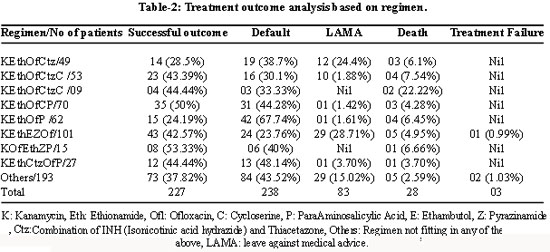
Two hundred and thirty nine patients defaulted in the study. They defaulted during the follow up period. Fifty-three patients (21.33%) defaulted within two to three months of discharge, 108 patients (45.18%) defaulted during month 7-12 (Of treatment) while 80 patients (33.47%) defaulted during month 13-18.
Side effects:
During hospital stay, eighty-eight patients (15.19%) 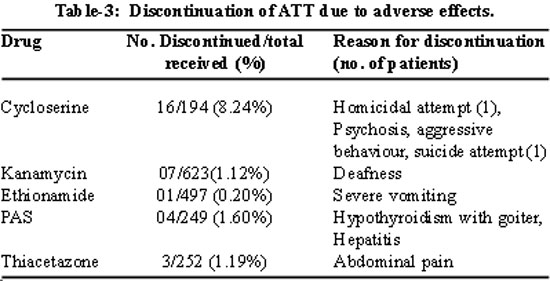
The follow up at three and six month had records of only 119 (52.42%) and 48 (21.14%) and all were smear negative.
Relapse Rate:
During the study period, eight patients (03.52%) reported with positive sputum among those who successfully completed the treatment. The gap between completion of treatment and relapse was between months 2 to 8.
Discussion
This is the first largest study from
The other observation in this study was a high default rate. Out of 579 patients, a total of 322 (55.6%) defaulted including both during hospitalization and afterward. Lockman et al4 from
We considered the correlation between past treatment history and response to current treatment but in
It has been reported13 that patients who receive initial therapy in a hospital had significantly higher treatment completion rates (79%) than those treated as outpatients alone (48%, p < 0.001). Our treatment completion rate was low in spite of all patients being admitted in the initial phase.
It is recommended13 that early surgical intervention (e.g., within 6 months after intensive chemotherapy) could be beneficial, even if the patient has a positive result of smear or culture. None of our patient underwent surgery due to non-availability of proper surgical facility otherwise results would have been better as studies14-16 have shown good results when chemotherapy was combined with surgery.
The relapse rate is quite low in this study. This could be because if the patient who benefitted from the treatment center would report to the same center, once symptoms recurred. The possibility of death has to be considered. It is possible that the patients did not develop a relapse or did not report due to the long distance and financial reasons.
The limitation of this study was that the patients were followed up with sputum smear only as the facility for AFB culture on a large scale was not available. It was therefore presumed, that any patient excreting bacilli was positive or became positive if he/she was excreting viable bacilli. The doubling time of Mycobacterium tuberculosis is 16-24 hours17 and for sputum to be positive on smear, the bacillary count should be 10,000 bacilli/ml of sputum.18 Others19 claim that with optimal laboratory conditions, smear can be positive with only 100-1000 bacilli/ml. If one hundred bacilli are present in the lung then after one month the count will increase to >10,000 and at next examination smear will become positive. The other limitation was lack of follow up after completion of treatment. In resource-limited countries, where default during treatment is high, it is difficult to expect a regular follow up after completion of treatment.
Conclusion
This is the first large study on MDR TB treatment outcome from
Acknowledgement
The authors extend their gratitude to Dr. Hassan Abbas and Dr. Ashraf Sadiq, Director, Ojha Institute of Chest Diseases for their valuable support in this study.
References
1.Global tuberculosis control: surveillance, planning, financing. WHO report 2008.
2.Tahaoglu K,
3.Guidelines for the programmatic management of drug-resistant tuberculosis,
4.Lockman S, Kruuner A, Binkin NJ, Levina K, Wang Y, Danilovitsh M, et al. Clinical outcomes of estonian patients with primary multidrug-resistant versus drug-susceptible tuberculosis. Clin Infect Dis 2001; 32: 373-80.
5.Flament-Saillour M, Robert J, Jarlier V, Grosset J. Outcome of multi-drug-resistant tuberculosis in
6.Goble M, Iseman MD, Madsen L, Waite D, Ackerson L, Horsburgh CR Jr. Treatment of 171 patients with pulmonary tuberculosis resistant to isoniazid and rifampin. N Engl J Med 1993; 328:527-32.
7.
8.Chiang CY, Enarson DA, Yu MC, Bai KJ, Huang RM, Hsu CJ, et al. Outcome of pulmonary multidrug-resistant tuberculosis: a 6-yr follow-up study. Eur Respir J 2006; 28: 980-5.
9.Kim HJ, Hong YP, Kim SJ, Lew WJ, Lee EG. Ambulatory treatment of multidrug-resistant pulmonary tuberculosis patients at a chest clinic. Int J Tuberc Lung Dis 2001; 5: 1129-36.
10.Sua´rez PG, Floyd K, Portocarrero J, Alarcon E, Rapit E, Ramos G, et al. Feasibility and cost-effectiveness of standardised second-line drug treatment for chronic tuberculosis patients: a national cohort study in
11.Kim HJ, Hong YP, Kim SJ, Lew WJ, Lee EG. Ambulatory treatment of multidrug-resistant pulmonary tuberculosis patients at a chest clinic. Int J Tuberc Lung Dis 2001; 5: 1129-36.
12.Prasad R. Long Term Treatment Outcome In Multi Drug Resistant Tuberculosis (MDR-TB). Chest 2004; 126: 836S.
13.Narita M, Alonso P, Lauzardo M, Hollerdes ES, Pitchenik AE, Ashkin D. Treatment Experience of multidrug-resistant tuberculosis in Florida, 1994-1997. Chest 2001; 120: 343-8.
14.Kwon YS, Kim YH, Suh GY, Chung MP, Kim H, Kuon OJ, et al. Treatment outcomes for HIV-uninfected patients with multidrug-resistant and extensively drug-resistant tuberculosis. Clin Infect Dis 2008; 47: 496-502.
15.Chan ED, Laurel V, Strand MJ, Chan JF, Huynh ML, Goble M, et al. Treatment and outcome analysis of 205 patients with multidrug-resistant tuberculosis. Am J Respir Crit Care Med 2004; 169: 1103-9.
16.
17.JoAnne L, Flynn. Immunopathologic consequences of inflammation. In: Bruce A M, Mietzner, Timothy A M, McClane. Microbial Pathogenesis.
18.Toman's tuberculosis case detection, treatment, and monitoring : questions and answers / edited by T. Frieden. - 2nd ed. WHO/HTM/TB/2004.334.
19.Wolinsky E. Conventional diagnostic methods for tuberculosis. Clin Infect Dis 1994; 19: 396-401.
Journal of the Pakistan Medical Association has agreed to receive and publish manuscripts in accordance with the principles of the following committees:


