

Ather Mohammed Taqui ( Student Section of Neurology, Department of Medicine Section of Epidemiology and Biostats, Department of Community Health Sciences, The Aga Khan University, Karachi, Pakistan. )
Saqib Ali Gowani ( Student Section of Neurology, Department of Medicine Section of Epidemiology and Biostats, Department of Community Health Sciences, The Aga Khan University, Karachi, Pakistan. )
Ayeesha Kamral Kamal ( Student Section of Neurology, Department of Medicine Section of Epidemiology and Biostats, Department of Community Health Sciences, The Aga Khan University, Karachi, Pakistan. )
Bhojo Asumal Khealani ( Student Section of Neurology, Department of Medicine Section of Epidemiology and Biostats, Department of Community Health Sciences, The Aga Khan University, Karachi, Pakistan. )
Shafquat Rozi ( Student Section of Neurology, Department of Medicine Section of Epidemiology and Biostats, Department of Community Health Sciences, The Aga Khan University, Karachi, Pakistan. )
May 2009, Volume 59, Issue 5
Student's Corner

Abstract
Objective: To study the association between admission hyperglycaemia and the presence and pattern of intracranial and extracranial vascular disease.
Methods: This retrospective study was conducted at a major tertiary care hospital in Karachi, Pakistan. Patients who had presented with acute stroke and had undergone a carotid ultrasound doppler of the carotids and/or Magnetic Resonance Angiography (MRA) of the brain were included in the study. A multiple logistic regression analysis of variables was done for an abnormal finding on each investigation.
Results: Out of the total of 216 patients, the age of majority of the patients (83.3%) was >50 years and 134 (62%) were male. One hundred and fourteen patients (52.8%) had admission hyperglyaemia. Multiple logistic regression analysis revealed that increasing age and admission hyperglycaemia (P=0.045, Odds ratio=1.9 [95% CI: 1.0-3.6]) were independent predictors of an abnormal finding on a carotid doppler investigation. Admission hyperglycaemia did not predict the presence of general intracranial vasculopathy but it was significantly associated with focal stenosis as visualized on a MRA.
Conclusion: Admission hyperglycaemia is associated with large vessel disease manifesting itself in the carotids as plaques and in the intracranial circulation as focal stenosis. Acute stroke patients presenting with admission hyperglycemia would require a more careful investigation for large artery disease especially in the extracranial vessels (JPMA 59:328; 2009).
Introduction
The occurrence of hyperglycaemia in the acute phase of stroke has been documented by several studies.1,2 A number of trials have suggested that this is not a benign occurrence and that admission hyperglycaemia is a risk factor for increased mortality3-7 and morbidity1,3,8 after stroke. Treatment of admission hyperglycaemia in post-stroke patients has received a lot of attention, because it has been recognized that hyperglycaemia may be a modifiable risk factor for brain damage.9 Research indicates that strict glycaemic control for the hospitalized stroke patient is associated with improved outcome compared with poor control.10,11 In the contemporary literature, various terms have been used to describe the nature of this hyperglycaemia: "stress hyperglycaemia",3,10 "reactive hyperglycaemia",12 "post-stroke hyperglycaemia"6 and "admission hyperglycaemia."13-15 Different definitions have been used for each term but in essence, they constitute a hyperglycaemia seen after occurrence of a stroke. In the present study, we will be referring to it simply as admission hyperglycaemia to avoid any confusion as to the etiology of the hyperglycaemia. Coutinho and colleagues concluded on the basis of their metaregression analysis that patients with dysglycaemia (blood glucose level above the normal range but below the threshold for diabetes16) or undiagnosed diabetes have a higher risk of cardiovascular disease than patients with normoglycaemia.17 It has been suggested that patients with admission hyperglycaemia are likely to have dysglycaemia and are more prone to have ischaemic damage at the time of infarction as a result of more extensive underlying cerebral vasculopathy compared with those who do not develop hyperglycaemia.3 However, the association between admission hyperglycaemia and the presence and pattern of intracranial or extracranial vasculopathy has not been studied, therefore we carried out a study to investigate this relationship.
Patients and Methods
This retrospective study was conducted at the Aga Khan University Hospital (AKUH); a major tertiary care hospital in Karachi, Pakistan. The hospital has a busy neurology service with a special stroke unit where all patients receive standardized care according to an established stroke pathway. Pakistan is a developing South Asian country. It is the sixth most populated country in the world with a population of 166 million.18 Karachi is the largest city of Pakistan and holds about 10% of its population.19 AKUH receives patients from all over Karachi. All acute stroke patients over the age of 14 years are enrolled in the Aga Khan University Stroke Data Bank were scrutinized. All patient information was obtained from here, for the study. Patients with subarachnoid, subdural or epidural haemorrhage are excluded from the Data Bank. Therefore patients who were not investigated with either Magnetic Resonance Angiography (MRA) of the head or carotid doppler ultrasonography were excluded. Institutional Ethical Review Committee (ERC) cleared this retrospective review. The data collection was done by neurology housestaff on a standardized data entry form. The data was collected during the patient's hospital stay and the patient's discharge was the end point for the purpose of this study. Neurological Definitions Acute stroke was defined as rapidly evolving focal or global loss of cerebral function with symptoms leading to death or lasting more than 24 hours due to a vascular etiology. Hypertension was defined as a past medical history of hypertension (whether treated or not) or electrocardiographic or echocardiographic evidence of hypertension. Diabetes Mellitus was defined as a past medical history of diabetes mellitus or sustained blood sugar elevation requiring treatment with hypoglycaemic agents or insulin throughout hospitalization. Admission hyperglycaemia was defined as venous blood random blood glucose levels over 150mg/dl within 3 hours of admission. Abnormal cholesterol elevation was defined as history of high cholesterol in the past or documentation of elevated cholesterol during hospital stay. Coronary artery disease was defined as clinical evidence of ischaemic heart disease and/or a history of myocardial infarction. The three patterns of intracranial vasculopathy documented on the MRA were: Diffuse atherosclerosis, focal stenosis of a specific region and focal occlusion.
Outcomes
The following two outcomes were investigated independently of each other. An abnormal MRA of the head was interpreted as intracranial vasculopathy. A variant of normal intracranial vasculature was not read as an abnormal MRA, but was included in normal MRAs. An abnormal carotid doppler ultrasonograph was interpreted as extracranial vasculopathy. The NASCET criteria were used to define moderate and severe stenosis on ultrasound.20 Statistical Analysis Data was entered and analyzed using the Statistical Package for Social Sciences 14.0 (SPSS, Inc., Chicago, IL, USA). Descriptive statistics were performed. Results were recorded as frequencies, means ± standard deviations (SD) and P values. A p value of <0.05 was taken as the criteria of significance for all purposes. Univariate analysis was done utilizing the chi square test and Fisher's exact test for categorical variables. The independent samples t-test was used for continuous variables. The variables which were biologically meaningful or had a p value of less than 0.25 on univariate analysis were subjected to a stepwise multiple logistic regression analysis to determine which factors were independent predictors of abnormal vasculopathy.20 The Hosmer and Lemeshow goodness-of-fit test was also used to determine the final model.21 Unadjusted as well as adjusted odds ratios were recorded.
Results
During the study period, there were 596 patients enrolled in the AKUH Stroke Data Bank. Out of these, 380 patients were excluded because they fulfilled the exclusion criteria, leaving 216 patients who had been investigated with either MRA of the head or carotid doppler ultrasonography of the carotids. Of the 216 patients, 124 (57.4%) had been investigated with a MRA study and 172 (79.6%) with a carotid doppler ultrasonography. Of the 124 patients who were investigated with MRA, 33 (26.6%) had an abnormal finding compared to 83 (48.3%) of the 172 who were investigated with carotid doppler ultrasonography. The age of majority of the patients (83.3%) was greater than or equal to 50 years. One hundred and thirty four (62.0%) of the 216 patients were male. Of the 216 patients, 114 (52.8%) had admission hyperglycaemia and 91 (42.1%) were either previously diagnosed diabetics or were diagnosed with diabetes during hospitalization. Majority of these diabetics (79.1%) had presented with admission hyperglycaemia. A sizable proportion of patients (33.6%) who were not previously diagnosed diabetics or treated as diabetics during hospital stay, had presented with admission hyperglycaemia. Univariate analysis was performed for both outcomes separately to study the association of the individual factors with each outcome. The multiple logistic regression analysis models were based on these results. Multiple logistic regression analysis revealed that increasing age and admission hyperglycaemia (P=0.045, Odds ratio=1.9 [95% CI: 1.0-3.6]) were independent predictors of an abnormal finding on a carotid doppler investigation (Table 1).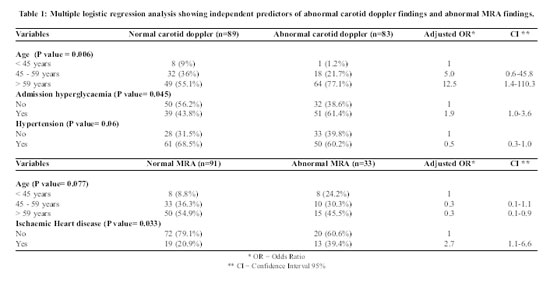
Hypertension was marginally significant as a negative predictor of an abnormal finding on a carotid doppler ultrasonograph (p = 0.06, Odds ratio=0.5 [95% CI: 0.3-1.0]). The multiple logistic regression analysis model included age, admission hyperglycaemia, diabetes and hypertension. The regression analysis revealed that coronary artery disease was an independent predictor of an abnormal MRA (p = 0.033, Odds ratio=2.7 [95% CI: 1.1-1.6]) (Table 1). Age, ischaemic heart disease and type of stroke were included in the multiple logistic regression analysis models. The three patterns of intracranial vasculopathy documented were diffuse atherosclerosis, focal stenosis of a specific region and focal occlusion. In the 14 patients with diffuse atherosclerosis, 8 (57.1%) had admission hyperglycaemia. In patients with focal stenosis, 13/15 (86.7%) had admission hyperglycaemia, compared to 3/10 (30%) of those who had focal occlusion. A significantly greater number of patients with focal stenosis had admission hyperglycaemia (p = 0.010) (Table 2).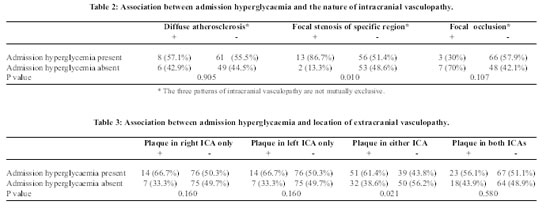 Patterns of vasculopathy in the carotids were documented according to the location of the plaque. The proportion of patients with admission hyperglycaemia was same in patients with a plaque in either the right or the left internal carotid artery (ICA): 66.7% (Table 3). Admission hyperglycaemia was significantly associated with presence of plaques in either right or left ICA (p = 0.021).
Discussion
This study investigated the association between admission hyperglycaemia and intracranial as well as extracranial vasculopathy and found that admission hyperglycaemia was an independent predictor of extracranial vascular disease, manifested as an abnormality on doppler ultrasonography of the carotids. Admission hyperglycaemia did not independently predict intracranial vasculopathy. However, it was significantly associated with focal stenosis on the MRA. Diabetes causes damage to intracranial as well as extracranial vessels.22 However, recent research shows that a definite relationship exists between blood glucose levels below the diabetic threshold and both macro- and microvascular disease, independent of a patient's progression to diabetes.23 Patients with admission hyperglycaemia include diagnosed as well as undiagnosed diabetics. It is known that the prevalence of recognised diabetes mellitus in acute stroke patients is between 8 and 20%, but around 6 to 42% of patients may have undiagnosed diabetes mellitus before presentation.24 Our study showed that the subset of patients with diagnosed as well as undiagnosed diabetes comprised 42.1% of the total number of acute stroke patients. The majority (79.1%) of this subset of patients recorded an admission hyperglycaemia. Increasing age and admission hyperglycaemia were both found to independently predict extracranial vasculopathy. This vascular disease was detected on doppler ultrasonography of the carotids. The implications of this finding are limited in their worth because the mere presence of a plaque does not necessarily mean that the patient is symptomatic because of it. The degree of stenosis caused by the plaque is more predictive of positive symptomatology. Any positive association between admission hyperglycaemia and critically stenosed carotids might have been more valuable. Unfortunately, the degree of stenosis was not documented for each plaque detected on the ultrasound. Despite this shortcoming, the presence of admission hyperglycaemia mandates careful investigation for carotid disease. We did not find a significant association between the presence of coronary artery disease and extracranial ICA atherosclerosis. This is not concurrent with other studies which showed a high prevalence of asymptomatic CAD in patients with extracranial ICA atherosclerosis.25 Admission hyperglycaemia did not predict the presence of general intracranial vasculopathy but it was significantly associated with focal stenosis as visualized on a MRA. The only independent predictor of intracranial vasculopathy was coronary artery disease. Our study had a number of limitations which merit discussion. This study was conducted at one institute only and the prevalence of admission hyperglycaemia in acute stroke patients may vary significantly at different institutes. This somewhat restricts the generalisability of the results. The retrospective study design has some inherent limitations. The unavailability of data on the degree of stenosis of carotid arteries limits the value of the predictive capability of admission hyperglycaemia for the presence of stenosis. The findings of the study must be interpreted in a prudent manner.
Conclusion
Admission hyperglycaemia is associated with large vessel disease manifesting itself in the carotids as plaques and in the intracranial circulation as focal stenosis. Acute stroke patients presenting with admission hyperglycaemia would require a more careful investigation for large artery disease especially extracranial vascular disease. Multicentre prospective studies are required to explore this relationship further.
References
1.van Kooten F, Hoogerbrugge N, Naarding P, Koudstaal PJ. Hyperglycemia in the acute phase of stroke is not caused by stress. Stroke 1993; 24:1129-32.
2.Weir CJ, Murray GD, Dyker AG, Lees KR. Is hyperglycaemia an independent predictor of poor outcome after acute stroke? Results of a long-term follow up study. BMJ 1997; 314:1303-6.
3.Capes SE, Hunt D, Malmberg K, Pathak P, Gerstein HC. Stress hyperglycemia and prognosis of stroke in nondiabetic and diabetic patients: a systematic overview. Stroke 2001; 32:2426-32.
4.Woo J, Lam CW, Kay R, Wong AH, Teoh R, Nicholls MG. The influence of hyperglycemia and diabetes mellitus on immediate and 3-month morbidity and mortality after acute stroke. Arch Neurol 1990; 47:1174-7.
5.Toni D, Sacchetti ML, Argentino C, Gentile M, Cavalletti C, Frontoni M, et al. Does hyperglycaemia play a role on the outcome of acute ischaemic stroke patients? J Neurol 1992; 239:382-6.
6.Zuliani G, Cherubini A, Ranzini M, Ruggiero C, Atti AR, Fellin R. Risk factors for short-term mortality in older subjects with acute ischemic stroke. Gerontology 2006; 52:231-6.
7.Bruno A, Biller J, Adams HP Jr, Clarke WR, Woolson RF, Williams LS, et al. Acute blood glucose level and outcome from ischemic stroke. Trial of ORG 10172 in Acute Stroke Treatment (TOAST) Investigators. Neurology 1999; 52:280-4.
8.Kushner M, Nencini P, Reivich M, Rango M, Jamieson D, Fazekas F, et al. Relation of hyperglycemia early in ischemic brain infarction to cerebral anatomy, metabolism, and clinical outcome. Ann Neurol 1990; 28:129-35.
9.Li PA, Gisselsson L, Keuker J, Vogel J, Smith ML, Kuschinsky W, et al. Hyperglycemia-exaggerated ischemic brain damage following 30 min of middle cerebral artery occlusion is not due to capillary obstruction. Brain Res 1998; 804:36-44.
10.Burroughs V, Weinberger J. Diabetes and stroke: part two--treating diabetes and stress hyperglycemia in hospitalized stroke patients. Curr Cardiol Rep 2006; 8:29-32.
11.Thal SC, Engelhard K, Werner C. New cerebral protection strategies. Curr Opin Anaesthesiol 2005; 18:490-5. 12.Melamed E. Reactive hyperglycaemia in patients with acute stroke. J Neurol Sci 1976; 29:267-75.
13.Bruno A, Levine SR, Frankel MR, Brott TG, Lin Y, Tilley BC, et al. Admission glucose level and clinical outcomes in the NINDS rt-PA Stroke Trial. Neurology 2002; 59:669-74.
14.Williams LS, Rotich J, Qi R, Fineberg N, Espay A, Bruno A, et al. Effects of admission hyperglycemia on mortality and costs in acute ischemic stroke. Neurology 2002; 59:67-71.
15.Alvarez-Sabin J, Molina CA, Ribo M, Arenillas JF, Montaner J, Huertas R, et al. Impact of admission hyperglycemia on stroke outcome after thrombolysis: risk stratification in relation to time to reperfusion. Stroke 2004; 35:2493-8. 16.Gerstein HC, Yusuf S. Dysglycaemia and risk of cardiovascular disease. Lancet 1996; 347:949-50.
17.Coutinho M, Gerstein HC, Wang Y, Yusuf S. The relationship between glucose and incident cardiovascular events. A metaregression analysis of published data from 20 studies of 95,783 individuals followed for 12.4 years. Diabetes care 1999; 22:233-40. 18.Population Reference Bureau. The 2006 World Health Data Sheet. (Online 2009 (Cited 2008 Jan 20). Available from URL:http://www.prb.org/Publications/Datasheets/2006/2006WorldPopulationDataSheet.aspx.
19.Population of Karachi. (Online) 2009 (Cited 2008 Jan 20) Available from URL: http://www.urckarachi.org/Population.htm.
20.Fisher M, Martin A, Cosgrove M, Norris JW. The NASCET-ACAS plaque project. North American Symptomatic Caroted Endarterectomy trial. A Systematic Carotid Atheroscterosis Study. Stroke 1993; 24:124-5; discussion 131-22.
21.Hosmer DW, Lemeshow S. Applied logistic regression. New York: John Wiley & Sons; 1996.
22.Mankovsky BN, Metzger BE, Molitch ME, Biller J. Cerebrovascular disorders in patients with diabetes mellitus. J Diabetes Complications 1996; 10:228-42.
23.Singleton JR, Smith AG, Russell JW, Feldman EL.. Microvascular complications of impaired glucose tolerance. Diabetes 2003; 52:2867-73.
24.Gray CS, Scott JF, French JM, Alberti KG, O'Connell JE. Prevalence and prediction of unrecognised diabetes mellitus and impaired glucose tolerance following acute stroke. Age Ageing 2004; 33:71-7.
25.Chimowitz MI, Weiss DG, Cohen SL, Starling MR, Hobson RW 2nd. Cardiac prognosis of patients with carotid stenosis and no history of coronary artery disease. Veterans Affairs Cooperative Study Group 167. Stroke 1994; 25:759-65.
Related Articles
Journal of the Pakistan Medical Association has agreed to receive and publish manuscripts in accordance with the principles of the following committees:


